

16 Towards Intercity Cooperation: Comparison of Spatial Transport …
249
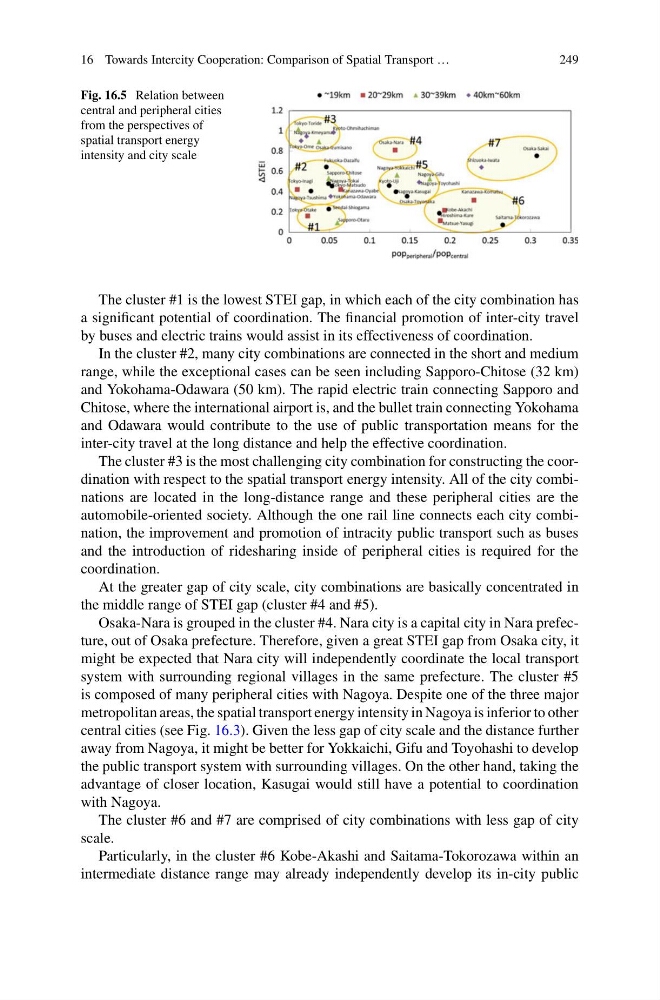
Fig. 16.5 Relation between
central and peripheral cities
from the perspectives of
spatial transport energy
intensity and city scale
The cluster #1 is the lowest STEI gap, in which each of the city combination has
a significant potential of coordination. The financial promotion of inter-city travel
by buses and electric trains would assist in its effectiveness of coordination.
In the cluster #2, many city combinations are connected in the short and medium
range, while the exceptional cases can be seen including Sapporo-Chitose (32 km)
and Yokohama-Odawara (50 km). The rapid electric train connecting Sapporo and
Chitose, where the international airport is, and the bullet train connecting Yokohama
and Odawara would contribute to the use of public transportation means for the
inter-city travel at the long distance and help the effective coordination.
The cluster #3 is the most challenging city combination for constructing the coordination with respect to the spatial transport energy intensity. All of the city combinations are located in the long-distance range and these peripheral cities are the
automobile-oriented society. Although the one rail line connects each city combination, the improvement and promotion of intracity public transport such as buses
and the introduction of ridesharing inside of peripheral cities is required for the
coordination.
At the greater gap of city scale, city combinations are basically concentrated in
the middle range of STEI gap (cluster #4 and #5).
Osaka-Nara is grouped in the cluster #4. Nara city is a capital city in Nara prefecture, out of Osaka prefecture. Therefore, given a great STEI gap from Osaka city, it
might be expected that Nara city will independently coordinate the local transport
system with surrounding regional villages in the same prefecture. The cluster #5
is composed of many peripheral cities with Nagoya. Despite one of the three major
metropolitan areas, the spatial transport energy intensity in Nagoya is inferior to other
central cities (see Fig. 16.3). Given the less gap of city scale and the distance further
away from Nagoya, it might be better for Yokkaichi, Gifu and Toyohashi to develop
the public transport system with surrounding villages. On the other hand, taking the
advantage of closer location, Kasugai would still have a potential to coordination
with Nagoya.
The cluster #6 and #7 are comprised of city combinations with less gap of city
scale.
Particularly, in the cluster #6 Kobe-Akashi and Saitama-Tokorozawa within an
intermediate distance range may already independently develop its in-city public
249
Fig. 16.5 Relation between
central and peripheral cities
from the perspectives of
spatial transport energy
intensity and city scale
The cluster #1 is the lowest STEI gap, in which each of the city combination has
a significant potential of coordination. The financial promotion of inter-city travel
by buses and electric trains would assist in its effectiveness of coordination.
In the cluster #2, many city combinations are connected in the short and medium
range, while the exceptional cases can be seen including Sapporo-Chitose (32 km)
and Yokohama-Odawara (50 km). The rapid electric train connecting Sapporo and
Chitose, where the international airport is, and the bullet train connecting Yokohama
and Odawara would contribute to the use of public transportation means for the
inter-city travel at the long distance and help the effective coordination.
The cluster #3 is the most challenging city combination for constructing the coordination with respect to the spatial transport energy intensity. All of the city combinations are located in the long-distance range and these peripheral cities are the
automobile-oriented society. Although the one rail line connects each city combination, the improvement and promotion of intracity public transport such as buses
and the introduction of ridesharing inside of peripheral cities is required for the
coordination.
At the greater gap of city scale, city combinations are basically concentrated in
the middle range of STEI gap (cluster #4 and #5).
Osaka-Nara is grouped in the cluster #4. Nara city is a capital city in Nara prefecture, out of Osaka prefecture. Therefore, given a great STEI gap from Osaka city, it
might be expected that Nara city will independently coordinate the local transport
system with surrounding regional villages in the same prefecture. The cluster #5
is composed of many peripheral cities with Nagoya. Despite one of the three major
metropolitan areas, the spatial transport energy intensity in Nagoya is inferior to other
central cities (see Fig. 16.3). Given the less gap of city scale and the distance further
away from Nagoya, it might be better for Yokkaichi, Gifu and Toyohashi to develop
the public transport system with surrounding villages. On the other hand, taking the
advantage of closer location, Kasugai would still have a potential to coordination
with Nagoya.
The cluster #6 and #7 are comprised of city combinations with less gap of city
scale.
Particularly, in the cluster #6 Kobe-Akashi and Saitama-Tokorozawa within an
intermediate distance range may already independently develop its in-city public