

16 Towards Intercity Cooperation: Comparison of Spatial Transport …
247
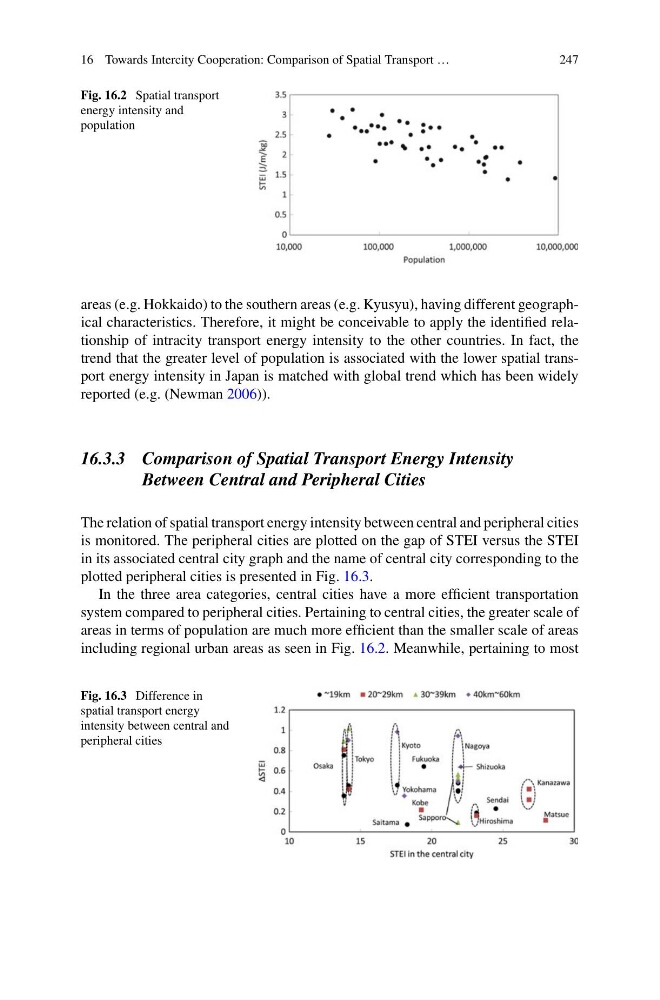
Fig. 16.2 Spatial transport
energy intensity and
population
areas (e.g. Hokkaido) to the southern areas (e.g. Kyusyu), having different geographical characteristics. Therefore, it might be conceivable to apply the identified relationship of intracity transport energy intensity to the other countries. In fact, the
trend that the greater level of population is associated with the lower spatial transport energy intensity in Japan is matched with global trend which has been widely
reported (e.g. (Newman 2006)).
16.3.3 Comparison of Spatial Transport Energy Intensity
Between Central and Peripheral Cities
The relation of spatial transport energy intensity between central and peripheral cities
is monitored. The peripheral cities are plotted on the gap of STEI versus the STEI
in its associated central city graph and the name of central city corresponding to the
plotted peripheral cities is presented in Fig. 16.3.
In the three area categories, central cities have a more efficient transportation
system compared to peripheral cities. Pertaining to central cities, the greater scale of
areas in terms of population are much more efficient than the smaller scale of areas
including regional urban areas as seen in Fig. 16.2. Meanwhile, pertaining to most
Fig. 16.3 Difference in
spatial transport energy
intensity between central and
peripheral cities
247
Fig. 16.2 Spatial transport
energy intensity and
population
areas (e.g. Hokkaido) to the southern areas (e.g. Kyusyu), having different geographical characteristics. Therefore, it might be conceivable to apply the identified relationship of intracity transport energy intensity to the other countries. In fact, the
trend that the greater level of population is associated with the lower spatial transport energy intensity in Japan is matched with global trend which has been widely
reported (e.g. (Newman 2006)).
16.3.3 Comparison of Spatial Transport Energy Intensity
Between Central and Peripheral Cities
The relation of spatial transport energy intensity between central and peripheral cities
is monitored. The peripheral cities are plotted on the gap of STEI versus the STEI
in its associated central city graph and the name of central city corresponding to the
plotted peripheral cities is presented in Fig. 16.3.
In the three area categories, central cities have a more efficient transportation
system compared to peripheral cities. Pertaining to central cities, the greater scale of
areas in terms of population are much more efficient than the smaller scale of areas
including regional urban areas as seen in Fig. 16.2. Meanwhile, pertaining to most
Fig. 16.3 Difference in
spatial transport energy
intensity between central and
peripheral cities