

220
X. Zhang et al.
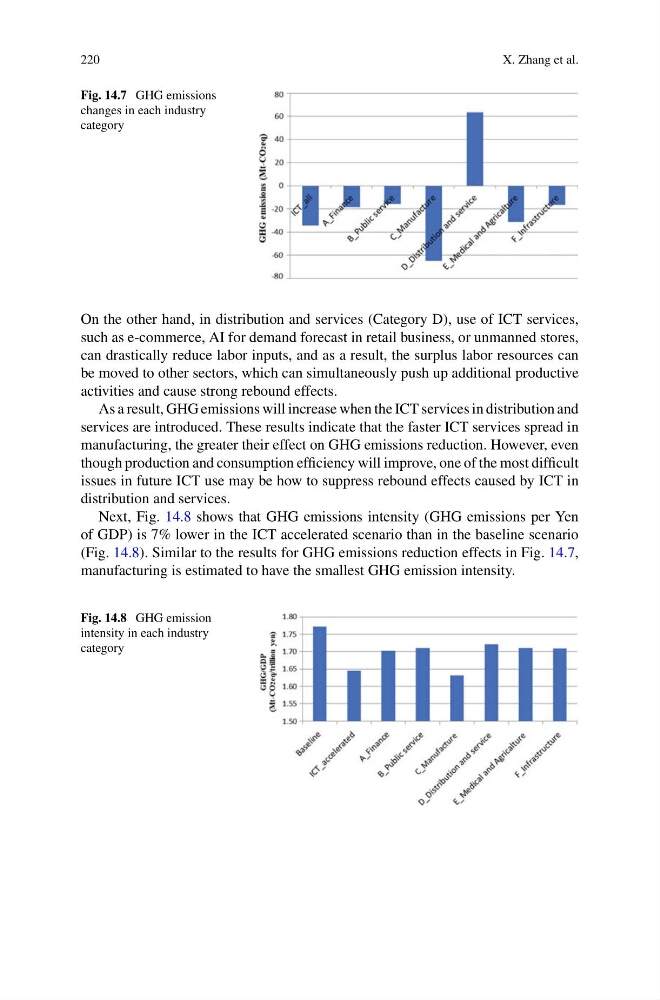
Fig. 14.7 GHG emissions
changes in each industry
category
On the other hand, in distribution and services (Category D), use of ICT services,
such as e-commerce, AI for demand forecast in retail business, or unmanned stores,
can drastically reduce labor inputs, and as a result, the surplus labor resources can
be moved to other sectors, which can simultaneously push up additional productive
activities and cause strong rebound effects.
As a result, GHG emissions will increase when the ICT services in distribution and
services are introduced. These results indicate that the faster ICT services spread in
manufacturing, the greater their effect on GHG emissions reduction. However, even
though production and consumption efficiency will improve, one of the most difficult
issues in future ICT use may be how to suppress rebound effects caused by ICT in
distribution and services.
Next, Fig. 14.8 shows that GHG emissions intensity (GHG emissions per Yen
of GDP) is 7% lower in the ICT accelerated scenario than in the baseline scenario
(Fig. 14.8). Similar to the results for GHG emissions reduction effects in Fig. 14.7,
manufacturing is estimated to have the smallest GHG emission intensity.
Fig. 14.8 GHG emission
intensity in each industry
category
X. Zhang et al.
Fig. 14.7 GHG emissions
changes in each industry
category
On the other hand, in distribution and services (Category D), use of ICT services,
such as e-commerce, AI for demand forecast in retail business, or unmanned stores,
can drastically reduce labor inputs, and as a result, the surplus labor resources can
be moved to other sectors, which can simultaneously push up additional productive
activities and cause strong rebound effects.
As a result, GHG emissions will increase when the ICT services in distribution and
services are introduced. These results indicate that the faster ICT services spread in
manufacturing, the greater their effect on GHG emissions reduction. However, even
though production and consumption efficiency will improve, one of the most difficult
issues in future ICT use may be how to suppress rebound effects caused by ICT in
distribution and services.
Next, Fig. 14.8 shows that GHG emissions intensity (GHG emissions per Yen
of GDP) is 7% lower in the ICT accelerated scenario than in the baseline scenario
(Fig. 14.8). Similar to the results for GHG emissions reduction effects in Fig. 14.7,
manufacturing is estimated to have the smallest GHG emission intensity.
Fig. 14.8 GHG emission
intensity in each industry
category