

12 Ecological Smart and Sustainable Waste Management: A Conceptual …
185
biological quality of the waste to do the selection process. The quality organic waste
is processed into animal-edible materials as illustrated in Fig. 12.2.
The process refers to biological process under specific circumstance by the help
of anaerobic fermentation technology, to produce hygiene and quality materials. The
process for producing animal edible materials are identifying the quality material
indicators of the organic waste, determining the appropriate fermentation technology
for the organic waste, determining the production method of the edible waste materials, implementing the production of the edible waste materials through a case study,
and analyzing the technical, economic, social and environmental benefits.
Specific characteristic of quality organic waste used in the process are voluminous,
high water concentration, high nutrition (even better than grass), and less contained
chemical material. Therefore, an-aerobic fermented technology is considered to be
suitable for the organic waste characteristic found in the four cities. The technology is
simple and economically beneficial for high water density material, as the technology
does not require drying process thus more efficient in time, cost and labor hour. The
technology is also environmentally friendly process, as it does not produce any smells
and pathogen bacteria. Long life time is the other consideration why this technology
is chosen. In additional, the technology is safe for human consumption as it does not
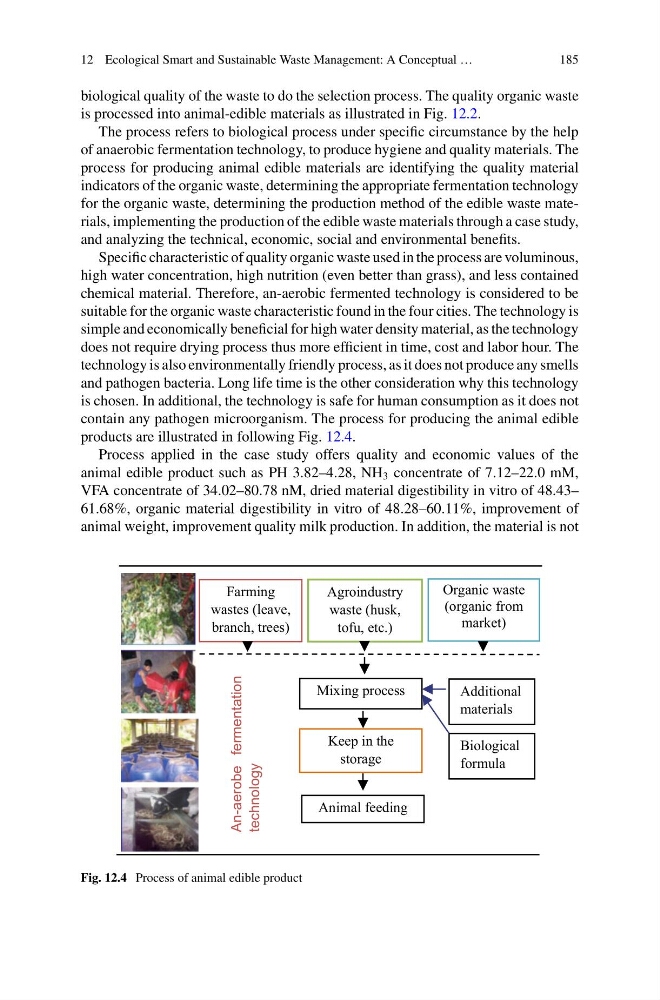
contain any pathogen microorganism. The process for producing the animal edible
products are illustrated in following Fig. 12.4.
Process applied in the case study offers quality and economic values of the
animal edible product such as PH 3.82–4.28, NH 3 concentrate of 7.12–22.0 mM,
VFA concentrate of 34.02–80.78 nM, dried material digestibility in vitro of 48.43–
61.68%, organic material digestibility in vitro of 48.28–60.11%, improvement of
animal weight, improvement quality milk production. In addition, the material is not
Farming
wastes (leave,
branch, trees)
Agroindustry
waste (husk,
tofu, etc.)
Organic waste
(organic from
market)
Mixing process
Biological
formula
Additional
materials
Keep in the
storage
Animal feeding
An-aerobe fermentation
technology
Fig. 12.4 Process of animal edible product
185
biological quality of the waste to do the selection process. The quality organic waste
is processed into animal-edible materials as illustrated in Fig. 12.2.
The process refers to biological process under specific circumstance by the help
of anaerobic fermentation technology, to produce hygiene and quality materials. The
process for producing animal edible materials are identifying the quality material
indicators of the organic waste, determining the appropriate fermentation technology
for the organic waste, determining the production method of the edible waste materials, implementing the production of the edible waste materials through a case study,
and analyzing the technical, economic, social and environmental benefits.
Specific characteristic of quality organic waste used in the process are voluminous,
high water concentration, high nutrition (even better than grass), and less contained
chemical material. Therefore, an-aerobic fermented technology is considered to be
suitable for the organic waste characteristic found in the four cities. The technology is
simple and economically beneficial for high water density material, as the technology
does not require drying process thus more efficient in time, cost and labor hour. The
technology is also environmentally friendly process, as it does not produce any smells
and pathogen bacteria. Long life time is the other consideration why this technology
is chosen. In additional, the technology is safe for human consumption as it does not
contain any pathogen microorganism. The process for producing the animal edible
products are illustrated in following Fig. 12.4.
Process applied in the case study offers quality and economic values of the
animal edible product such as PH 3.82–4.28, NH 3 concentrate of 7.12–22.0 mM,
VFA concentrate of 34.02–80.78 nM, dried material digestibility in vitro of 48.43–
61.68%, organic material digestibility in vitro of 48.28–60.11%, improvement of
animal weight, improvement quality milk production. In addition, the material is not
Farming
wastes (leave,
branch, trees)
Agroindustry
waste (husk,
tofu, etc.)
Organic waste
(organic from
market)
Mixing process
Biological
formula
Additional
materials
Keep in the
storage
Animal feeding
An-aerobe fermentation
technology
Fig. 12.4 Process of animal edible product