

184
Y. A. Fatimah et al.
Circular
waste
management
(set 1)
Organic
waste
management
(Set 2)
Invaluable
Waste
collection
management
and treatment
(Energy, gas,
electricity,
Landfill
Waste
sources,
collection,
sorting,
transportation
Nonorganic
waste
management
(Set 3)
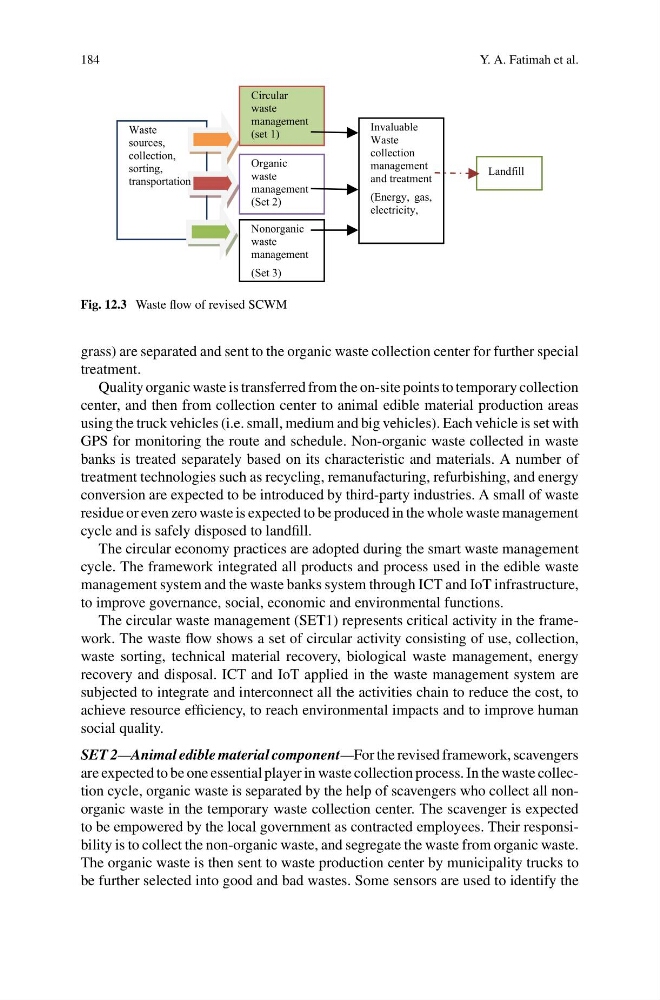
Fig. 12.3 Waste flow of revised SCWM
grass) are separated and sent to the organic waste collection center for further special
treatment.
Quality organic waste is transferred from the on-site points to temporary collection
center, and then from collection center to animal edible material production areas
using the truck vehicles (i.e. small, medium and big vehicles). Each vehicle is set with
GPS for monitoring the route and schedule. Non-organic waste collected in waste
banks is treated separately based on its characteristic and materials. A number of
treatment technologies such as recycling, remanufacturing, refurbishing, and energy
conversion are expected to be introduced by third-party industries. A small of waste
residue or even zero waste is expected to be produced in the whole waste management
cycle and is safely disposed to landfill.
The circular economy practices are adopted during the smart waste management
cycle. The framework integrated all products and process used in the edible waste
management system and the waste banks system through ICT and IoT infrastructure,
to improve governance, social, economic and environmental functions.
The circular waste management (SET1) represents critical activity in the framework. The waste flow shows a set of circular activity consisting of use, collection,
waste sorting, technical material recovery, biological waste management, energy
recovery and disposal. ICT and IoT applied in the waste management system are
subjected to integrate and interconnect all the activities chain to reduce the cost, to
achieve resource efficiency, to reach environmental impacts and to improve human
social quality.
SET 2—Animal edible material component—For the revised framework, scavengers
are expected to be one essential player in waste collection process. In the waste collection cycle, organic waste is separated by the help of scavengers who collect all nonorganic waste in the temporary waste collection center. The scavenger is expected
to be empowered by the local government as contracted employees. Their responsibility is to collect the non-organic waste, and segregate the waste from organic waste.
The organic waste is then sent to waste production center by municipality trucks to
be further selected into good and bad wastes. Some sensors are used to identify the
Y. A. Fatimah et al.
Circular
waste
management
(set 1)
Organic
waste
management
(Set 2)
Invaluable
Waste
collection
management
and treatment
(Energy, gas,
electricity,
Landfill
Waste
sources,
collection,
sorting,
transportation
Nonorganic
waste
management
(Set 3)
Fig. 12.3 Waste flow of revised SCWM
grass) are separated and sent to the organic waste collection center for further special
treatment.
Quality organic waste is transferred from the on-site points to temporary collection
center, and then from collection center to animal edible material production areas
using the truck vehicles (i.e. small, medium and big vehicles). Each vehicle is set with
GPS for monitoring the route and schedule. Non-organic waste collected in waste
banks is treated separately based on its characteristic and materials. A number of
treatment technologies such as recycling, remanufacturing, refurbishing, and energy
conversion are expected to be introduced by third-party industries. A small of waste
residue or even zero waste is expected to be produced in the whole waste management
cycle and is safely disposed to landfill.
The circular economy practices are adopted during the smart waste management
cycle. The framework integrated all products and process used in the edible waste
management system and the waste banks system through ICT and IoT infrastructure,
to improve governance, social, economic and environmental functions.
The circular waste management (SET1) represents critical activity in the framework. The waste flow shows a set of circular activity consisting of use, collection,
waste sorting, technical material recovery, biological waste management, energy
recovery and disposal. ICT and IoT applied in the waste management system are
subjected to integrate and interconnect all the activities chain to reduce the cost, to
achieve resource efficiency, to reach environmental impacts and to improve human
social quality.
SET 2—Animal edible material component—For the revised framework, scavengers
are expected to be one essential player in waste collection process. In the waste collection cycle, organic waste is separated by the help of scavengers who collect all nonorganic waste in the temporary waste collection center. The scavenger is expected
to be empowered by the local government as contracted employees. Their responsibility is to collect the non-organic waste, and segregate the waste from organic waste.
The organic waste is then sent to waste production center by municipality trucks to
be further selected into good and bad wastes. Some sensors are used to identify the