

12 Ecological Smart and Sustainable Waste Management: A Conceptual …
183
ICT and IoT
Use
Collection
Waste
sorting
Technical
material
recovery
Biological
material
recovery
Disposal
Energy
recovery
Governance
Governance
Society Society
Economy
Economy
Environment
Environment
Regulation, Standardization,
Process, Infrastructure
Technology Communication
Authority
Income/profit, Employment,
Market, Productivity,
Investment, Value chain,
Innovation
Emission, Pollution, Land
use,Energy Recovery,
Resource efficiency, Water,
Workplace
Community, Customer,
Quality of life, Collectors,
Scavengers, Gender,
Networking, Awareness
Individual waste
sorting
Organic waste
collection
Quality waste
sorting
Animal edible
materials
Individual waste
sorting
Non-organic waste
collection
Material waste
sorting
Waste treatment
options
SET 1
SET 2
SET 1
SET 3
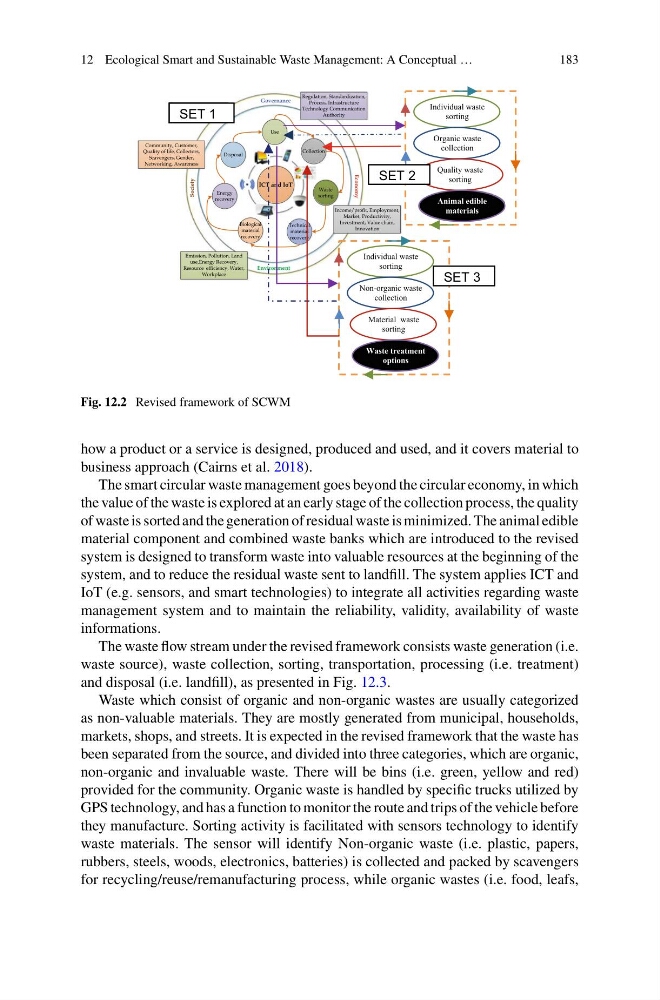
Fig. 12.2 Revised framework of SCWM
how a product or a service is designed, produced and used, and it covers material to
business approach (Cairns et al. 2018).
The smart circular waste management goes beyond the circular economy, in which
the value of the waste is explored at an early stage of the collection process, the quality
of waste is sorted and the generation of residual waste is minimized. The animal edible
material component and combined waste banks which are introduced to the revised
system is designed to transform waste into valuable resources at the beginning of the
system, and to reduce the residual waste sent to landfill. The system applies ICT and
IoT (e.g. sensors, and smart technologies) to integrate all activities regarding waste
management system and to maintain the reliability, validity, availability of waste
informations.
The waste flow stream under the revised framework consists waste generation (i.e.
waste source), waste collection, sorting, transportation, processing (i.e. treatment)
and disposal (i.e. landfill), as presented in Fig. 12.3.
Waste which consist of organic and non-organic wastes are usually categorized
as non-valuable materials. They are mostly generated from municipal, households,
markets, shops, and streets. It is expected in the revised framework that the waste has
been separated from the source, and divided into three categories, which are organic,
non-organic and invaluable waste. There will be bins (i.e. green, yellow and red)
provided for the community. Organic waste is handled by specific trucks utilized by
GPS technology, and has a function to monitor the route and trips of the vehicle before
they manufacture. Sorting activity is facilitated with sensors technology to identify
waste materials. The sensor will identify Non-organic waste (i.e. plastic, papers,
rubbers, steels, woods, electronics, batteries) is collected and packed by scavengers
for recycling/reuse/remanufacturing process, while organic wastes (i.e. food, leafs,
183
ICT and IoT
Use
Collection
Waste
sorting
Technical
material
recovery
Biological
material
recovery
Disposal
Energy
recovery
Governance
Governance
Society Society
Economy
Economy
Environment
Environment
Regulation, Standardization,
Process, Infrastructure
Technology Communication
Authority
Income/profit, Employment,
Market, Productivity,
Investment, Value chain,
Innovation
Emission, Pollution, Land
use,Energy Recovery,
Resource efficiency, Water,
Workplace
Community, Customer,
Quality of life, Collectors,
Scavengers, Gender,
Networking, Awareness
Individual waste
sorting
Organic waste
collection
Quality waste
sorting
Animal edible
materials
Individual waste
sorting
Non-organic waste
collection
Material waste
sorting
Waste treatment
options
SET 1
SET 2
SET 1
SET 3
Fig. 12.2 Revised framework of SCWM
how a product or a service is designed, produced and used, and it covers material to
business approach (Cairns et al. 2018).
The smart circular waste management goes beyond the circular economy, in which
the value of the waste is explored at an early stage of the collection process, the quality
of waste is sorted and the generation of residual waste is minimized. The animal edible
material component and combined waste banks which are introduced to the revised
system is designed to transform waste into valuable resources at the beginning of the
system, and to reduce the residual waste sent to landfill. The system applies ICT and
IoT (e.g. sensors, and smart technologies) to integrate all activities regarding waste
management system and to maintain the reliability, validity, availability of waste
informations.
The waste flow stream under the revised framework consists waste generation (i.e.
waste source), waste collection, sorting, transportation, processing (i.e. treatment)
and disposal (i.e. landfill), as presented in Fig. 12.3.
Waste which consist of organic and non-organic wastes are usually categorized
as non-valuable materials. They are mostly generated from municipal, households,
markets, shops, and streets. It is expected in the revised framework that the waste has
been separated from the source, and divided into three categories, which are organic,
non-organic and invaluable waste. There will be bins (i.e. green, yellow and red)
provided for the community. Organic waste is handled by specific trucks utilized by
GPS technology, and has a function to monitor the route and trips of the vehicle before
they manufacture. Sorting activity is facilitated with sensors technology to identify
waste materials. The sensor will identify Non-organic waste (i.e. plastic, papers,
rubbers, steels, woods, electronics, batteries) is collected and packed by scavengers
for recycling/reuse/remanufacturing process, while organic wastes (i.e. food, leafs,