

186
Y. A. Fatimah et al.
smelly, life longer, probiotic content, easy to make and economically viable, safe to
be consumed by animal and at competitive price.
The animal edible material solves complex and hug amount of waste, to maximize
economic benefit gathered from organic waste, to increase effective organic waste
management, to provide affordable green material food for animals, and to substitute
expensive animal concentrate.
SET 3—Combined waste bank—Waste bank is a community based waste management with a specific purpose to manage waste through collection, sorting, and
depositing valuable waste, and to convert the waste into certain value of money, products (e.g. rice, sugars, vegetables oil) or facilities (e.g. electricity bill, water, cellular
credit). The waste bank development also offers benefits to the society including
the raising of community awareness on waste collection, the increase of community income, the improvement of standard life, and the reduction of waste sent to
landfill. There are two type of waste bank (i.e. conventional and online waste bank)
developing in Indonesian community.
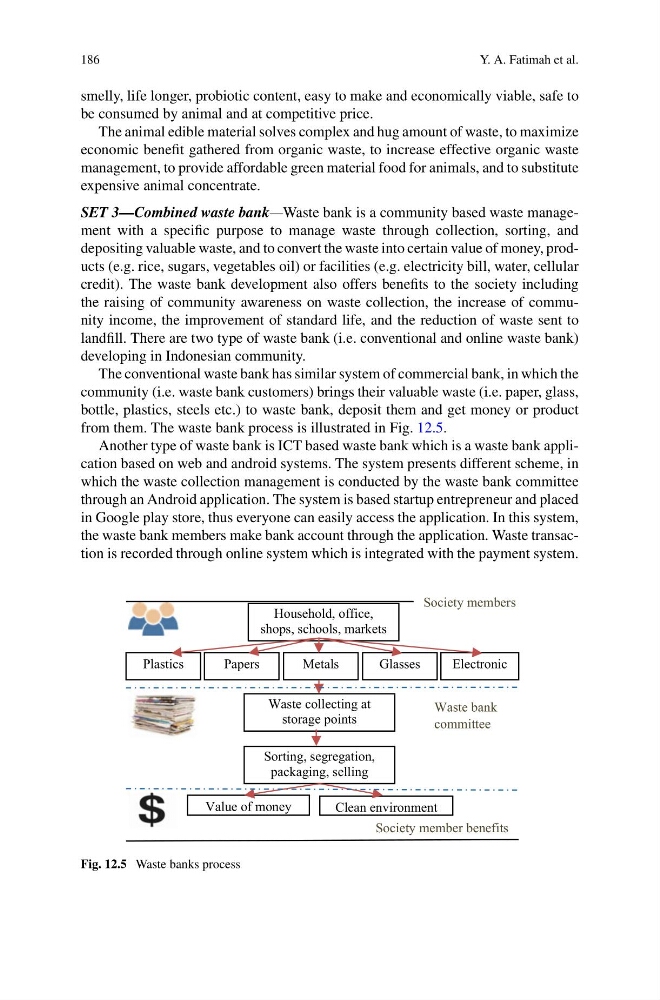
The conventional waste bank has similar system of commercial bank, in which the
community (i.e. waste bank customers) brings their valuable waste (i.e. paper, glass,
bottle, plastics, steels etc.) to waste bank, deposit them and get money or product
from them. The waste bank process is illustrated in Fig. 12.5.
Another type of waste bank is ICT based waste bank which is a waste bank application based on web and android systems. The system presents different scheme, in
which the waste collection management is conducted by the waste bank committee
through an Android application. The system is based startup entrepreneur and placed
in Google play store, thus everyone can easily access the application. In this system,
the waste bank members make bank account through the application. Waste transaction is recorded through online system which is integrated with the payment system.
Household, office,
shops, schools, markets
Plastics
Papers
Metals
Glasses
Electronic
Waste collecting at
storage points
Sorting, segregation,
packaging, selling
Value of money
Society members
Clean environment
Society member benefits
Waste bank
committee
Fig. 12.5 Waste banks process
Y. A. Fatimah et al.
smelly, life longer, probiotic content, easy to make and economically viable, safe to
be consumed by animal and at competitive price.
The animal edible material solves complex and hug amount of waste, to maximize
economic benefit gathered from organic waste, to increase effective organic waste
management, to provide affordable green material food for animals, and to substitute
expensive animal concentrate.
SET 3—Combined waste bank—Waste bank is a community based waste management with a specific purpose to manage waste through collection, sorting, and
depositing valuable waste, and to convert the waste into certain value of money, products (e.g. rice, sugars, vegetables oil) or facilities (e.g. electricity bill, water, cellular
credit). The waste bank development also offers benefits to the society including
the raising of community awareness on waste collection, the increase of community income, the improvement of standard life, and the reduction of waste sent to
landfill. There are two type of waste bank (i.e. conventional and online waste bank)
developing in Indonesian community.
The conventional waste bank has similar system of commercial bank, in which the
community (i.e. waste bank customers) brings their valuable waste (i.e. paper, glass,
bottle, plastics, steels etc.) to waste bank, deposit them and get money or product
from them. The waste bank process is illustrated in Fig. 12.5.
Another type of waste bank is ICT based waste bank which is a waste bank application based on web and android systems. The system presents different scheme, in
which the waste collection management is conducted by the waste bank committee
through an Android application. The system is based startup entrepreneur and placed
in Google play store, thus everyone can easily access the application. In this system,
the waste bank members make bank account through the application. Waste transaction is recorded through online system which is integrated with the payment system.
Household, office,
shops, schools, markets
Plastics
Papers
Metals
Glasses
Electronic
Waste collecting at
storage points
Sorting, segregation,
packaging, selling
Value of money
Society members
Clean environment
Society member benefits
Waste bank
committee
Fig. 12.5 Waste banks process