

11 Economy-Wide Material Flow Analysis and Its Projection …
169
domestic resources. This decrease is highly associated with the national policy. Public
investment into infrastructure construction had previously been a major driver for
the economic growth to address a business depression in Japan. However, Japanese
government reconsidered the national financial management and stringently adopted
the only inevitable investment. As a result, the public investment into infrastructure construction has been mitigated by 10.7% in 2002, 3.9% in 2003, 3.5% in
2004 compared with the preceding year. The vital cut of public investment into
infrastructure construction would lead to the mitigation of aggregate, gravel, and
stone.
The trend of TMR is then examined as follows. The fine aggregate, gravel and stone
aforementioned in the top DMI are not presented due to their small specific TMR.
Instead, steam coal, iron ore, liquefied natural gas, and coking coal have significantly
increased by 458%, 73.4%, 147%, and 66.1% respectively from 1990 to 2013. These
are categorized in imported resources under the 2nd classification, which primarily
contributed to the increase in imported resources. Particularly, the ore grade has
recently declined and it is unlikely to find new high grade deposits (Watling 2015).
After over-exploitation of richer ore grades, mining activities globally move to lower
grade ores. In addition, the stripping ratio associated with mine depth has decreased
as well over time (Xian et al. 2016). The deterioration of resource landscape requires
larger amounts of unused materials (Crowson 2012). The rise of exploiting unused
materials has contributed to the increase in imported resources on the TMR basis.
11.3.2 Sensitivity Analysis
Although this study assumes the transition of ore grade based on the work (Yamatomi
2008), the accuracy of assuming degree of decline in ore grade is a major concern. To
evaluate the influence of ore grade, this study compares the overall TMR under the
case of between the assumption of the ore grade transition and the non-consideration
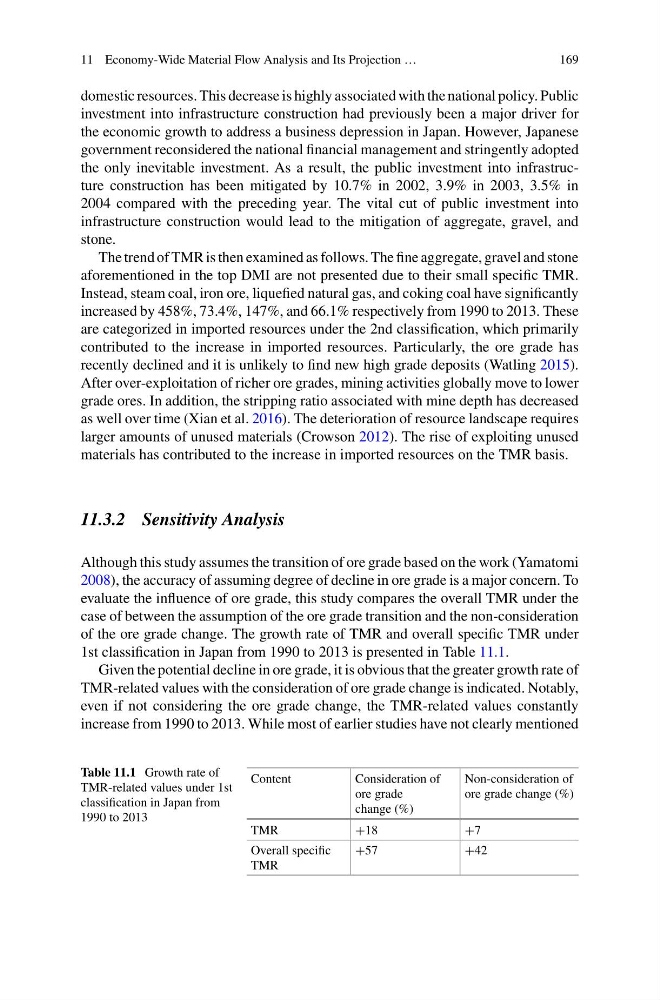
of the ore grade change. The growth rate of TMR and overall specific TMR under
1st classification in Japan from 1990 to 2013 is presented in Table 11.1.
Given the potential decline in ore grade, it is obvious that the greater growth rate of
TMR-related values with the consideration of ore grade change is indicated. Notably,
even if not considering the ore grade change, the TMR-related values constantly
increase from 1990 to 2013. While most of earlier studies have not clearly mentioned
Table 11.1 Growth rate of
TMR-related values under 1st
classification in Japan from
1990 to 2013
Content
Consideration of
ore grade
change (%)
Non-consideration of
ore grade change (%)
TMR
+18
+7
Overall specific
TMR
+57
+42
169
domestic resources. This decrease is highly associated with the national policy. Public
investment into infrastructure construction had previously been a major driver for
the economic growth to address a business depression in Japan. However, Japanese
government reconsidered the national financial management and stringently adopted
the only inevitable investment. As a result, the public investment into infrastructure construction has been mitigated by 10.7% in 2002, 3.9% in 2003, 3.5% in
2004 compared with the preceding year. The vital cut of public investment into
infrastructure construction would lead to the mitigation of aggregate, gravel, and
stone.
The trend of TMR is then examined as follows. The fine aggregate, gravel and stone
aforementioned in the top DMI are not presented due to their small specific TMR.
Instead, steam coal, iron ore, liquefied natural gas, and coking coal have significantly
increased by 458%, 73.4%, 147%, and 66.1% respectively from 1990 to 2013. These
are categorized in imported resources under the 2nd classification, which primarily
contributed to the increase in imported resources. Particularly, the ore grade has
recently declined and it is unlikely to find new high grade deposits (Watling 2015).
After over-exploitation of richer ore grades, mining activities globally move to lower
grade ores. In addition, the stripping ratio associated with mine depth has decreased
as well over time (Xian et al. 2016). The deterioration of resource landscape requires
larger amounts of unused materials (Crowson 2012). The rise of exploiting unused
materials has contributed to the increase in imported resources on the TMR basis.
11.3.2 Sensitivity Analysis
Although this study assumes the transition of ore grade based on the work (Yamatomi
2008), the accuracy of assuming degree of decline in ore grade is a major concern. To
evaluate the influence of ore grade, this study compares the overall TMR under the
case of between the assumption of the ore grade transition and the non-consideration
of the ore grade change. The growth rate of TMR and overall specific TMR under
1st classification in Japan from 1990 to 2013 is presented in Table 11.1.
Given the potential decline in ore grade, it is obvious that the greater growth rate of
TMR-related values with the consideration of ore grade change is indicated. Notably,
even if not considering the ore grade change, the TMR-related values constantly
increase from 1990 to 2013. While most of earlier studies have not clearly mentioned
Table 11.1 Growth rate of
TMR-related values under 1st
classification in Japan from
1990 to 2013
Content
Consideration of
ore grade
change (%)
Non-consideration of
ore grade change (%)
TMR
+18
+7
Overall specific
TMR
+57
+42