

168
S. Kosai and E. Yamasue
resources have covered the great share of the total DMI, its continuous decrease
greatly contributed to the reduction of total DMI under 1st classification.
The increase of utilization of domestic cycle resources would imply a positive
effect of national recycling policy. Japanese government enforced the Basic Act for
Establishing a Sound Material-Cycle Society in 2000, which aims to mitigate the
waste amount, to consider its usefulness and to establish the material cycle systems
from the perspectives of reduce, reuse, and recycle (material and thermal) (Ministry of
Environment 2000). Under this principle, Act on the Promotion of Effective Utilization of Resources was enforced in 2001, which obligates companies to rationalize
raw material utilization to mitigate the generation of by-products, to use recyclable
materials, and to promote the utilization of by-products (Ministry of Economy 2015).
It must be noted that domestic cycled resources reached its peak in 2005, whereas
after that it has slightly decreased, which would indicate that, in spite of the positive
effect of earlier national recycling policy, long-termed policy is required.
The trend of TMR is then examined as follows. Due to the increase in the volume
of imported resources, it has increased by 48.5% from 4710 million ton in 1990 to
7000 million ton in 2013. Since the imported resources cover the great share of total
TMR, the significant increase in the imported resources mitigated the the influence
of increase in the domestic resources and contributed to the overall increase of total
TMR under 1st classification.
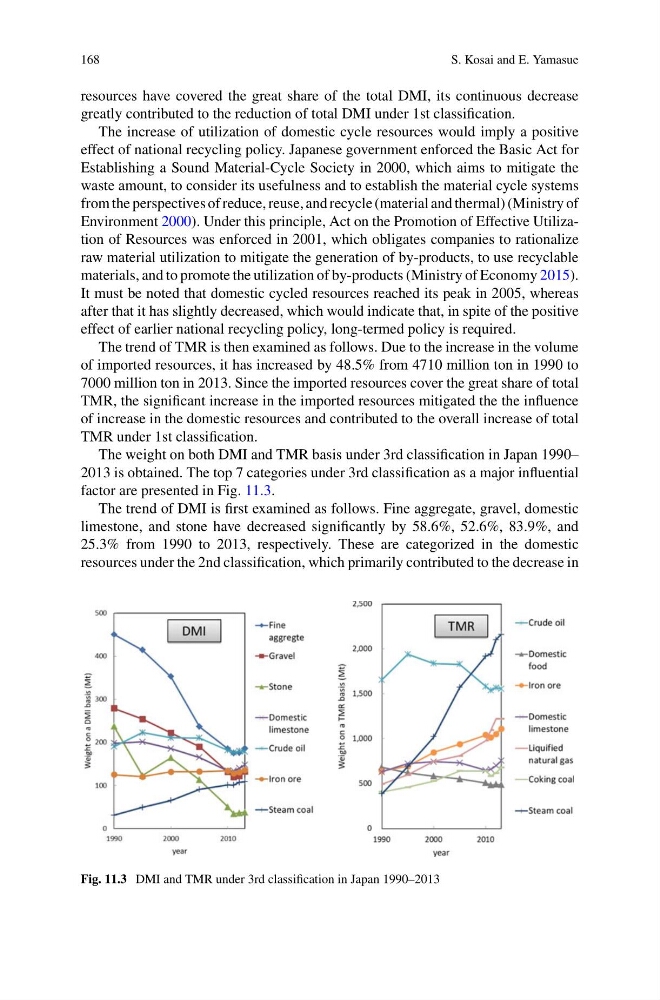
The weight on both DMI and TMR basis under 3rd classification in Japan 1990–
2013 is obtained. The top 7 categories under 3rd classification as a major influential
factor are presented in Fig. 11.3.
The trend of DMI is first examined as follows. Fine aggregate, gravel, domestic
limestone, and stone have decreased significantly by 58.6%, 52.6%, 83.9%, and
25.3% from 1990 to 2013, respectively. These are categorized in the domestic
resources under the 2nd classification, which primarily contributed to the decrease in
Fig. 11.3 DMI and TMR under 3rd classification in Japan 1990–2013
S. Kosai and E. Yamasue
resources have covered the great share of the total DMI, its continuous decrease
greatly contributed to the reduction of total DMI under 1st classification.
The increase of utilization of domestic cycle resources would imply a positive
effect of national recycling policy. Japanese government enforced the Basic Act for
Establishing a Sound Material-Cycle Society in 2000, which aims to mitigate the
waste amount, to consider its usefulness and to establish the material cycle systems
from the perspectives of reduce, reuse, and recycle (material and thermal) (Ministry of
Environment 2000). Under this principle, Act on the Promotion of Effective Utilization of Resources was enforced in 2001, which obligates companies to rationalize
raw material utilization to mitigate the generation of by-products, to use recyclable
materials, and to promote the utilization of by-products (Ministry of Economy 2015).
It must be noted that domestic cycled resources reached its peak in 2005, whereas
after that it has slightly decreased, which would indicate that, in spite of the positive
effect of earlier national recycling policy, long-termed policy is required.
The trend of TMR is then examined as follows. Due to the increase in the volume
of imported resources, it has increased by 48.5% from 4710 million ton in 1990 to
7000 million ton in 2013. Since the imported resources cover the great share of total
TMR, the significant increase in the imported resources mitigated the the influence
of increase in the domestic resources and contributed to the overall increase of total
TMR under 1st classification.
The weight on both DMI and TMR basis under 3rd classification in Japan 1990–
2013 is obtained. The top 7 categories under 3rd classification as a major influential
factor are presented in Fig. 11.3.
The trend of DMI is first examined as follows. Fine aggregate, gravel, domestic
limestone, and stone have decreased significantly by 58.6%, 52.6%, 83.9%, and
25.3% from 1990 to 2013, respectively. These are categorized in the domestic
resources under the 2nd classification, which primarily contributed to the decrease in
Fig. 11.3 DMI and TMR under 3rd classification in Japan 1990–2013