

1.4 The Physical Mechanisms and Characteristics
21
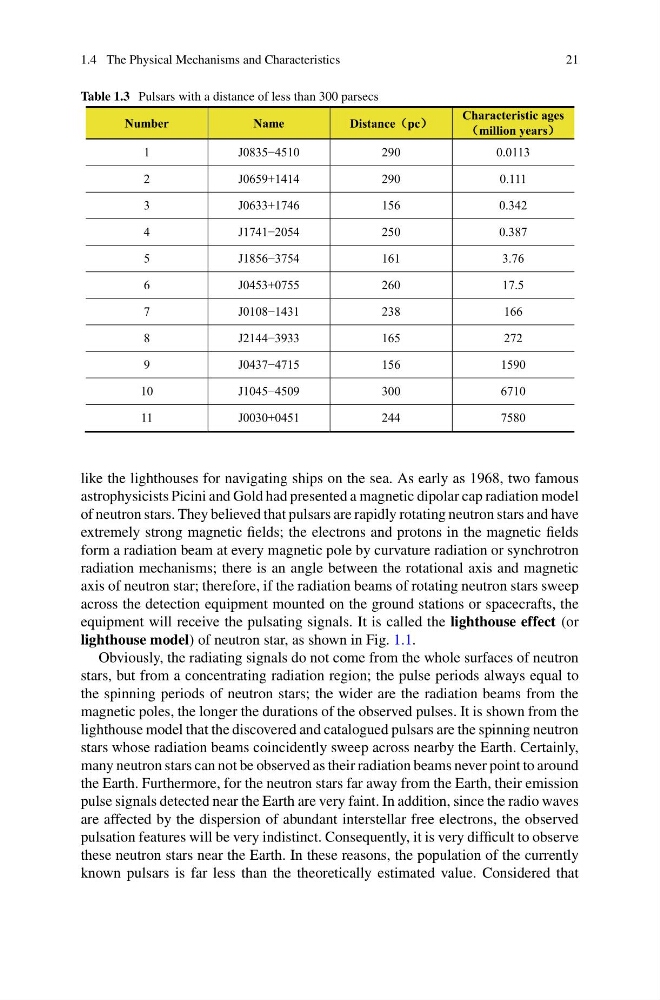
Table 1.3 Pulsars with a distance of less than 300 parsecs
Number
Name
Distance pc
Characteristic ages
million years
1
J 0 8 3 5 −4510
290
0.0113
2
J0659+1414
290
0.111
3
J0633+1746
156
0.342
4
J 1 7 4 1 −2054
250
0.387
5
J 1 8 5 6 −3754
161
3.76
6
J0453+0755
260
17.5
7
J 0 1 0 8 −1431
238
166
8
J 2 1 4 4 −3933
165
272
9
J 0 4 3 7 −4715
156
1590
10
J1045−4509
300
6710
11
J0030+0451
244
7580
like the lighthouses for navigating ships on the sea. As early as 1968, two famous
astrophysicists Picini and Gold had presented a magnetic dipolar cap radiation model
of neutron stars. They believed that pulsars are rapidly rotating neutron stars and have
extremely strong magnetic fields; the electrons and protons in the magnetic fields
form a radiation beam at every magnetic pole by curvature radiation or synchrotron
radiation mechanisms; there is an angle between the rotational axis and magnetic
axis of neutron star; therefore, if the radiation beams of rotating neutron stars sweep
across the detection equipment mounted on the ground stations or spacecrafts, the
equipment will receive the pulsating signals. It is called the lighthouse effect (or
lighthouse model) of neutron star, as shown in Fig. 1.1.
Obviously, the radiating signals do not come from the whole surfaces of neutron
stars, but from a concentrating radiation region; the pulse periods always equal to
the spinning periods of neutron stars; the wider are the radiation beams from the
magnetic poles, the longer the durations of the observed pulses. It is shown from the
lighthouse model that the discovered and catalogued pulsars are the spinning neutron
stars whose radiation beams coincidently sweep across nearby the Earth. Certainly,
many neutron stars can not be observed as their radiation beams never point to around
the Earth. Furthermore, for the neutron stars far away from the Earth, their emission
pulse signals detected near the Earth are very faint. In addition, since the radio waves
are affected by the dispersion of abundant interstellar free electrons, the observed
pulsation features will be very indistinct. Consequently, it is very difficult to observe
these neutron stars near the Earth. In these reasons, the population of the currently
known pulsars is far less than the theoretically estimated value. Considered that
21
Table 1.3 Pulsars with a distance of less than 300 parsecs
Number
Name
Distance pc
Characteristic ages
million years
1
J 0 8 3 5 −4510
290
0.0113
2
J0659+1414
290
0.111
3
J0633+1746
156
0.342
4
J 1 7 4 1 −2054
250
0.387
5
J 1 8 5 6 −3754
161
3.76
6
J0453+0755
260
17.5
7
J 0 1 0 8 −1431
238
166
8
J 2 1 4 4 −3933
165
272
9
J 0 4 3 7 −4715
156
1590
10
J1045−4509
300
6710
11
J0030+0451
244
7580
like the lighthouses for navigating ships on the sea. As early as 1968, two famous
astrophysicists Picini and Gold had presented a magnetic dipolar cap radiation model
of neutron stars. They believed that pulsars are rapidly rotating neutron stars and have
extremely strong magnetic fields; the electrons and protons in the magnetic fields
form a radiation beam at every magnetic pole by curvature radiation or synchrotron
radiation mechanisms; there is an angle between the rotational axis and magnetic
axis of neutron star; therefore, if the radiation beams of rotating neutron stars sweep
across the detection equipment mounted on the ground stations or spacecrafts, the
equipment will receive the pulsating signals. It is called the lighthouse effect (or
lighthouse model) of neutron star, as shown in Fig. 1.1.
Obviously, the radiating signals do not come from the whole surfaces of neutron
stars, but from a concentrating radiation region; the pulse periods always equal to
the spinning periods of neutron stars; the wider are the radiation beams from the
magnetic poles, the longer the durations of the observed pulses. It is shown from the
lighthouse model that the discovered and catalogued pulsars are the spinning neutron
stars whose radiation beams coincidently sweep across nearby the Earth. Certainly,
many neutron stars can not be observed as their radiation beams never point to around
the Earth. Furthermore, for the neutron stars far away from the Earth, their emission
pulse signals detected near the Earth are very faint. In addition, since the radio waves
are affected by the dispersion of abundant interstellar free electrons, the observed
pulsation features will be very indistinct. Consequently, it is very difficult to observe
these neutron stars near the Earth. In these reasons, the population of the currently
known pulsars is far less than the theoretically estimated value. Considered that