

20
1 Introduction to the Pulsars
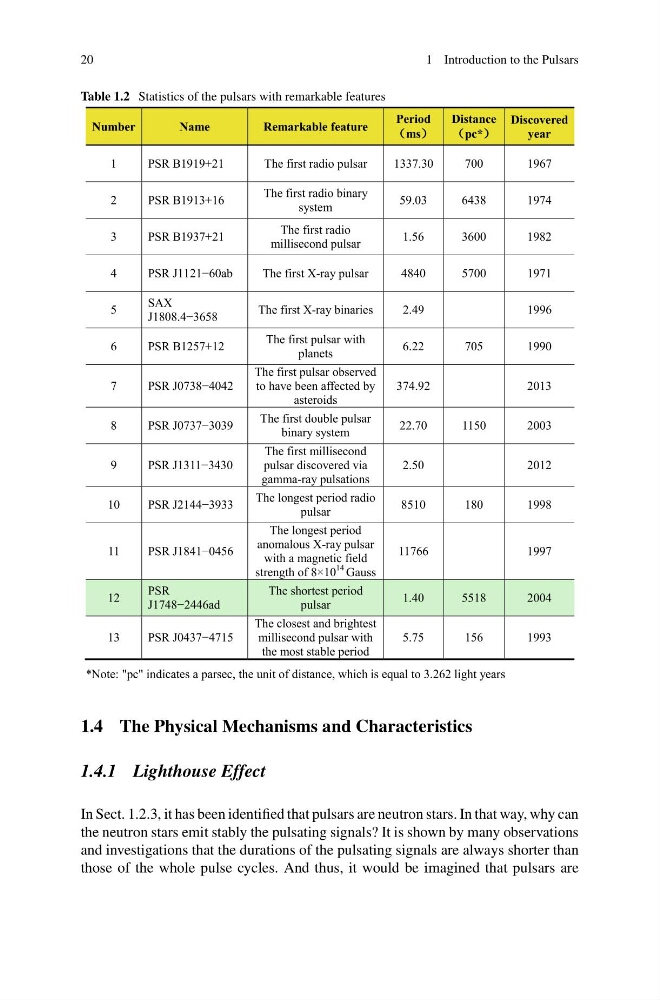
Table 1.2 Statistics of the pulsars with remarkable features
Number
Name
Remarkable feature
Period
ms
Distance
pc*
Discovered
year
1
PSR B1919+21
The first radio pulsar
1337.30
700
1967
2
PSR B1913+16
The first radio binary
system
59.03
6438
1974
3
PSR B1937+21
The first radio
millisecond pulsar
1.56
3600
1982
4
PSR J1121−60ab
The first X-ray pulsar
4840
5700
1971
5
SAX
J1808.4−3658
The first X-ray binaries
2.49
1996
6
PSR B1257+12
The first pulsar with
planets
6.22
705
1990
7
PSR J0738−4042
The first pulsar observed
to have been affected by
asteroids
374.92
2013
8
PSR J0737−3039
The first double pulsar
binary system
22.70
1150
2003
9
PSR J1311−3430
The first millisecond
pulsar discovered via
gamma-ray pulsations
2.50
2012
10
PSR J2144−3933
The longest period radio
pulsar
8510
180
1998
11
PSR J1841−0456
The longest period
anomalous X-ray pulsar
with a magnetic field
strength of 8×10
14 Gauss
11766
1997
12
PSR
J1748−2446ad
The shortest period
pulsar
1.40
5518
2004
13
PSR J0437−4715
The closest and brightest
millisecond pulsar with
the most stable period
5.75
156
1993
*Note: "pc" indicates a parsec, the unit of distance, which is equal to 3.262 light years
1.4 The Physical Mechanisms and Characteristics
1.4.1 Lighthouse Effect
In Sect. 1.2.3, it has been identified that pulsars are neutron stars. In that way, why can
the neutron stars emit stably the pulsating signals? It is shown by many observations
and investigations that the durations of the pulsating signals are always shorter than
those of the whole pulse cycles. And thus, it would be imagined that pulsars are
1 Introduction to the Pulsars
Table 1.2 Statistics of the pulsars with remarkable features
Number
Name
Remarkable feature
Period
ms
Distance
pc*
Discovered
year
1
PSR B1919+21
The first radio pulsar
1337.30
700
1967
2
PSR B1913+16
The first radio binary
system
59.03
6438
1974
3
PSR B1937+21
The first radio
millisecond pulsar
1.56
3600
1982
4
PSR J1121−60ab
The first X-ray pulsar
4840
5700
1971
5
SAX
J1808.4−3658
The first X-ray binaries
2.49
1996
6
PSR B1257+12
The first pulsar with
planets
6.22
705
1990
7
PSR J0738−4042
The first pulsar observed
to have been affected by
asteroids
374.92
2013
8
PSR J0737−3039
The first double pulsar
binary system
22.70
1150
2003
9
PSR J1311−3430
The first millisecond
pulsar discovered via
gamma-ray pulsations
2.50
2012
10
PSR J2144−3933
The longest period radio
pulsar
8510
180
1998
11
PSR J1841−0456
The longest period
anomalous X-ray pulsar
with a magnetic field
strength of 8×10
14 Gauss
11766
1997
12
PSR
J1748−2446ad
The shortest period
pulsar
1.40
5518
2004
13
PSR J0437−4715
The closest and brightest
millisecond pulsar with
the most stable period
5.75
156
1993
*Note: "pc" indicates a parsec, the unit of distance, which is equal to 3.262 light years
1.4 The Physical Mechanisms and Characteristics
1.4.1 Lighthouse Effect
In Sect. 1.2.3, it has been identified that pulsars are neutron stars. In that way, why can
the neutron stars emit stably the pulsating signals? It is shown by many observations
and investigations that the durations of the pulsating signals are always shorter than
those of the whole pulse cycles. And thus, it would be imagined that pulsars are