

312
5 X-ray Pulsar-Based Navigation: Theories and Experiments
space-time interval of two world-points in the inertial system can be expressed by
formula (5.48) as follows.
ds
2
= −c
2 dT
2
+ dR
2
+ R
2 d
2
.
(5.54)
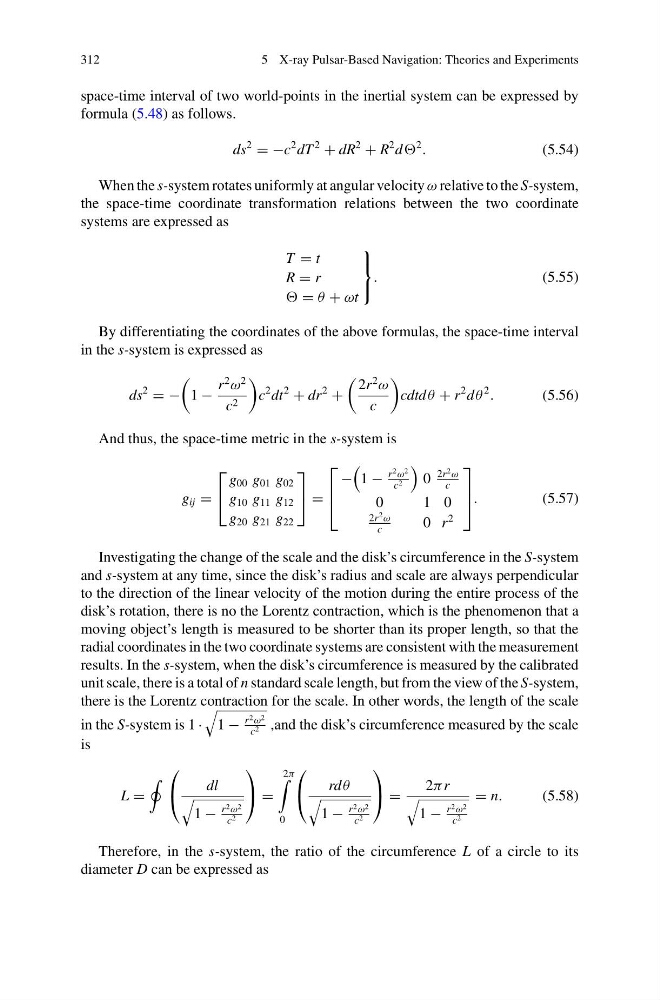
When the s-system rotates uniformly at angular velocity ω relative to the S-system,
the space-time coordinate transformation relations between the two coordinate
systems are expressed as
T = t
R = r
= θ + ωt
⎫
⎬
⎭
.
(5.55)
By differentiating the coordinates of the above formulas, the space-time interval
in the s-system is expressed as
ds
2
= −
1 −
r
2
ω
2
c 2
c
2 dt
2
+ dr
2
+
2r
2
ω
c
cdtd θ + r
2 d θ
2
.
(5.56)
And thus, the space-time metric in the s-system is
g ij =
⎡
⎣
g 00 g 01 g 02
g 10 g 11 g 12
g 20 g 21 g 22
⎤
⎦ =
⎡
⎢
⎣
−
1 −
r
2 ω
2
c 2
0
2r
2 ω
c
0
1 0
2r
2 ω
c
0 r
2
⎤
⎥
⎦.
(5.57)
Investigating the change of the scale and the disk’s circumference in the S-system
and s-system at any time, since the disk’s radius and scale are always perpendicular
to the direction of the linear velocity of the motion during the entire process of the
disk’s rotation, there is no the Lorentz contraction, which is the phenomenon that a
moving object’s length is measured to be shorter than its proper length, so that the
radial coordinates in the two coordinate systems are consistent with the measurement
results. In the s-system, when the disk’s circumference is measured by the calibrated
unit scale, there is a total of n standard scale length, but from the view of the S-system,
there is the Lorentz contraction for the scale. In other words, the length of the scale
in the S-system is 1 ·
1 −
r 2 ω 2
c 2 ,and the disk’s circumference measured by the scale
is
L =
⎛
⎝
dl
1 −
r 2 ω 2
c 2
⎞
⎠ =
2π
0
⎛
⎝ rd θ
1 −
r 2 ω 2
c 2
⎞
⎠ =
2π r
1 −
r 2 ω 2
c 2
= n.
(5.58)
Therefore, in the s-system, the ratio of the circumference L of a circle to its
diameter D can be expressed as
5 X-ray Pulsar-Based Navigation: Theories and Experiments
space-time interval of two world-points in the inertial system can be expressed by
formula (5.48) as follows.
ds
2
= −c
2 dT
2
+ dR
2
+ R
2 d
2
.
(5.54)
When the s-system rotates uniformly at angular velocity ω relative to the S-system,
the space-time coordinate transformation relations between the two coordinate
systems are expressed as
T = t
R = r
= θ + ωt
⎫
⎬
⎭
.
(5.55)
By differentiating the coordinates of the above formulas, the space-time interval
in the s-system is expressed as
ds
2
= −
1 −
r
2
ω
2
c 2
c
2 dt
2
+ dr
2
+
2r
2
ω
c
cdtd θ + r
2 d θ
2
.
(5.56)
And thus, the space-time metric in the s-system is
g ij =
⎡
⎣
g 00 g 01 g 02
g 10 g 11 g 12
g 20 g 21 g 22
⎤
⎦ =
⎡
⎢
⎣
−
1 −
r
2 ω
2
c 2
0
2r
2 ω
c
0
1 0
2r
2 ω
c
0 r
2
⎤
⎥
⎦.
(5.57)
Investigating the change of the scale and the disk’s circumference in the S-system
and s-system at any time, since the disk’s radius and scale are always perpendicular
to the direction of the linear velocity of the motion during the entire process of the
disk’s rotation, there is no the Lorentz contraction, which is the phenomenon that a
moving object’s length is measured to be shorter than its proper length, so that the
radial coordinates in the two coordinate systems are consistent with the measurement
results. In the s-system, when the disk’s circumference is measured by the calibrated
unit scale, there is a total of n standard scale length, but from the view of the S-system,
there is the Lorentz contraction for the scale. In other words, the length of the scale
in the S-system is 1 ·
1 −
r 2 ω 2
c 2 ,and the disk’s circumference measured by the scale
is
L =
⎛
⎝
dl
1 −
r 2 ω 2
c 2
⎞
⎠ =
2π
0
⎛
⎝ rd θ
1 −
r 2 ω 2
c 2
⎞
⎠ =
2π r
1 −
r 2 ω 2
c 2
= n.
(5.58)
Therefore, in the s-system, the ratio of the circumference L of a circle to its
diameter D can be expressed as