

5.4 Space-Time Reference Based on General Relativity
311
This is known as physical coordinate conditions of space-time metric. If a
space-time metric cannot meet one of the above four conditions, the selected coordinate system is non-physical, relative to which a physical observer cannot be at rest
locally.
In 1916, the distribution expression of the vacuum gravitational field outside the
spherically symmetric and stationary celestial body with the mass of M was derived
from the Einstein field equations by Karl Schwarzschild (1873—1916), a German
physicist and astronomer, which is known as Schwarzschild metric. Taking the
center of mass of the celestial body as the coordinate origin, the Schwarzschild
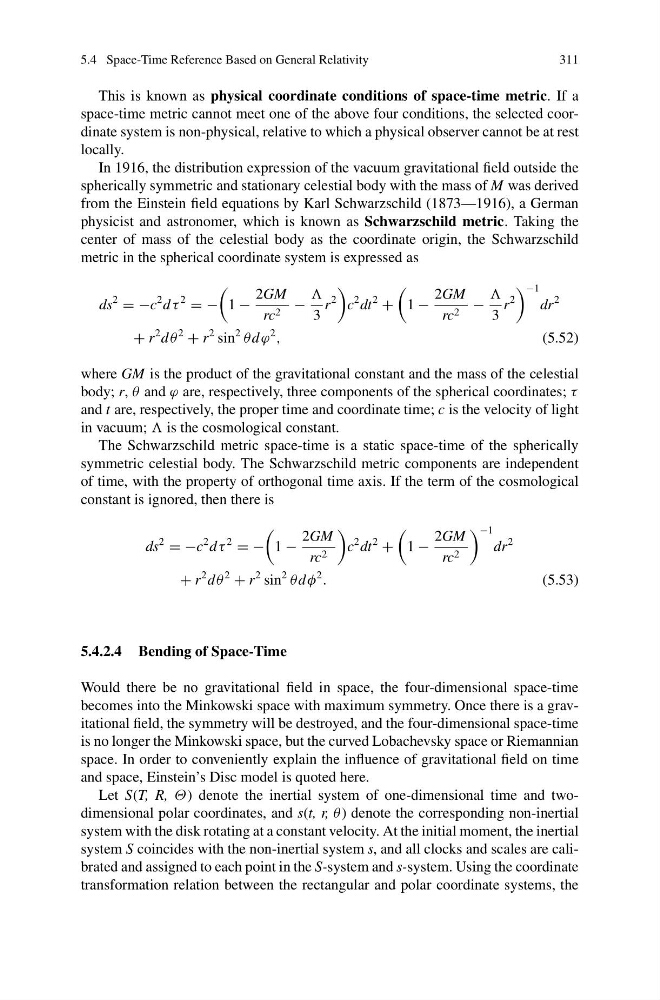
metric in the spherical coordinate system is expressed as
ds
2
= −c
2 d τ
2
= −
1 −
2GM
rc 2 −
3
r
2
c
2 dt
2
+
1 −
2GM
rc 2 −
3
r
2
−1
dr
2
+ r
2 d θ
2
+ r
2 sin
2
θ d ϕ
2
,
(5.52)
where GM is the product of the gravitational constant and the mass of the celestial
body; r, θ and ϕ are, respectively, three components of the spherical coordinates; τ
and t are, respectively, the proper time and coordinate time; c is the velocity of light
in vacuum; is the cosmological constant.
The Schwarzschild metric space-time is a static space-time of the spherically
symmetric celestial body. The Schwarzschild metric components are independent
of time, with the property of orthogonal time axis. If the term of the cosmological
constant is ignored, then there is
ds
2
= −c
2 d τ
2
= −
1 −
2GM
rc 2
c
2 dt
2
+
1 −
2GM
rc 2
−1
dr
2
+ r
2 d θ
2
+ r
2 sin
2
θ d φ
2
.
(5.53)
5.4.2.4 Bending of Space-Time
Would there be no gravitational field in space, the four-dimensional space-time
becomes into the Minkowski space with maximum symmetry. Once there is a gravitational field, the symmetry will be destroyed, and the four-dimensional space-time
is no longer the Minkowski space, but the curved Lobachevsky space or Riemannian
space. In order to conveniently explain the influence of gravitational field on time
and space, Einstein’s Disc model is quoted here.
Let S(T, R, Θ) denote the inertial system of one-dimensional time and twodimensional polar coordinates, and s(t, r, θ ) denote the corresponding non-inertial
system with the disk rotating at a constant velocity. At the initial moment, the inertial
system S coincides with the non-inertial system s, and all clocks and scales are calibrated and assigned to each point in the S-system and s-system. Using the coordinate
transformation relation between the rectangular and polar coordinate systems, the
311
This is known as physical coordinate conditions of space-time metric. If a
space-time metric cannot meet one of the above four conditions, the selected coordinate system is non-physical, relative to which a physical observer cannot be at rest
locally.
In 1916, the distribution expression of the vacuum gravitational field outside the
spherically symmetric and stationary celestial body with the mass of M was derived
from the Einstein field equations by Karl Schwarzschild (1873—1916), a German
physicist and astronomer, which is known as Schwarzschild metric. Taking the
center of mass of the celestial body as the coordinate origin, the Schwarzschild
metric in the spherical coordinate system is expressed as
ds
2
= −c
2 d τ
2
= −
1 −
2GM
rc 2 −
3
r
2
c
2 dt
2
+
1 −
2GM
rc 2 −
3
r
2
−1
dr
2
+ r
2 d θ
2
+ r
2 sin
2
θ d ϕ
2
,
(5.52)
where GM is the product of the gravitational constant and the mass of the celestial
body; r, θ and ϕ are, respectively, three components of the spherical coordinates; τ
and t are, respectively, the proper time and coordinate time; c is the velocity of light
in vacuum; is the cosmological constant.
The Schwarzschild metric space-time is a static space-time of the spherically
symmetric celestial body. The Schwarzschild metric components are independent
of time, with the property of orthogonal time axis. If the term of the cosmological
constant is ignored, then there is
ds
2
= −c
2 d τ
2
= −
1 −
2GM
rc 2
c
2 dt
2
+
1 −
2GM
rc 2
−1
dr
2
+ r
2 d θ
2
+ r
2 sin
2
θ d φ
2
.
(5.53)
5.4.2.4 Bending of Space-Time
Would there be no gravitational field in space, the four-dimensional space-time
becomes into the Minkowski space with maximum symmetry. Once there is a gravitational field, the symmetry will be destroyed, and the four-dimensional space-time
is no longer the Minkowski space, but the curved Lobachevsky space or Riemannian
space. In order to conveniently explain the influence of gravitational field on time
and space, Einstein’s Disc model is quoted here.
Let S(T, R, Θ) denote the inertial system of one-dimensional time and twodimensional polar coordinates, and s(t, r, θ ) denote the corresponding non-inertial
system with the disk rotating at a constant velocity. At the initial moment, the inertial
system S coincides with the non-inertial system s, and all clocks and scales are calibrated and assigned to each point in the S-system and s-system. Using the coordinate
transformation relation between the rectangular and polar coordinate systems, the