

310
5 X-ray Pulsar-Based Navigation: Theories and Experiments
can only be given by the space-time metric, it has the clear definition within the
whole space range of the reference system. The relationship between the “local”
proper time and the “global” coordinate time can be given by the space-time metric.
The coordinate time of any “space point” in the reference system can be calculated
by the proper time measured by the local clock.
When the time axis of a coordinate system is orthogonal to its space-axis, then the
coordinate system is called time-axis orthogonal coordinate system, i.e., g 0i = 0.
Furthermore, the axes of the selected three-dimensional space coordinate system
are also orthogonal to one another, i.e., g ij = 0, then the coordinate system is called
space-time orthogonal coordinate system. In the space-time orthogonal coordinate
system, there are only four independent components for the space-time metric, and
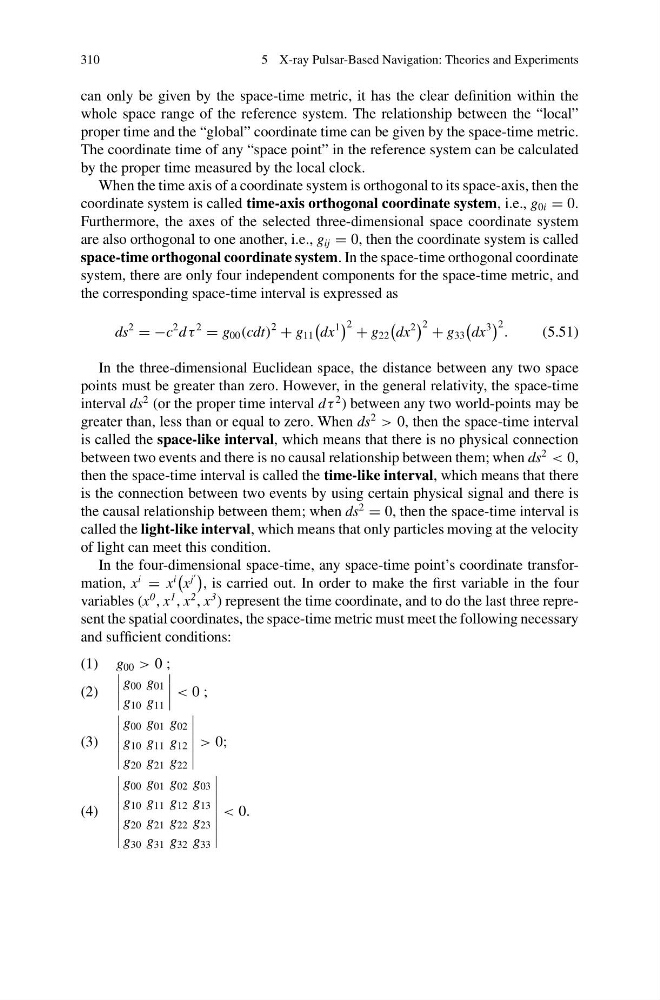
the corresponding space-time interval is expressed as
ds
2
= −c
2 d τ
2
= g 00 (cdt)
2
+ g 11
dx
1
2 + g 22
dx
2
2 + g 33
dx
3
2 .
(5.51)
In the three-dimensional Euclidean space, the distance between any two space
points must be greater than zero. However, in the general relativity, the space-time
interval ds
2 (or the proper time interval d τ
2 ) between any two world-points may be
greater than, less than or equal to zero. When ds
2
> 0, then the space-time interval
is called the space-like interval, which means that there is no physical connection
between two events and there is no causal relationship between them; when ds
2
< 0,
then the space-time interval is called the time-like interval, which means that there
is the connection between two events by using certain physical signal and there is
the causal relationship between them; when ds
2
= 0, then the space-time interval is
called the light-like interval, which means that only particles moving at the velocity
of light can meet this condition.
In the four-dimensional space-time, any space-time point’s coordinate transformation, x
i
= x
i
x
j
, is carried out. In order to make the first variable in the four
variables (x
0 , x
1 , x
2 , x
3 ) represent the time coordinate, and to do the last three represent the spatial coordinates, the space-time metric must meet the following necessary
and sufficient conditions:
(1) g 00 > 0 ;
(2)
g 00 g 01
g 10 g 11
< 0 ;
(3)
g 00 g 01 g 02
g 10 g 11 g 12
g 20 g 21 g 22
> 0;
(4)
g 00 g 01 g 02 g 03
g 10 g 11 g 12 g 13
g 20 g 21 g 22 g 23
g 30 g 31 g 32 g 33
< 0.
5 X-ray Pulsar-Based Navigation: Theories and Experiments
can only be given by the space-time metric, it has the clear definition within the
whole space range of the reference system. The relationship between the “local”
proper time and the “global” coordinate time can be given by the space-time metric.
The coordinate time of any “space point” in the reference system can be calculated
by the proper time measured by the local clock.
When the time axis of a coordinate system is orthogonal to its space-axis, then the
coordinate system is called time-axis orthogonal coordinate system, i.e., g 0i = 0.
Furthermore, the axes of the selected three-dimensional space coordinate system
are also orthogonal to one another, i.e., g ij = 0, then the coordinate system is called
space-time orthogonal coordinate system. In the space-time orthogonal coordinate
system, there are only four independent components for the space-time metric, and
the corresponding space-time interval is expressed as
ds
2
= −c
2 d τ
2
= g 00 (cdt)
2
+ g 11
dx
1
2 + g 22
dx
2
2 + g 33
dx
3
2 .
(5.51)
In the three-dimensional Euclidean space, the distance between any two space
points must be greater than zero. However, in the general relativity, the space-time
interval ds
2 (or the proper time interval d τ
2 ) between any two world-points may be
greater than, less than or equal to zero. When ds
2
> 0, then the space-time interval
is called the space-like interval, which means that there is no physical connection
between two events and there is no causal relationship between them; when ds
2
< 0,
then the space-time interval is called the time-like interval, which means that there
is the connection between two events by using certain physical signal and there is
the causal relationship between them; when ds
2
= 0, then the space-time interval is
called the light-like interval, which means that only particles moving at the velocity
of light can meet this condition.
In the four-dimensional space-time, any space-time point’s coordinate transformation, x
i
= x
i
x
j
, is carried out. In order to make the first variable in the four
variables (x
0 , x
1 , x
2 , x
3 ) represent the time coordinate, and to do the last three represent the spatial coordinates, the space-time metric must meet the following necessary
and sufficient conditions:
(1) g 00 > 0 ;
(2)
g 00 g 01
g 10 g 11
< 0 ;
(3)
g 00 g 01 g 02
g 10 g 11 g 12
g 20 g 21 g 22
> 0;
(4)
g 00 g 01 g 02 g 03
g 10 g 11 g 12 g 13
g 20 g 21 g 22 g 23
g 30 g 31 g 32 g 33
< 0.