

5.4 Space-Time Reference Based on General Relativity
309
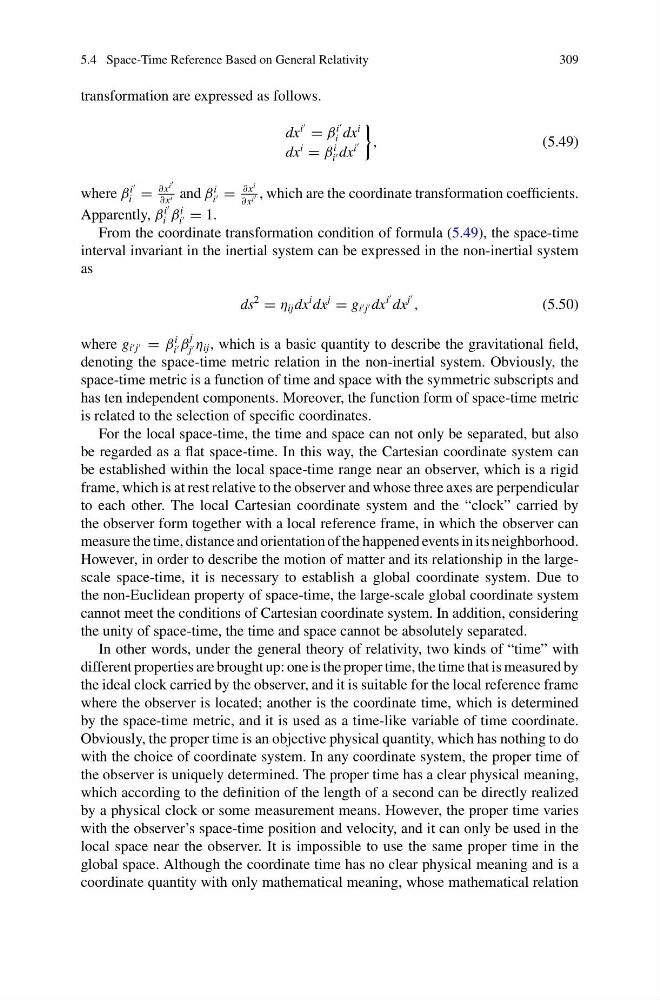
transformation are expressed as follows.
dx
i
= β
i
i dx
i
dx
i
= β
i
i dx
i
,
(5.49)
where β
i
i =
∂x
i
∂x i and β
i
i =
∂x
i
∂x i , which are the coordinate transformation coefficients.
Apparently, β
i
i β
i
i = 1.
From the coordinate transformation condition of formula (5.49), the space-time
interval invariant in the inertial system can be expressed in the non-inertial system
as
ds
2
= η ij dx
i dx
j
= g i j dx
i
dx
j
,
(5.50)
where g i j = β
i
i β
j
j η ij , which is a basic quantity to describe the gravitational field,
denoting the space-time metric relation in the non-inertial system. Obviously, the
space-time metric is a function of time and space with the symmetric subscripts and
has ten independent components. Moreover, the function form of space-time metric
is related to the selection of specific coordinates.
For the local space-time, the time and space can not only be separated, but also
be regarded as a flat space-time. In this way, the Cartesian coordinate system can
be established within the local space-time range near an observer, which is a rigid
frame, which is at rest relative to the observer and whose three axes are perpendicular
to each other. The local Cartesian coordinate system and the “clock” carried by
the observer form together with a local reference frame, in which the observer can
measure the time, distance and orientation of the happened events in its neighborhood.
However, in order to describe the motion of matter and its relationship in the largescale space-time, it is necessary to establish a global coordinate system. Due to
the non-Euclidean property of space-time, the large-scale global coordinate system
cannot meet the conditions of Cartesian coordinate system. In addition, considering
the unity of space-time, the time and space cannot be absolutely separated.
In other words, under the general theory of relativity, two kinds of “time” with
different properties are brought up: one is the proper time, the time that is measured by
the ideal clock carried by the observer, and it is suitable for the local reference frame
where the observer is located; another is the coordinate time, which is determined
by the space-time metric, and it is used as a time-like variable of time coordinate.
Obviously, the proper time is an objective physical quantity, which has nothing to do
with the choice of coordinate system. In any coordinate system, the proper time of
the observer is uniquely determined. The proper time has a clear physical meaning,
which according to the definition of the length of a second can be directly realized
by a physical clock or some measurement means. However, the proper time varies
with the observer’s space-time position and velocity, and it can only be used in the
local space near the observer. It is impossible to use the same proper time in the
global space. Although the coordinate time has no clear physical meaning and is a
coordinate quantity with only mathematical meaning, whose mathematical relation
309
transformation are expressed as follows.
dx
i
= β
i
i dx
i
dx
i
= β
i
i dx
i
,
(5.49)
where β
i
i =
∂x
i
∂x i and β
i
i =
∂x
i
∂x i , which are the coordinate transformation coefficients.
Apparently, β
i
i β
i
i = 1.
From the coordinate transformation condition of formula (5.49), the space-time
interval invariant in the inertial system can be expressed in the non-inertial system
as
ds
2
= η ij dx
i dx
j
= g i j dx
i
dx
j
,
(5.50)
where g i j = β
i
i β
j
j η ij , which is a basic quantity to describe the gravitational field,
denoting the space-time metric relation in the non-inertial system. Obviously, the
space-time metric is a function of time and space with the symmetric subscripts and
has ten independent components. Moreover, the function form of space-time metric
is related to the selection of specific coordinates.
For the local space-time, the time and space can not only be separated, but also
be regarded as a flat space-time. In this way, the Cartesian coordinate system can
be established within the local space-time range near an observer, which is a rigid
frame, which is at rest relative to the observer and whose three axes are perpendicular
to each other. The local Cartesian coordinate system and the “clock” carried by
the observer form together with a local reference frame, in which the observer can
measure the time, distance and orientation of the happened events in its neighborhood.
However, in order to describe the motion of matter and its relationship in the largescale space-time, it is necessary to establish a global coordinate system. Due to
the non-Euclidean property of space-time, the large-scale global coordinate system
cannot meet the conditions of Cartesian coordinate system. In addition, considering
the unity of space-time, the time and space cannot be absolutely separated.
In other words, under the general theory of relativity, two kinds of “time” with
different properties are brought up: one is the proper time, the time that is measured by
the ideal clock carried by the observer, and it is suitable for the local reference frame
where the observer is located; another is the coordinate time, which is determined
by the space-time metric, and it is used as a time-like variable of time coordinate.
Obviously, the proper time is an objective physical quantity, which has nothing to do
with the choice of coordinate system. In any coordinate system, the proper time of
the observer is uniquely determined. The proper time has a clear physical meaning,
which according to the definition of the length of a second can be directly realized
by a physical clock or some measurement means. However, the proper time varies
with the observer’s space-time position and velocity, and it can only be used in the
local space near the observer. It is impossible to use the same proper time in the
global space. Although the coordinate time has no clear physical meaning and is a
coordinate quantity with only mathematical meaning, whose mathematical relation