

5.4 Space-Time Reference Based on General Relativity
313
L
D
=
2π r
2r
1 −
r 2 ω 2
c 2
=
π
1 −
r 2 ω 2
c 2
> π.
(5.59)
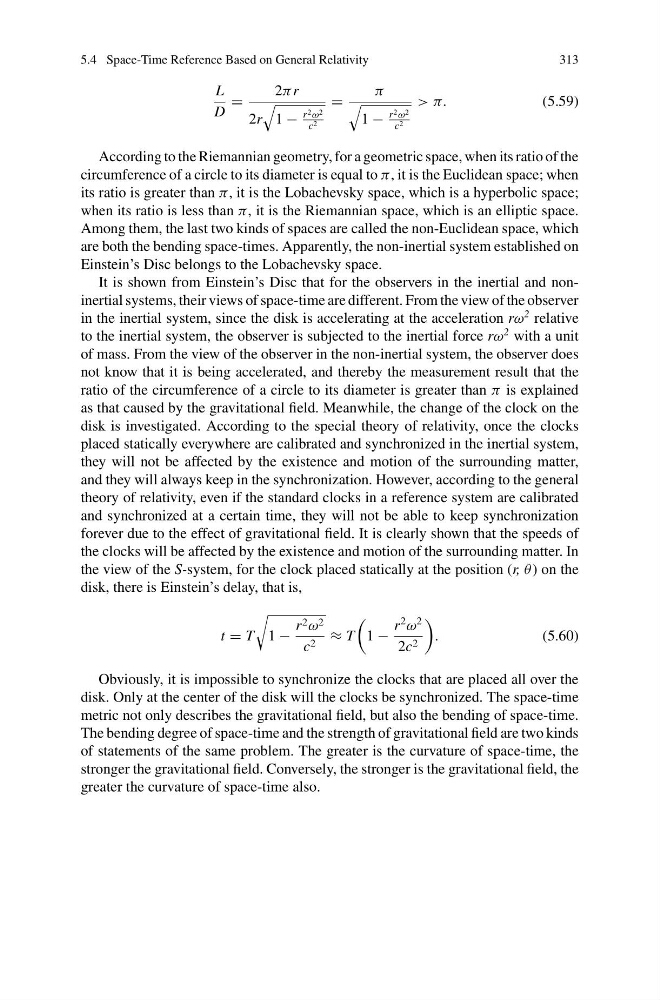
According to the Riemannian geometry, for a geometric space, when its ratio of the
circumference of a circle to its diameter is equal to π, it is the Euclidean space; when
its ratio is greater than π, it is the Lobachevsky space, which is a hyperbolic space;
when its ratio is less than π, it is the Riemannian space, which is an elliptic space.
Among them, the last two kinds of spaces are called the non-Euclidean space, which
are both the bending space-times. Apparently, the non-inertial system established on
Einstein’s Disc belongs to the Lobachevsky space.
It is shown from Einstein’s Disc that for the observers in the inertial and noninertial systems, their views of space-time are different. From the view of the observer
in the inertial system, since the disk is accelerating at the acceleration rω
2 relative
to the inertial system, the observer is subjected to the inertial force rω
2 with a unit
of mass. From the view of the observer in the non-inertial system, the observer does
not know that it is being accelerated, and thereby the measurement result that the
ratio of the circumference of a circle to its diameter is greater than π is explained
as that caused by the gravitational field. Meanwhile, the change of the clock on the
disk is investigated. According to the special theory of relativity, once the clocks
placed statically everywhere are calibrated and synchronized in the inertial system,
they will not be affected by the existence and motion of the surrounding matter,
and they will always keep in the synchronization. However, according to the general
theory of relativity, even if the standard clocks in a reference system are calibrated
and synchronized at a certain time, they will not be able to keep synchronization
forever due to the effect of gravitational field. It is clearly shown that the speeds of
the clocks will be affected by the existence and motion of the surrounding matter. In
the view of the S-system, for the clock placed statically at the position (r, θ ) on the
disk, there is Einstein’s delay, that is,
t = T
1 −
r 2 ω 2
c 2 ≈ T
1 −
r
2
ω
2
2c 2
.
(5.60)
Obviously, it is impossible to synchronize the clocks that are placed all over the
disk. Only at the center of the disk will the clocks be synchronized. The space-time
metric not only describes the gravitational field, but also the bending of space-time.
The bending degree of space-time and the strength of gravitational field are two kinds
of statements of the same problem. The greater is the curvature of space-time, the
stronger the gravitational field. Conversely, the stronger is the gravitational field, the
greater the curvature of space-time also.
313
L
D
=
2π r
2r
1 −
r 2 ω 2
c 2
=
π
1 −
r 2 ω 2
c 2
> π.
(5.59)
According to the Riemannian geometry, for a geometric space, when its ratio of the
circumference of a circle to its diameter is equal to π, it is the Euclidean space; when
its ratio is greater than π, it is the Lobachevsky space, which is a hyperbolic space;
when its ratio is less than π, it is the Riemannian space, which is an elliptic space.
Among them, the last two kinds of spaces are called the non-Euclidean space, which
are both the bending space-times. Apparently, the non-inertial system established on
Einstein’s Disc belongs to the Lobachevsky space.
It is shown from Einstein’s Disc that for the observers in the inertial and noninertial systems, their views of space-time are different. From the view of the observer
in the inertial system, since the disk is accelerating at the acceleration rω
2 relative
to the inertial system, the observer is subjected to the inertial force rω
2 with a unit
of mass. From the view of the observer in the non-inertial system, the observer does
not know that it is being accelerated, and thereby the measurement result that the
ratio of the circumference of a circle to its diameter is greater than π is explained
as that caused by the gravitational field. Meanwhile, the change of the clock on the
disk is investigated. According to the special theory of relativity, once the clocks
placed statically everywhere are calibrated and synchronized in the inertial system,
they will not be affected by the existence and motion of the surrounding matter,
and they will always keep in the synchronization. However, according to the general
theory of relativity, even if the standard clocks in a reference system are calibrated
and synchronized at a certain time, they will not be able to keep synchronization
forever due to the effect of gravitational field. It is clearly shown that the speeds of
the clocks will be affected by the existence and motion of the surrounding matter. In
the view of the S-system, for the clock placed statically at the position (r, θ ) on the
disk, there is Einstein’s delay, that is,
t = T
1 −
r 2 ω 2
c 2 ≈ T
1 −
r
2
ω
2
2c 2
.
(5.60)
Obviously, it is impossible to synchronize the clocks that are placed all over the
disk. Only at the center of the disk will the clocks be synchronized. The space-time
metric not only describes the gravitational field, but also the bending of space-time.
The bending degree of space-time and the strength of gravitational field are two kinds
of statements of the same problem. The greater is the curvature of space-time, the
stronger the gravitational field. Conversely, the stronger is the gravitational field, the
greater the curvature of space-time also.