

6.3 Resonant States of 11 Li, Probability Distributions and β-decay of Halo Analog States
83
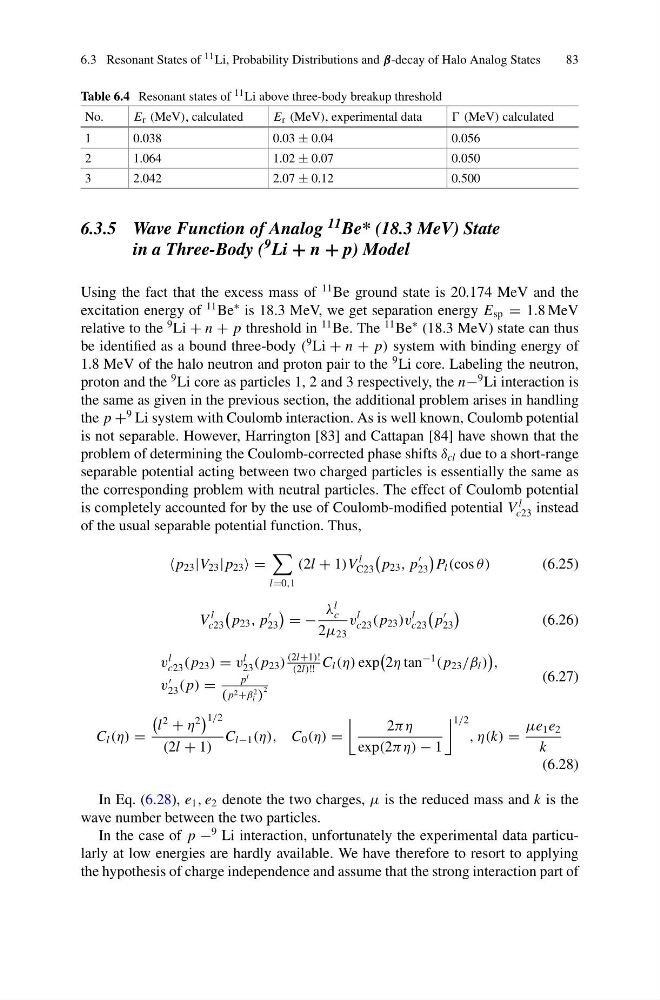
Table 6.4 Resonant states of 11 Li above three-body breakup threshold
No.
E r (MeV), calculated
E r (MeV), experimental data
(MeV) calculated
1
0.038
0.03 ± 0.04
0.056
2
1.064
1.02 ± 0.07
0.050
3
2.042
2.07 ± 0.12
0.500
6.3.5 Wave Function of Analog 11 Be* (18.3 MeV) State
in a Three-Body ( 9 Li + n + p) Model
Using the fact that the excess mass of
11 Be ground state is 20.174 MeV and the
excitation energy of
11 Be
∗ is 18.3 MeV, we get separation energy E sp = 1.8 MeV
relative to the
9 Li + n + p threshold in
11 Be. The
11 Be
∗ (18.3 MeV) state can thus
be identified as a bound three-body (
9 Li + n + p) system with binding energy of
1.8 MeV of the halo neutron and proton pair to the
9 Li core. Labeling the neutron,
proton and the
9 Li core as particles 1, 2 and 3 respectively, the n−
9 Li interaction is
the same as given in the previous section, the additional problem arises in handling
the p +
9 Li system with Coulomb interaction. As is well known, Coulomb potential
is not separable. However, Harrington [83] and Cattapan [84] have shown that the
problem of determining the Coulomb-corrected phase shifts δ cl due to a short-range
separable potential acting between two charged particles is essentially the same as
the corresponding problem with neutral particles. The effect of Coulomb potential
is completely accounted for by the use of Coulomb-modified potential V
l
c23 instead
of the usual separable potential function. Thus,
p 23 |V 23 | p 23 =
l=0,1
(2l + 1)V
l
C23
p 23 , p
23
P l (cos θ)
(6.25)
V
l
c23
p 23 , p
23
= −
λ
l
c
2μ 23
v
l
c23 ( p 23 )v
l
c23
p
23
(6.26)
v
l
c23 ( p 23 ) = v
l
23 ( p 23 )
(2l+1)!
(2l)!!
C l (η) exp
2η tan
−1
( p 23 /β l )
,
v
23 ( p) =
p
l
(p
2 +β
2
l )
2
(6.27)
C l (η) =
l
2
+ η
2
1/2
(2l + 1)
C l−1 (η), C 0 (η) =
2πη
exp(2πη) − 1
1/2
, η(k) =
μe 1 e 2
k
(6.28)
In Eq. (6.28), e 1 , e 2 denote the two charges, μ is the reduced mass and k is the
wave number between the two particles.
In the case of p −
9 Li interaction, unfortunately the experimental data particularly at low energies are hardly available. We have therefore to resort to applying
the hypothesis of charge independence and assume that the strong interaction part of
83
Table 6.4 Resonant states of 11 Li above three-body breakup threshold
No.
E r (MeV), calculated
E r (MeV), experimental data
(MeV) calculated
1
0.038
0.03 ± 0.04
0.056
2
1.064
1.02 ± 0.07
0.050
3
2.042
2.07 ± 0.12
0.500
6.3.5 Wave Function of Analog 11 Be* (18.3 MeV) State
in a Three-Body ( 9 Li + n + p) Model
Using the fact that the excess mass of
11 Be ground state is 20.174 MeV and the
excitation energy of
11 Be
∗ is 18.3 MeV, we get separation energy E sp = 1.8 MeV
relative to the
9 Li + n + p threshold in
11 Be. The
11 Be
∗ (18.3 MeV) state can thus
be identified as a bound three-body (
9 Li + n + p) system with binding energy of
1.8 MeV of the halo neutron and proton pair to the
9 Li core. Labeling the neutron,
proton and the
9 Li core as particles 1, 2 and 3 respectively, the n−
9 Li interaction is
the same as given in the previous section, the additional problem arises in handling
the p +
9 Li system with Coulomb interaction. As is well known, Coulomb potential
is not separable. However, Harrington [83] and Cattapan [84] have shown that the
problem of determining the Coulomb-corrected phase shifts δ cl due to a short-range
separable potential acting between two charged particles is essentially the same as
the corresponding problem with neutral particles. The effect of Coulomb potential
is completely accounted for by the use of Coulomb-modified potential V
l
c23 instead
of the usual separable potential function. Thus,
p 23 |V 23 | p 23 =
l=0,1
(2l + 1)V
l
C23
p 23 , p
23
P l (cos θ)
(6.25)
V
l
c23
p 23 , p
23
= −
λ
l
c
2μ 23
v
l
c23 ( p 23 )v
l
c23
p
23
(6.26)
v
l
c23 ( p 23 ) = v
l
23 ( p 23 )
(2l+1)!
(2l)!!
C l (η) exp
2η tan
−1
( p 23 /β l )
,
v
23 ( p) =
p
l
(p
2 +β
2
l )
2
(6.27)
C l (η) =
l
2
+ η
2
1/2
(2l + 1)
C l−1 (η), C 0 (η) =
2πη
exp(2πη) − 1
1/2
, η(k) =
μe 1 e 2
k
(6.28)
In Eq. (6.28), e 1 , e 2 denote the two charges, μ is the reduced mass and k is the
wave number between the two particles.
In the case of p −
9 Li interaction, unfortunately the experimental data particularly at low energies are hardly available. We have therefore to resort to applying
the hypothesis of charge independence and assume that the strong interaction part of