

82
6 Three-Body Approach to Structural Properties …
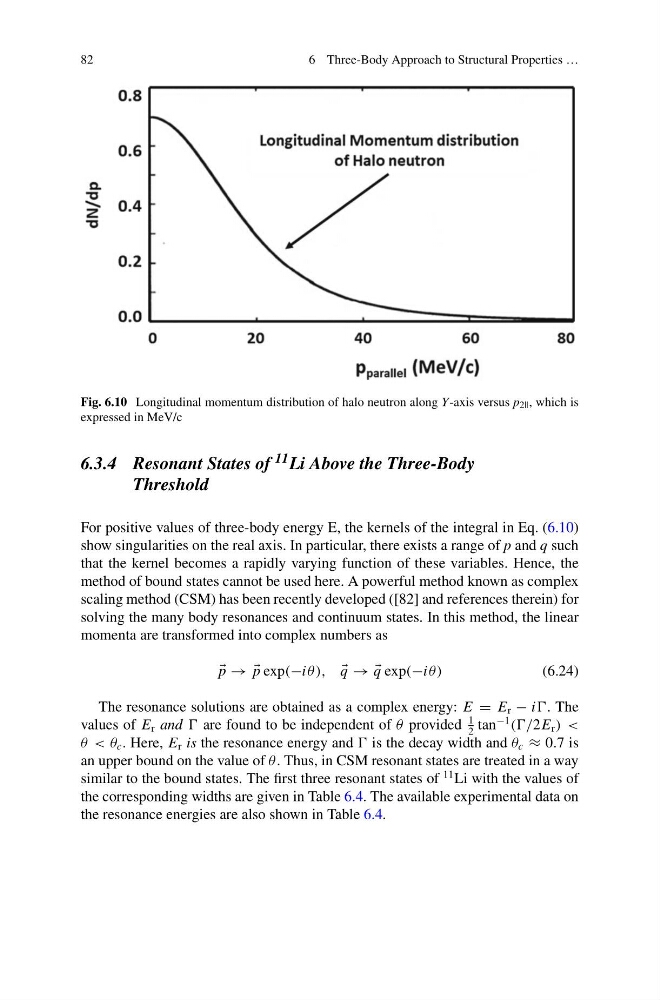
Fig. 6.10 Longitudinal momentum distribution of halo neutron along Y-axis versus p 2|| , which is
expressed in MeV/c
6.3.4 Resonant States of 11 Li Above the Three-Body
Threshold
For positive values of three-body energy E, the kernels of the integral in Eq. (6.10)
show singularities on the real axis. In particular, there exists a range of p and q such
that the kernel becomes a rapidly varying function of these variables. Hence, the
method of bound states cannot be used here. A powerful method known as complex
scaling method (CSM) has been recently developed ([82] and references therein) for
solving the many body resonances and continuum states. In this method, the linear
momenta are transformed into complex numbers as
p → →
p exp(−iθ),
q → →
q exp(−iθ)
(6.24)
The resonance solutions are obtained as a complex energy: E = E r − i. The
values of E r and are found to be independent of θ provided
1
2
tan
−1
(/2E r ) <
θ < θ c . Here, E r is the resonance energy and is the decay width and θ c ≈ 0.7 is
an upper bound on the value of θ . Thus, in CSM resonant states are treated in a way
similar to the bound states. The first three resonant states of
11 Li with the values of
the corresponding widths are given in Table 6.4. The available experimental data on
the resonance energies are also shown in Table 6.4.
6 Three-Body Approach to Structural Properties …
Fig. 6.10 Longitudinal momentum distribution of halo neutron along Y-axis versus p 2|| , which is
expressed in MeV/c
6.3.4 Resonant States of 11 Li Above the Three-Body
Threshold
For positive values of three-body energy E, the kernels of the integral in Eq. (6.10)
show singularities on the real axis. In particular, there exists a range of p and q such
that the kernel becomes a rapidly varying function of these variables. Hence, the
method of bound states cannot be used here. A powerful method known as complex
scaling method (CSM) has been recently developed ([82] and references therein) for
solving the many body resonances and continuum states. In this method, the linear
momenta are transformed into complex numbers as
p → →
p exp(−iθ),
q → →
q exp(−iθ)
(6.24)
The resonance solutions are obtained as a complex energy: E = E r − i. The
values of E r and are found to be independent of θ provided
1
2
tan
−1
(/2E r ) <
θ < θ c . Here, E r is the resonance energy and is the decay width and θ c ≈ 0.7 is
an upper bound on the value of θ . Thus, in CSM resonant states are treated in a way
similar to the bound states. The first three resonant states of
11 Li with the values of
the corresponding widths are given in Table 6.4. The available experimental data on
the resonance energies are also shown in Table 6.4.