

5.2 Salient Structural Features of Halo Nuclei
65
dineutron in
6 He [52]. Hagino et al. have also studied correlated 2-neutron emission
from unbound
26 O [53].
5.3 Known Halo Nuclei and Unbound Nuclei Beyond
the Drip Line
As mentioned earlier, the experimental efforts have been to produce radioactive
isotopes to expand our known region of the nuclear landscape and reach toward the
drip lines. As of now the neutron drip line has been extended up to Z = 9 (
31 F),
and Z = 10 (
34 Ne) [54]. Of all the nuclei near the drip lines, synthesized so far,
some are halo nuclei. Very recent measurements have confirmed the heaviest bound
isotope of boron
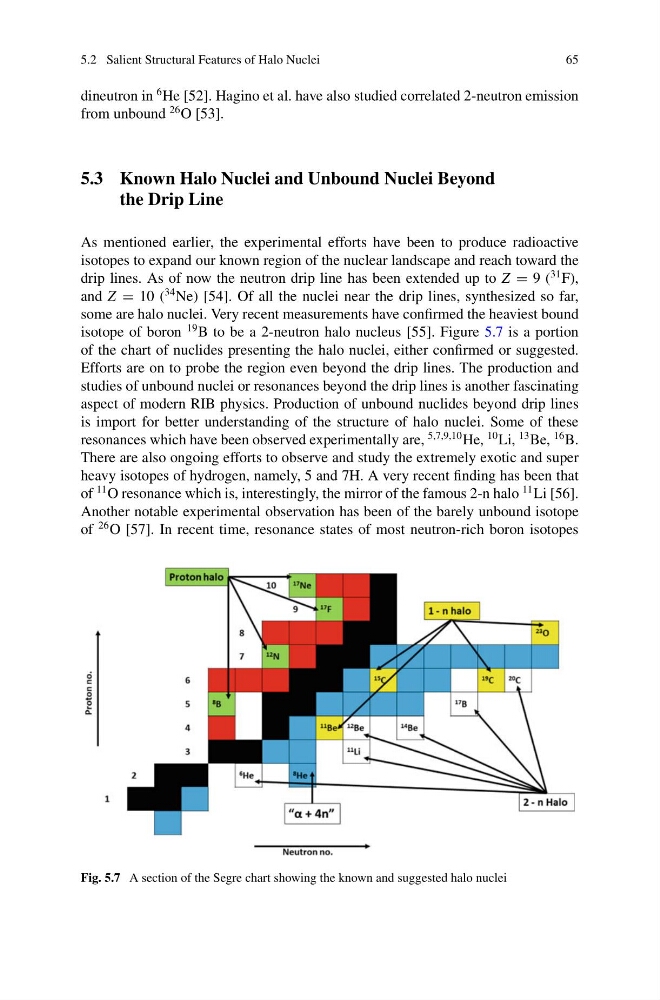
19 B to be a 2-neutron halo nucleus [55]. Figure 5.7 is a portion
of the chart of nuclides presenting the halo nuclei, either confirmed or suggested.
Efforts are on to probe the region even beyond the drip lines. The production and
studies of unbound nuclei or resonances beyond the drip lines is another fascinating
aspect of modern RIB physics. Production of unbound nuclides beyond drip lines
is import for better understanding of the structure of halo nuclei. Some of these
resonances which have been observed experimentally are,
5,7,9,10 He,
10 Li,
13 Be,
16 B.
There are also ongoing efforts to observe and study the extremely exotic and super
heavy isotopes of hydrogen, namely, 5 and 7H. A very recent finding has been that
of
11 O resonance which is, interestingly, the mirror of the famous 2-n halo
11 Li [56].
Another notable experimental observation has been of the barely unbound isotope
of
26 O [57]. In recent time, resonance states of most neutron-rich boron isotopes
Fig. 5.7 A section of the Segre chart showing the known and suggested halo nuclei
65
dineutron in
6 He [52]. Hagino et al. have also studied correlated 2-neutron emission
from unbound
26 O [53].
5.3 Known Halo Nuclei and Unbound Nuclei Beyond
the Drip Line
As mentioned earlier, the experimental efforts have been to produce radioactive
isotopes to expand our known region of the nuclear landscape and reach toward the
drip lines. As of now the neutron drip line has been extended up to Z = 9 (
31 F),
and Z = 10 (
34 Ne) [54]. Of all the nuclei near the drip lines, synthesized so far,
some are halo nuclei. Very recent measurements have confirmed the heaviest bound
isotope of boron
19 B to be a 2-neutron halo nucleus [55]. Figure 5.7 is a portion
of the chart of nuclides presenting the halo nuclei, either confirmed or suggested.
Efforts are on to probe the region even beyond the drip lines. The production and
studies of unbound nuclei or resonances beyond the drip lines is another fascinating
aspect of modern RIB physics. Production of unbound nuclides beyond drip lines
is import for better understanding of the structure of halo nuclei. Some of these
resonances which have been observed experimentally are,
5,7,9,10 He,
10 Li,
13 Be,
16 B.
There are also ongoing efforts to observe and study the extremely exotic and super
heavy isotopes of hydrogen, namely, 5 and 7H. A very recent finding has been that
of
11 O resonance which is, interestingly, the mirror of the famous 2-n halo
11 Li [56].
Another notable experimental observation has been of the barely unbound isotope
of
26 O [57]. In recent time, resonance states of most neutron-rich boron isotopes
Fig. 5.7 A section of the Segre chart showing the known and suggested halo nuclei