

64
5 Halo Nuclei: Properties and Experimental Techniques
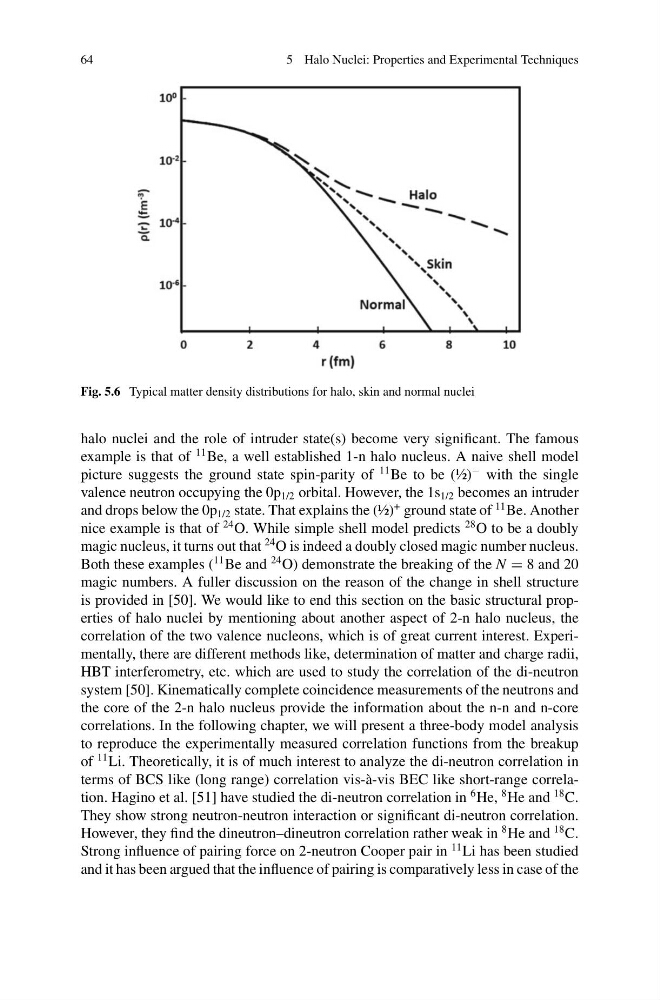
Fig. 5.6 Typical matter density distributions for halo, skin and normal nuclei
halo nuclei and the role of intruder state(s) become very significant. The famous
example is that of
11 Be, a well established 1-n halo nucleus. A naive shell model
picture suggests the ground state spin-parity of
11 Be to be (½)
− with the single
valence neutron occupying the 0p 1/2 orbital. However, the 1s 1/2 becomes an intruder
and drops below the 0p 1/2 state. That explains the (½)
+ ground state of
11 Be. Another
nice example is that of
24 O. While simple shell model predicts
28 O to be a doubly
magic nucleus, it turns out that
24 O is indeed a doubly closed magic number nucleus.
Both these examples (
11 Be and
24 O) demonstrate the breaking of the N = 8 and 20
magic numbers. A fuller discussion on the reason of the change in shell structure
is provided in [50]. We would like to end this section on the basic structural properties of halo nuclei by mentioning about another aspect of 2-n halo nucleus, the
correlation of the two valence nucleons, which is of great current interest. Experimentally, there are different methods like, determination of matter and charge radii,
HBT interferometry, etc. which are used to study the correlation of the di-neutron
system [50]. Kinematically complete coincidence measurements of the neutrons and
the core of the 2-n halo nucleus provide the information about the n-n and n-core
correlations. In the following chapter, we will present a three-body model analysis
to reproduce the experimentally measured correlation functions from the breakup
of
11 Li. Theoretically, it is of much interest to analyze the di-neutron correlation in
terms of BCS like (long range) correlation vis-à-vis BEC like short-range correlation. Hagino et al. [51] have studied the di-neutron correlation in
6 He,
8 He and
18 C.
They show strong neutron-neutron interaction or significant di-neutron correlation.
However, they find the dineutron–dineutron correlation rather weak in
8 He and
18 C.
Strong influence of pairing force on 2-neutron Cooper pair in
11 Li has been studied
and it has been argued that the influence of pairing is comparatively less in case of the
5 Halo Nuclei: Properties and Experimental Techniques
Fig. 5.6 Typical matter density distributions for halo, skin and normal nuclei
halo nuclei and the role of intruder state(s) become very significant. The famous
example is that of
11 Be, a well established 1-n halo nucleus. A naive shell model
picture suggests the ground state spin-parity of
11 Be to be (½)
− with the single
valence neutron occupying the 0p 1/2 orbital. However, the 1s 1/2 becomes an intruder
and drops below the 0p 1/2 state. That explains the (½)
+ ground state of
11 Be. Another
nice example is that of
24 O. While simple shell model predicts
28 O to be a doubly
magic nucleus, it turns out that
24 O is indeed a doubly closed magic number nucleus.
Both these examples (
11 Be and
24 O) demonstrate the breaking of the N = 8 and 20
magic numbers. A fuller discussion on the reason of the change in shell structure
is provided in [50]. We would like to end this section on the basic structural properties of halo nuclei by mentioning about another aspect of 2-n halo nucleus, the
correlation of the two valence nucleons, which is of great current interest. Experimentally, there are different methods like, determination of matter and charge radii,
HBT interferometry, etc. which are used to study the correlation of the di-neutron
system [50]. Kinematically complete coincidence measurements of the neutrons and
the core of the 2-n halo nucleus provide the information about the n-n and n-core
correlations. In the following chapter, we will present a three-body model analysis
to reproduce the experimentally measured correlation functions from the breakup
of
11 Li. Theoretically, it is of much interest to analyze the di-neutron correlation in
terms of BCS like (long range) correlation vis-à-vis BEC like short-range correlation. Hagino et al. [51] have studied the di-neutron correlation in
6 He,
8 He and
18 C.
They show strong neutron-neutron interaction or significant di-neutron correlation.
However, they find the dineutron–dineutron correlation rather weak in
8 He and
18 C.
Strong influence of pairing force on 2-neutron Cooper pair in
11 Li has been studied
and it has been argued that the influence of pairing is comparatively less in case of the