

5.2 Salient Structural Features of Halo Nuclei
63
11
Li
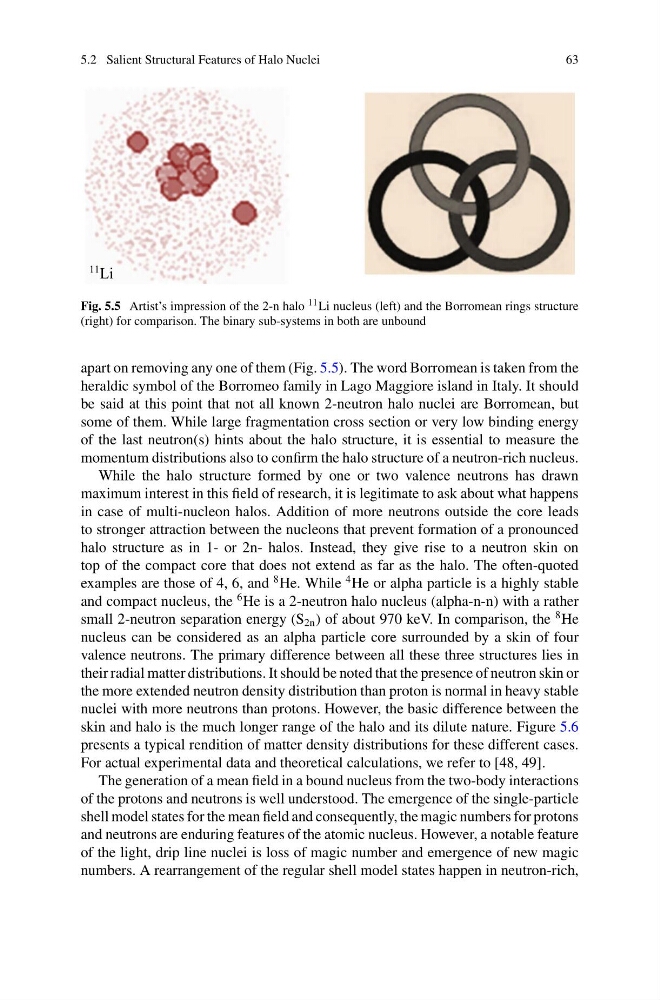
Fig. 5.5 Artist’s impression of the 2-n halo 11 Li nucleus (left) and the Borromean rings structure
(right) for comparison. The binary sub-systems in both are unbound
apart on removing any one of them (Fig. 5.5). The word Borromean is taken from the
heraldic symbol of the Borromeo family in Lago Maggiore island in Italy. It should
be said at this point that not all known 2-neutron halo nuclei are Borromean, but
some of them. While large fragmentation cross section or very low binding energy
of the last neutron(s) hints about the halo structure, it is essential to measure the
momentum distributions also to confirm the halo structure of a neutron-rich nucleus.
While the halo structure formed by one or two valence neutrons has drawn
maximum interest in this field of research, it is legitimate to ask about what happens
in case of multi-nucleon halos. Addition of more neutrons outside the core leads
to stronger attraction between the nucleons that prevent formation of a pronounced
halo structure as in 1- or 2n- halos. Instead, they give rise to a neutron skin on
top of the compact core that does not extend as far as the halo. The often-quoted
examples are those of 4, 6, and
8 He. While
4 He or alpha particle is a highly stable
and compact nucleus, the
6 He is a 2-neutron halo nucleus (alpha-n-n) with a rather
small 2-neutron separation energy (S 2n ) of about 970 keV. In comparison, the
8 He
nucleus can be considered as an alpha particle core surrounded by a skin of four
valence neutrons. The primary difference between all these three structures lies in
their radial matter distributions. It should be noted that the presence of neutron skin or
the more extended neutron density distribution than proton is normal in heavy stable
nuclei with more neutrons than protons. However, the basic difference between the
skin and halo is the much longer range of the halo and its dilute nature. Figure 5.6
presents a typical rendition of matter density distributions for these different cases.
For actual experimental data and theoretical calculations, we refer to [48, 49].
The generation of a mean field in a bound nucleus from the two-body interactions
of the protons and neutrons is well understood. The emergence of the single-particle
shell model states for the mean field and consequently, the magic numbers for protons
and neutrons are enduring features of the atomic nucleus. However, a notable feature
of the light, drip line nuclei is loss of magic number and emergence of new magic
numbers. A rearrangement of the regular shell model states happen in neutron-rich,
63
11
Li
Fig. 5.5 Artist’s impression of the 2-n halo 11 Li nucleus (left) and the Borromean rings structure
(right) for comparison. The binary sub-systems in both are unbound
apart on removing any one of them (Fig. 5.5). The word Borromean is taken from the
heraldic symbol of the Borromeo family in Lago Maggiore island in Italy. It should
be said at this point that not all known 2-neutron halo nuclei are Borromean, but
some of them. While large fragmentation cross section or very low binding energy
of the last neutron(s) hints about the halo structure, it is essential to measure the
momentum distributions also to confirm the halo structure of a neutron-rich nucleus.
While the halo structure formed by one or two valence neutrons has drawn
maximum interest in this field of research, it is legitimate to ask about what happens
in case of multi-nucleon halos. Addition of more neutrons outside the core leads
to stronger attraction between the nucleons that prevent formation of a pronounced
halo structure as in 1- or 2n- halos. Instead, they give rise to a neutron skin on
top of the compact core that does not extend as far as the halo. The often-quoted
examples are those of 4, 6, and
8 He. While
4 He or alpha particle is a highly stable
and compact nucleus, the
6 He is a 2-neutron halo nucleus (alpha-n-n) with a rather
small 2-neutron separation energy (S 2n ) of about 970 keV. In comparison, the
8 He
nucleus can be considered as an alpha particle core surrounded by a skin of four
valence neutrons. The primary difference between all these three structures lies in
their radial matter distributions. It should be noted that the presence of neutron skin or
the more extended neutron density distribution than proton is normal in heavy stable
nuclei with more neutrons than protons. However, the basic difference between the
skin and halo is the much longer range of the halo and its dilute nature. Figure 5.6
presents a typical rendition of matter density distributions for these different cases.
For actual experimental data and theoretical calculations, we refer to [48, 49].
The generation of a mean field in a bound nucleus from the two-body interactions
of the protons and neutrons is well understood. The emergence of the single-particle
shell model states for the mean field and consequently, the magic numbers for protons
and neutrons are enduring features of the atomic nucleus. However, a notable feature
of the light, drip line nuclei is loss of magic number and emergence of new magic
numbers. A rearrangement of the regular shell model states happen in neutron-rich,