

34
3 Efimov’s Universal Three-Body Effect
∂
∂r
(r χ( r,
ρ))
r →0
+χ
√
3
2
ρ, −
1
2
ρ
+ χ
−
√
3
2
ρ, −
1
2
ρ
=
−
r
a
χ( r,
ρ) + χ
√
3
2
ρ, −
1
2
ρ
+ χ
−
√
3
2
ρ, −
1
2
ρ
r →0
(3.11)
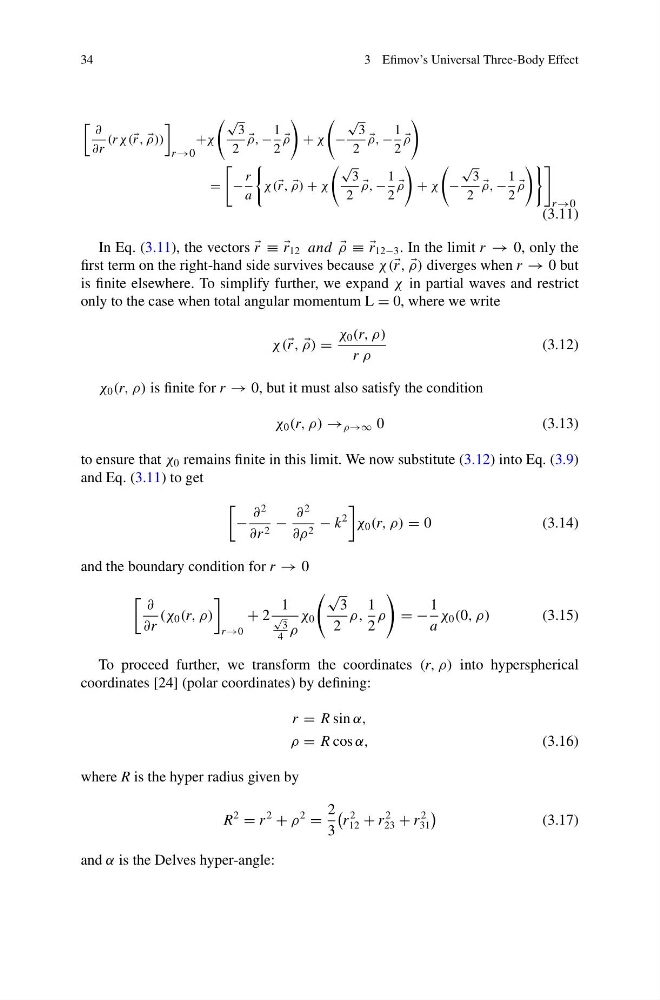
In Eq. (3.11), the vectors
r ≡ ≡
r 12 and
ρ ≡ ≡
r 12−3 . In the limit r → 0, only the
first term on the right-hand side survives because χ( r,
ρ) diverges when r → 0 but
is finite elsewhere. To simplify further, we expand χ in partial waves and restrict
only to the case when total angular momentum L = 0, where we write
χ( r ,
ρ) =
χ 0 (r, ρ)
r ρ
(3.12)
χ 0 (r, ρ) is finite for r → 0, but it must also satisfy the condition
χ 0 (r, ρ) → ρ→∞ 0
(3.13)
to ensure that χ 0 remains finite in this limit. We now substitute (3.12) into Eq. (3.9)
and Eq. (3.11) to get
−
∂
2
∂r 2 −
∂
2
∂ρ 2 − k
2
χ 0 (r, ρ) = 0
(3.14)
and the boundary condition for r → 0
∂
∂r
(χ 0 (r, ρ)
r →0
+ 2
1
√
3
4
ρ
χ 0
√
3
2
ρ,
1
2
ρ
= −
1
a
χ 0 (0, ρ)
(3.15)
To proceed further, we transform the coordinates (r, ρ) into hyperspherical
coordinates [24] (polar coordinates) by defining:
r = R sin α,
ρ = R cos α,
(3.16)
where R is the hyper radius given by
R
2
= r
2
+ ρ
2
=
2
3
r
2
12 + r
2
23 + r
2
31
(3.17)
and α is the Delves hyper-angle:
3 Efimov’s Universal Three-Body Effect
∂
∂r
(r χ( r,
ρ))
r →0
+χ
√
3
2
ρ, −
1
2
ρ
+ χ
−
√
3
2
ρ, −
1
2
ρ
=
−
r
a
χ( r,
ρ) + χ
√
3
2
ρ, −
1
2
ρ
+ χ
−
√
3
2
ρ, −
1
2
ρ
r →0
(3.11)
In Eq. (3.11), the vectors
r ≡ ≡
r 12 and
ρ ≡ ≡
r 12−3 . In the limit r → 0, only the
first term on the right-hand side survives because χ( r,
ρ) diverges when r → 0 but
is finite elsewhere. To simplify further, we expand χ in partial waves and restrict
only to the case when total angular momentum L = 0, where we write
χ( r ,
ρ) =
χ 0 (r, ρ)
r ρ
(3.12)
χ 0 (r, ρ) is finite for r → 0, but it must also satisfy the condition
χ 0 (r, ρ) → ρ→∞ 0
(3.13)
to ensure that χ 0 remains finite in this limit. We now substitute (3.12) into Eq. (3.9)
and Eq. (3.11) to get
−
∂
2
∂r 2 −
∂
2
∂ρ 2 − k
2
χ 0 (r, ρ) = 0
(3.14)
and the boundary condition for r → 0
∂
∂r
(χ 0 (r, ρ)
r →0
+ 2
1
√
3
4
ρ
χ 0
√
3
2
ρ,
1
2
ρ
= −
1
a
χ 0 (0, ρ)
(3.15)
To proceed further, we transform the coordinates (r, ρ) into hyperspherical
coordinates [24] (polar coordinates) by defining:
r = R sin α,
ρ = R cos α,
(3.16)
where R is the hyper radius given by
R
2
= r
2
+ ρ
2
=
2
3
r
2
12 + r
2
23 + r
2
31
(3.17)
and α is the Delves hyper-angle: