

3.3 Efimov Effect in Three-Boson System
35
tan α =
r
ρ
(3.18)
In terms of these coordinates, one has the equation:
−
∂
2
∂ R 2 −
1
R
∂
∂ R
−
1 ∂
2
R 2 ∂α 2 − k
2
χ 0 (R, α) = 0
(3.19)
with the boundary condition:
∂
∂α
(χ 0 (R, α))
α→0
+
8
√
3
χ 0 (R, π/3) = −
R
a
χ 0 (R, 0)
(3.20)
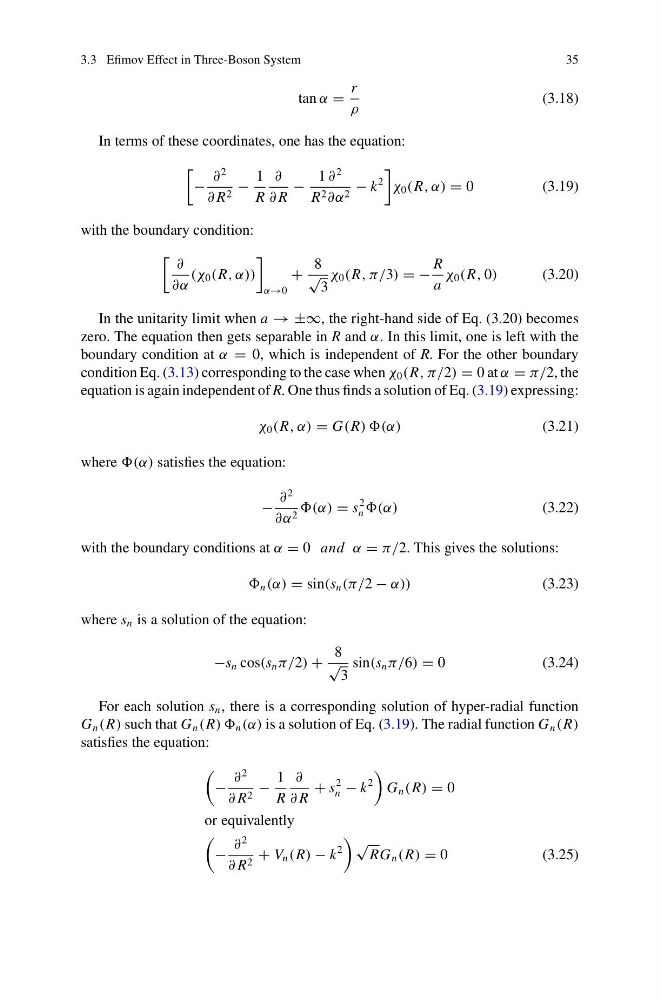
In the unitarity limit when a → ±∞, the right-hand side of Eq. (3.20) becomes
zero. The equation then gets separable in R and α. In this limit, one is left with the
boundary condition at α = 0, which is independent of R. For the other boundary
condition Eq. (3.13) corresponding to the case when χ 0 (R, π/2) = 0 at α = π/2, the
equation is again independent of R. One thus finds a solution of Eq. (3.19) expressing:
χ 0 (R, α) = G(R) )(α)
(3.21)
where satisfies the equation:
−
∂
2
∂α 2 (α) = s
2
n (α)
(3.22)
with the boundary conditions at α = 0 and α = π/2. This gives the solutions:
n (α) = sin(s n (π/2 − α))
(3.23)
where s n is a solution of the equation:
−s n cos(s n π/2) +
8
√
3
sin(s n π/6) = 0
(3.24)
For each solution s n , there is a corresponding solution of hyper-radial function
G n (R) such that G n (R) ) n (α) is a solution of Eq. (3.19). The radial function G n (R)
satisfies the equation:
−
∂
2
∂ R 2 −
1
R
∂
∂ R
+ s
2
n − k
2
G n (R) = 0
or equivalently
−
∂
2
∂ R 2 + V n (R) − k
2
√
RG n (R) = 0
(3.25)
35
tan α =
r
ρ
(3.18)
In terms of these coordinates, one has the equation:
−
∂
2
∂ R 2 −
1
R
∂
∂ R
−
1 ∂
2
R 2 ∂α 2 − k
2
χ 0 (R, α) = 0
(3.19)
with the boundary condition:
∂
∂α
(χ 0 (R, α))
α→0
+
8
√
3
χ 0 (R, π/3) = −
R
a
χ 0 (R, 0)
(3.20)
In the unitarity limit when a → ±∞, the right-hand side of Eq. (3.20) becomes
zero. The equation then gets separable in R and α. In this limit, one is left with the
boundary condition at α = 0, which is independent of R. For the other boundary
condition Eq. (3.13) corresponding to the case when χ 0 (R, π/2) = 0 at α = π/2, the
equation is again independent of R. One thus finds a solution of Eq. (3.19) expressing:
χ 0 (R, α) = G(R) )(α)
(3.21)
where satisfies the equation:
−
∂
2
∂α 2 (α) = s
2
n (α)
(3.22)
with the boundary conditions at α = 0 and α = π/2. This gives the solutions:
n (α) = sin(s n (π/2 − α))
(3.23)
where s n is a solution of the equation:
−s n cos(s n π/2) +
8
√
3
sin(s n π/6) = 0
(3.24)
For each solution s n , there is a corresponding solution of hyper-radial function
G n (R) such that G n (R) ) n (α) is a solution of Eq. (3.19). The radial function G n (R)
satisfies the equation:
−
∂
2
∂ R 2 −
1
R
∂
∂ R
+ s
2
n − k
2
G n (R) = 0
or equivalently
−
∂
2
∂ R 2 + V n (R) − k
2
√
RG n (R) = 0
(3.25)