

3.3 Efimov Effect in Three-Boson System
33
r i j = =
r j − −
r i
and
ρ i j, k =
2
√
3
( r k −
r i + +
r j
2
), where (i, j, k = 1, 2, 3)
(3.5)
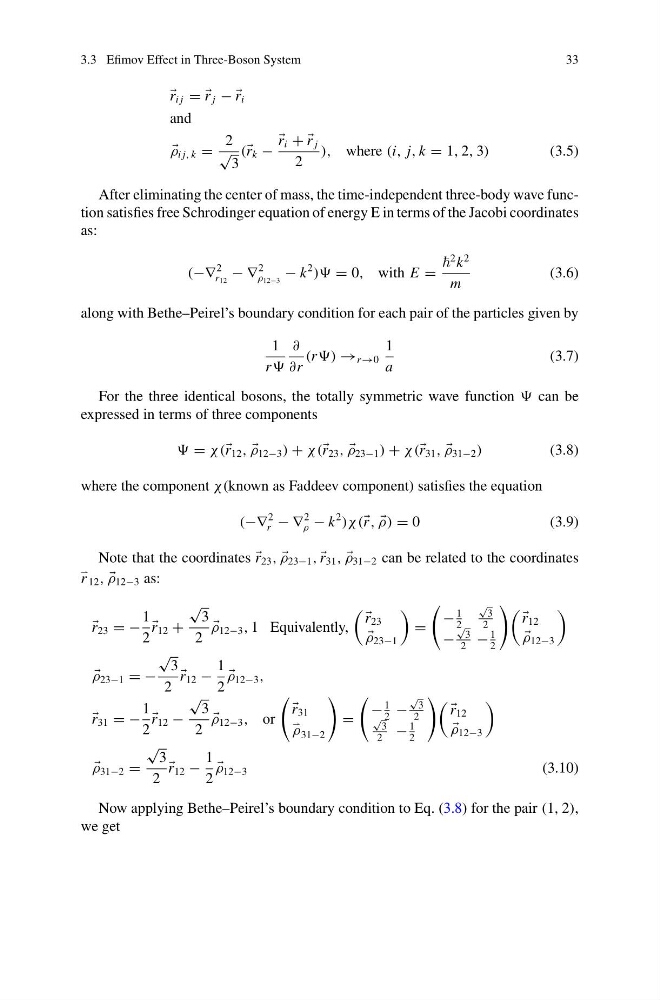
After eliminating the center of mass, the time-independent three-body wave function satisfies free Schrodinger equation of energy E in terms of the Jacobi coordinates
as:
(−∇
2
r 12
− ∇
2
ρ 12−3
− k
2
)) = 0, with E =
2 k
2
m
(3.6)
along with Bethe–Peirel’s boundary condition for each pair of the particles given by
1
r
∂
∂r
(r ) → r →0
1
a
(3.7)
For the three identical bosons, the totally symmetric wave function can be
expressed in terms of three components
= χ( r 12 ,
ρ 12−3 ) + χ( r 23 ,
ρ 23−1 ) + χ( r 31 ,
ρ 31−2 )
(3.8)
where the component χ (known as Faddeev component) satisfies the equation
(−∇
2
r − ∇
2
ρ − k
2
)χ ( r,
ρ) = 0
(3.9)
Note that the coordinates
r 23 ,
ρ 23−1 ,
r 31 ,
ρ 31−2 can be related to the coordinates
r 12 ,
ρ 12−3 as:
r 23 = −
1
2
r 12 +
√
3
2
ρ 12−3 , 1 Equivalently,
r 23
ρ 23−1
=
−
1
2
√
3
2
−
√
3
2
−
1
2
r 12
ρ 12−3
ρ 23−1 = −
√
3
2
r 12 −
1
2
ρ 12−3 ,
r 31 = −
1
2
r 12 −
√
3
2
ρ 12−3 , or
r 31
ρ 31−2
=
−
1
2
−
√
3
2
√
3
2
−
1
2
r 12
ρ 12−3
ρ 31−2 =
√
3
2
r 12 −
1
2
ρ 12−3
(3.10)
Now applying Bethe–Peirel’s boundary condition to Eq. (3.8) for the pair (1, 2),
we get
33
r i j = =
r j − −
r i
and
ρ i j, k =
2
√
3
( r k −
r i + +
r j
2
), where (i, j, k = 1, 2, 3)
(3.5)
After eliminating the center of mass, the time-independent three-body wave function satisfies free Schrodinger equation of energy E in terms of the Jacobi coordinates
as:
(−∇
2
r 12
− ∇
2
ρ 12−3
− k
2
)) = 0, with E =
2 k
2
m
(3.6)
along with Bethe–Peirel’s boundary condition for each pair of the particles given by
1
r
∂
∂r
(r ) → r →0
1
a
(3.7)
For the three identical bosons, the totally symmetric wave function can be
expressed in terms of three components
= χ( r 12 ,
ρ 12−3 ) + χ( r 23 ,
ρ 23−1 ) + χ( r 31 ,
ρ 31−2 )
(3.8)
where the component χ (known as Faddeev component) satisfies the equation
(−∇
2
r − ∇
2
ρ − k
2
)χ ( r,
ρ) = 0
(3.9)
Note that the coordinates
r 23 ,
ρ 23−1 ,
r 31 ,
ρ 31−2 can be related to the coordinates
r 12 ,
ρ 12−3 as:
r 23 = −
1
2
r 12 +
√
3
2
ρ 12−3 , 1 Equivalently,
r 23
ρ 23−1
=
−
1
2
√
3
2
−
√
3
2
−
1
2
r 12
ρ 12−3
ρ 23−1 = −
√
3
2
r 12 −
1
2
ρ 12−3 ,
r 31 = −
1
2
r 12 −
√
3
2
ρ 12−3 , or
r 31
ρ 31−2
=
−
1
2
−
√
3
2
√
3
2
−
1
2
r 12
ρ 12−3
ρ 31−2 =
√
3
2
r 12 −
1
2
ρ 12−3
(3.10)
Now applying Bethe–Peirel’s boundary condition to Eq. (3.8) for the pair (1, 2),
we get