

26
2 Scattering Theory of Three-Particle System
E = k
2
/2μ − α
2
/m; μ =
2m
3
=
3
4
k
2
m
−
α
2
m
,
where
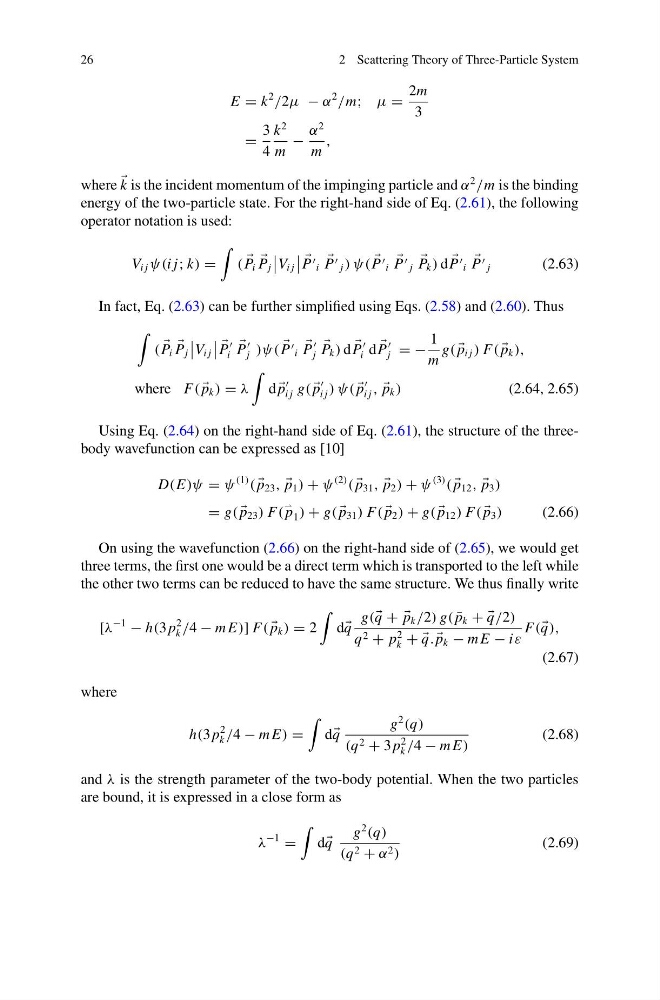
k is the incident momentum of the impinging particle and α
2
/m is the binding
energy of the two-particle state. For the right-hand side of Eq. (2.61), the following
operator notation is used:
V i j ψ(i j; k) =
(
P i
P j
V i j
P i
P j ) ψ(
P i
P j
P k ) d
P i
P j
(2.63)
In fact, Eq. (2.63) can be further simplified using Eqs. (2.58) and (2.60). Thus
(
P i
P j
V i j
P
i
P
j )ψ(
P i
P
j
P k ) d
P
i d
P
j = −
1
m
g(
p i j ) F(
p k ),
where F(
p k ) = λ
d
p
i j g(
p
i j ) ψ(
p
i j ,
p k )
(2.64, 2.65)
Using Eq. (2.64) on the right-hand side of Eq. (2.61), the structure of the threebody wavefunction can be expressed as [10]
D(E)ψ = ψ
(1)
(
p 23 ,
p 1 ) + ψ
(2)
(
p 31 ,
p 2 ) + ψ
(3)
(
p 12 ,
p 3 )
= g(
p 23 ) F(
p 1 ) + g(
p 31 ) F(
p 2 ) + g(
p 12 ) F(
p 3 )
(2.66)
On using the wavefunction (2.66) on the right-hand side of (2.65), we would get
three terms, the first one would be a direct term which is transported to the left while
the other two terms can be reduced to have the same structure. We thus finally write
[λ
−1
− h(3 p
2
k /4 − m E)] F(
p k ) = 2
d q
g( q + +
p k /2) g( ¯
p k + +
q/2)
q 2 + p
2
k + +
q.
p k − m E − iε
F( q),
(2.67)
where
h(3 p
2
k /4 − m E) =
d q
g
2
(q)
(q 2 + 3 p
2
k /4 − m E)
(2.68)
and λ is the strength parameter of the two-body potential. When the two particles
are bound, it is expressed in a close form as
λ
−1
=
d q
g
2
(q)
(q 2 + α 2 )
(2.69)
2 Scattering Theory of Three-Particle System
E = k
2
/2μ − α
2
/m; μ =
2m
3
=
3
4
k
2
m
−
α
2
m
,
where
k is the incident momentum of the impinging particle and α
2
/m is the binding
energy of the two-particle state. For the right-hand side of Eq. (2.61), the following
operator notation is used:
V i j ψ(i j; k) =
(
P i
P j
V i j
P i
P j ) ψ(
P i
P j
P k ) d
P i
P j
(2.63)
In fact, Eq. (2.63) can be further simplified using Eqs. (2.58) and (2.60). Thus
(
P i
P j
V i j
P
i
P
j )ψ(
P i
P
j
P k ) d
P
i d
P
j = −
1
m
g(
p i j ) F(
p k ),
where F(
p k ) = λ
d
p
i j g(
p
i j ) ψ(
p
i j ,
p k )
(2.64, 2.65)
Using Eq. (2.64) on the right-hand side of Eq. (2.61), the structure of the threebody wavefunction can be expressed as [10]
D(E)ψ = ψ
(1)
(
p 23 ,
p 1 ) + ψ
(2)
(
p 31 ,
p 2 ) + ψ
(3)
(
p 12 ,
p 3 )
= g(
p 23 ) F(
p 1 ) + g(
p 31 ) F(
p 2 ) + g(
p 12 ) F(
p 3 )
(2.66)
On using the wavefunction (2.66) on the right-hand side of (2.65), we would get
three terms, the first one would be a direct term which is transported to the left while
the other two terms can be reduced to have the same structure. We thus finally write
[λ
−1
− h(3 p
2
k /4 − m E)] F(
p k ) = 2
d q
g( q + +
p k /2) g( ¯
p k + +
q/2)
q 2 + p
2
k + +
q.
p k − m E − iε
F( q),
(2.67)
where
h(3 p
2
k /4 − m E) =
d q
g
2
(q)
(q 2 + 3 p
2
k /4 − m E)
(2.68)
and λ is the strength parameter of the two-body potential. When the two particles
are bound, it is expressed in a close form as
λ
−1
=
d q
g
2
(q)
(q 2 + α 2 )
(2.69)