

2.7 Three-Body Problem with Separable Potentials
27
2.7.1 How the Problems of Disconnectedness
and the Uniqueness of Boundary Conditions Are
Tackled Here?
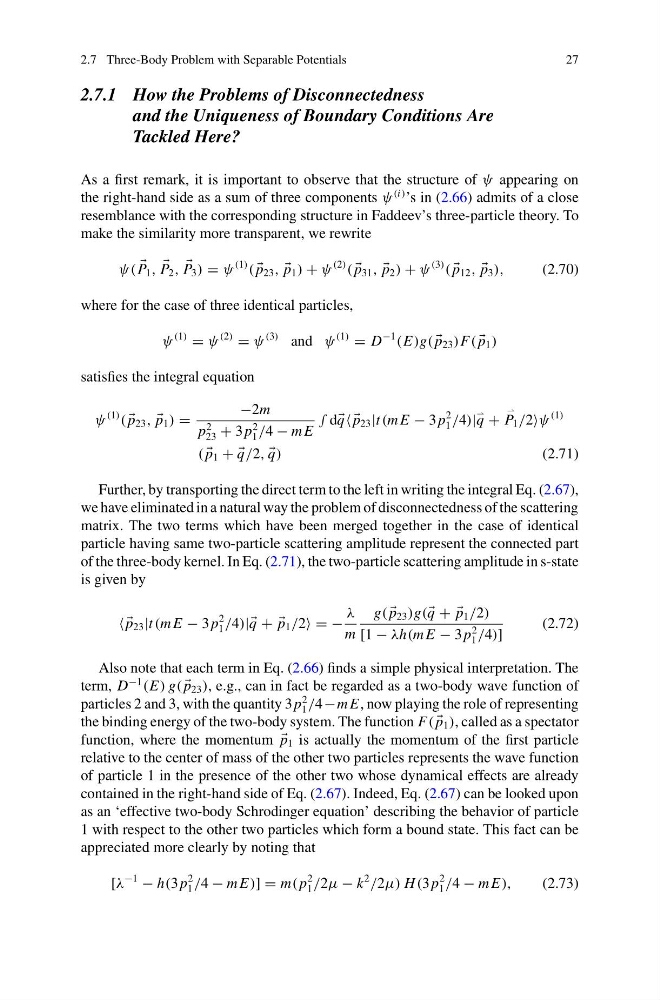
As a first remark, it is important to observe that the structure of ψ appearing on
the right-hand side as a sum of three components ψ
(i) ’s in (2.66) admits of a close
resemblance with the corresponding structure in Faddeev’s three-particle theory. To
make the similarity more transparent, we rewrite
ψ(
P 1 ,
P 2 ,
P 3 ) = ψ
(1)
(
p 23 ,
p 1 ) + ψ
(2)
(
p 31 ,
p 2 ) + ψ
(3)
(
p 12 ,
p 3 ),
(2.70)
where for the case of three identical particles,
ψ
(1)
= ψ
(2)
= ψ
(3) and ψ
(1)
= D
−1
(E)g(
p 23 )F(
p 1 )
satisfies the integral equation
ψ
(1)
(
p 23 ,
p 1 ) =
−2m
p
2
23 + 3 p
2
1 /4 − m E
∫ d q
p 23 |t (m E − 3 p
2
1 /4)|
q +
P 1 /2ψ
(1)
(
p 1 + +
q/2,
q)
(2.71)
Further, by transporting the direct term to the left in writing the integral Eq. (2.67),
we have eliminated in a natural way the problem of disconnectedness of the scattering
matrix. The two terms which have been merged together in the case of identical
particle having same two-particle scattering amplitude represent the connected part
of the three-body kernel. In Eq. (2.71), the two-particle scattering amplitude in s-state
is given by
p 23 |t (m E − 3 p
2
1 /4)| q + +
p 1 /2 = −
λ
m
g(
p 23 )g( q + +
p 1 /2)
[1 − λh(m E − 3 p
2
1 /4)]
(2.72)
Also note that each term in Eq. (2.66) finds a simple physical interpretation. The
term, D
−1
(E) g(
p 23 ), e.g., can in fact be regarded as a two-body wave function of
particles 2 and 3, with the quantity 3 p
2
1 /4−m E, now playing the role of representing
the binding energy of the two-body system. The function F(
p 1 ), called as a spectator
function, where the momentum
p 1 is actually the momentum of the first particle
relative to the center of mass of the other two particles represents the wave function
of particle 1 in the presence of the other two whose dynamical effects are already
contained in the right-hand side of Eq. (2.67). Indeed, Eq. (2.67) can be looked upon
as an ‘effective two-body Schrodinger equation’ describing the behavior of particle
1 with respect to the other two particles which form a bound state. This fact can be
appreciated more clearly by noting that
[λ
−1
− h(3 p
2
1 /4 − m E)] = m( p
2
1 /2μ − k
2
/2μ) H (3 p
2
1 /4 − m E),
(2.73)
27
2.7.1 How the Problems of Disconnectedness
and the Uniqueness of Boundary Conditions Are
Tackled Here?
As a first remark, it is important to observe that the structure of ψ appearing on
the right-hand side as a sum of three components ψ
(i) ’s in (2.66) admits of a close
resemblance with the corresponding structure in Faddeev’s three-particle theory. To
make the similarity more transparent, we rewrite
ψ(
P 1 ,
P 2 ,
P 3 ) = ψ
(1)
(
p 23 ,
p 1 ) + ψ
(2)
(
p 31 ,
p 2 ) + ψ
(3)
(
p 12 ,
p 3 ),
(2.70)
where for the case of three identical particles,
ψ
(1)
= ψ
(2)
= ψ
(3) and ψ
(1)
= D
−1
(E)g(
p 23 )F(
p 1 )
satisfies the integral equation
ψ
(1)
(
p 23 ,
p 1 ) =
−2m
p
2
23 + 3 p
2
1 /4 − m E
∫ d q
p 23 |t (m E − 3 p
2
1 /4)|
q +
P 1 /2ψ
(1)
(
p 1 + +
q/2,
q)
(2.71)
Further, by transporting the direct term to the left in writing the integral Eq. (2.67),
we have eliminated in a natural way the problem of disconnectedness of the scattering
matrix. The two terms which have been merged together in the case of identical
particle having same two-particle scattering amplitude represent the connected part
of the three-body kernel. In Eq. (2.71), the two-particle scattering amplitude in s-state
is given by
p 23 |t (m E − 3 p
2
1 /4)| q + +
p 1 /2 = −
λ
m
g(
p 23 )g( q + +
p 1 /2)
[1 − λh(m E − 3 p
2
1 /4)]
(2.72)
Also note that each term in Eq. (2.66) finds a simple physical interpretation. The
term, D
−1
(E) g(
p 23 ), e.g., can in fact be regarded as a two-body wave function of
particles 2 and 3, with the quantity 3 p
2
1 /4−m E, now playing the role of representing
the binding energy of the two-body system. The function F(
p 1 ), called as a spectator
function, where the momentum
p 1 is actually the momentum of the first particle
relative to the center of mass of the other two particles represents the wave function
of particle 1 in the presence of the other two whose dynamical effects are already
contained in the right-hand side of Eq. (2.67). Indeed, Eq. (2.67) can be looked upon
as an ‘effective two-body Schrodinger equation’ describing the behavior of particle
1 with respect to the other two particles which form a bound state. This fact can be
appreciated more clearly by noting that
[λ
−1
− h(3 p
2
1 /4 − m E)] = m( p
2
1 /2μ − k
2
/2μ) H (3 p
2
1 /4 − m E),
(2.73)