

2.6 Faddeev Equations for Scattering States
25
sym = sym q,k;q 0,k 0
[δ( q 23 −
q
0
23 ) δ(
k 1 −
k
0
1 ) + 3ψ n ( q 23 ,
k 1 ; ;
q
0
23 ,
k
0
1 )] (2.56)
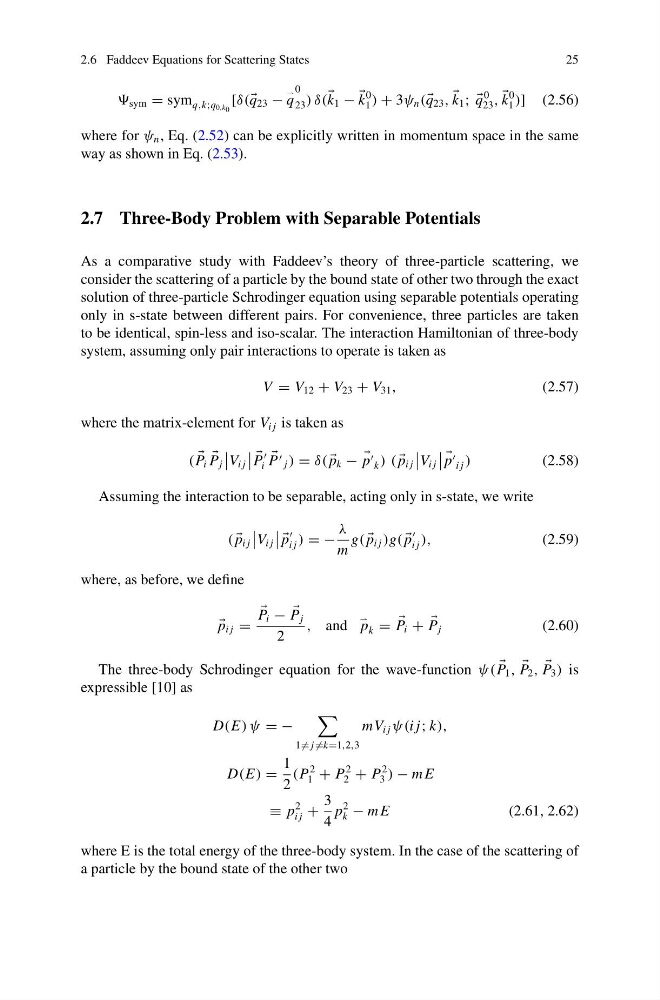
where for ψ n , Eq. (2.52) can be explicitly written in momentum space in the same
way as shown in Eq. (2.53).
2.7 Three-Body Problem with Separable Potentials
As a comparative study with Faddeev’s theory of three-particle scattering, we
consider the scattering of a particle by the bound state of other two through the exact
solution of three-particle Schrodinger equation using separable potentials operating
only in s-state between different pairs. For convenience, three particles are taken
to be identical, spin-less and iso-scalar. The interaction Hamiltonian of three-body
system, assuming only pair interactions to operate is taken as
V = V 12 + V 23 + V 31 ,
(2.57)
where the matrix-element for V i j is taken as
(
P i
P j
V i j
P
i
P j ) = δ(
p k −
p
k ) (
p i j
V i j
p
i j )
(2.58)
Assuming the interaction to be separable, acting only in s-state, we write
(
p i j
V i j
p
i j ) = −
λ
m
g(
p i j )g(
p
i j ),
(2.59)
where, as before, we define
p i j =
P i −
P j
2
, and
p k =
P i +
P j
(2.60)
The three-body Schrodinger equation for the wave-function ψ(
P 1 ,
P 2 ,
P 3 ) is
expressible [10] as
D(E) ψ = −
1 = j =k=1,2,3
mV i j ψ(i j; k),
D(E) =
1
2
(P
2
1 + P
2
2 + P
2
3 ) − m E
≡ p
2
i j +
3
4
p
2
k − m E
(2.61, 2.62)
where E is the total energy of the three-body system. In the case of the scattering of
a particle by the bound state of the other two
25
sym = sym q,k;q 0,k 0
[δ( q 23 −
q
0
23 ) δ(
k 1 −
k
0
1 ) + 3ψ n ( q 23 ,
k 1 ; ;
q
0
23 ,
k
0
1 )] (2.56)
where for ψ n , Eq. (2.52) can be explicitly written in momentum space in the same
way as shown in Eq. (2.53).
2.7 Three-Body Problem with Separable Potentials
As a comparative study with Faddeev’s theory of three-particle scattering, we
consider the scattering of a particle by the bound state of other two through the exact
solution of three-particle Schrodinger equation using separable potentials operating
only in s-state between different pairs. For convenience, three particles are taken
to be identical, spin-less and iso-scalar. The interaction Hamiltonian of three-body
system, assuming only pair interactions to operate is taken as
V = V 12 + V 23 + V 31 ,
(2.57)
where the matrix-element for V i j is taken as
(
P i
P j
V i j
P
i
P j ) = δ(
p k −
p
k ) (
p i j
V i j
p
i j )
(2.58)
Assuming the interaction to be separable, acting only in s-state, we write
(
p i j
V i j
p
i j ) = −
λ
m
g(
p i j )g(
p
i j ),
(2.59)
where, as before, we define
p i j =
P i −
P j
2
, and
p k =
P i +
P j
(2.60)
The three-body Schrodinger equation for the wave-function ψ(
P 1 ,
P 2 ,
P 3 ) is
expressible [10] as
D(E) ψ = −
1 = j =k=1,2,3
mV i j ψ(i j; k),
D(E) =
1
2
(P
2
1 + P
2
2 + P
2
3 ) − m E
≡ p
2
i j +
3
4
p
2
k − m E
(2.61, 2.62)
where E is the total energy of the three-body system. In the case of the scattering of
a particle by the bound state of the other two