

24
2 Scattering Theory of Three-Particle System
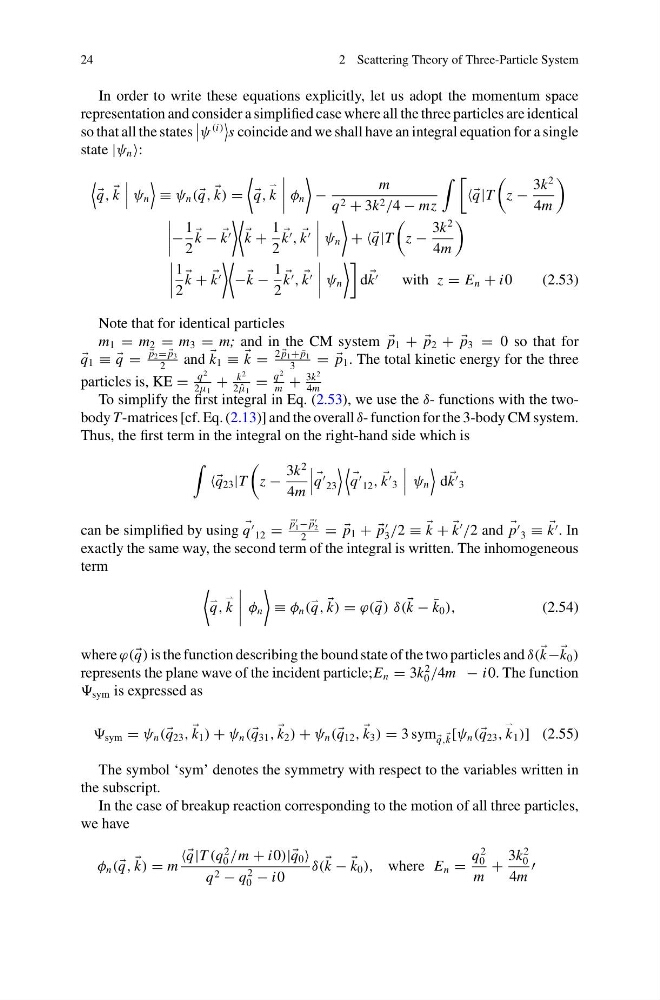
In order to write these equations explicitly, let us adopt the momentum space
representation and consider a simplified case where all the three particles are identical
so that all the states
ψ
(i)
s coincide and we shall have an integral equation for a single
state |ψ n :
q,
k
ψ n
≡ ψ n ( q,
k) =
q,
k
φ n
−
m
q 2 + 3k 2 /4 − mz
q|T
z −
3k
2
4m
−
1
2
k −
k
k +
1
2
k ,
k
ψ n
+ q|T
z −
3k
2
4m
1
2
k +
k
−
k −
1
2
k ,
k
ψ n
d
k
with z = E n + i0
(2.53)
Note that for identical particles
m 1 = m 2 = m 3 = m; and in the CM system
p 1 + +
p 2 + +
p 3 = 0 so that for
q 1 ≡ ≡
q =
p 2 = =
p 3
2
and
k 1 ≡
k =
2
p 1 + ¯
p 1
3
= =
p 1 . The total kinetic energy for the three
particles is, KE =
q
2
2μ 1
+
k
2
2 ˆ
μ 1
=
q
2
m
+
3k
2
4m
To simplify the first integral in Eq. (2.53), we use the δ- functions with the twobody T-matrices [cf. Eq. (2.13)] and the overall δ- function for the 3-body CM system.
Thus, the first term in the integral on the right-hand side which is
q 23 |T
z −
3k
2
4m
q
23
q
12 ,
k 3
ψ n
d
k 3
can be simplified by using
q
12 =
p
1 − −
p
2
2
= =
p 1 + +
p
3 /2 ≡
k +
k
/2 and
p
3 ≡
k . In
exactly the same way, the second term of the integral is written. The inhomogeneous
term
q,
k
φ n
≡ φ n (
q,
k) = ϕ( q) δ(
k − ¯
k 0 ),
(2.54)
where ϕ( q) is the function describing the bound state of the two particles and δ(
k−
k 0 )
represents the plane wave of the incident particle;E n = 3k
2
0 /4m − i0. The function
sym is expressed as
sym = ψ n ( q 23 ,
k 1 ) + ψ n ( q 31 ,
k 2 ) + ψ n ( q 12 ,
k 3 ) = 3 sym
q,
k [ψ n ( q 23 ,
k 1 )] (2.55)
The symbol ‘sym’ denotes the symmetry with respect to the variables written in
the subscript.
In the case of breakup reaction corresponding to the motion of all three particles,
we have
φ n ( q,
k) = m
q|T (q
2
0 /m + i0)| q 0
q 2 − q
2
0 − i0
δ(
k −
k 0 ), where E n =
q
2
0
m
+
3k
2
0
4m
2 Scattering Theory of Three-Particle System
In order to write these equations explicitly, let us adopt the momentum space
representation and consider a simplified case where all the three particles are identical
so that all the states
ψ
(i)
s coincide and we shall have an integral equation for a single
state |ψ n :
q,
k
ψ n
≡ ψ n ( q,
k) =
q,
k
φ n
−
m
q 2 + 3k 2 /4 − mz
q|T
z −
3k
2
4m
−
1
2
k −
k
k +
1
2
k ,
k
ψ n
+ q|T
z −
3k
2
4m
1
2
k +
k
−
k −
1
2
k ,
k
ψ n
d
k
with z = E n + i0
(2.53)
Note that for identical particles
m 1 = m 2 = m 3 = m; and in the CM system
p 1 + +
p 2 + +
p 3 = 0 so that for
q 1 ≡ ≡
q =
p 2 = =
p 3
2
and
k 1 ≡
k =
2
p 1 + ¯
p 1
3
= =
p 1 . The total kinetic energy for the three
particles is, KE =
q
2
2μ 1
+
k
2
2 ˆ
μ 1
=
q
2
m
+
3k
2
4m
To simplify the first integral in Eq. (2.53), we use the δ- functions with the twobody T-matrices [cf. Eq. (2.13)] and the overall δ- function for the 3-body CM system.
Thus, the first term in the integral on the right-hand side which is
q 23 |T
z −
3k
2
4m
q
23
q
12 ,
k 3
ψ n
d
k 3
can be simplified by using
q
12 =
p
1 − −
p
2
2
= =
p 1 + +
p
3 /2 ≡
k +
k
/2 and
p
3 ≡
k . In
exactly the same way, the second term of the integral is written. The inhomogeneous
term
q,
k
φ n
≡ φ n (
q,
k) = ϕ( q) δ(
k − ¯
k 0 ),
(2.54)
where ϕ( q) is the function describing the bound state of the two particles and δ(
k−
k 0 )
represents the plane wave of the incident particle;E n = 3k
2
0 /4m − i0. The function
sym is expressed as
sym = ψ n ( q 23 ,
k 1 ) + ψ n ( q 31 ,
k 2 ) + ψ n ( q 12 ,
k 3 ) = 3 sym
q,
k [ψ n ( q 23 ,
k 1 )] (2.55)
The symbol ‘sym’ denotes the symmetry with respect to the variables written in
the subscript.
In the case of breakup reaction corresponding to the motion of all three particles,
we have
φ n ( q,
k) = m
q|T (q
2
0 /m + i0)| q 0
q 2 − q
2
0 − i0
δ(
k −
k 0 ), where E n =
q
2
0
m
+
3k
2
0
4m