

1.5 The S-Matrix, T-Matrix and Differential Cross Section
9
S ba = lim
t→∞
φ b (t)
ψ
(+)
a (t)
,
(1.32)
= lim
t→∞
exp(−i H 0 t)φ b
exp(−i Ht)ψ
(+)
a
(1.33)
= lim
t→∞
exp(i Ht) exp(−i H 0 t)φ b
ψ
(+)
a
(1.34)
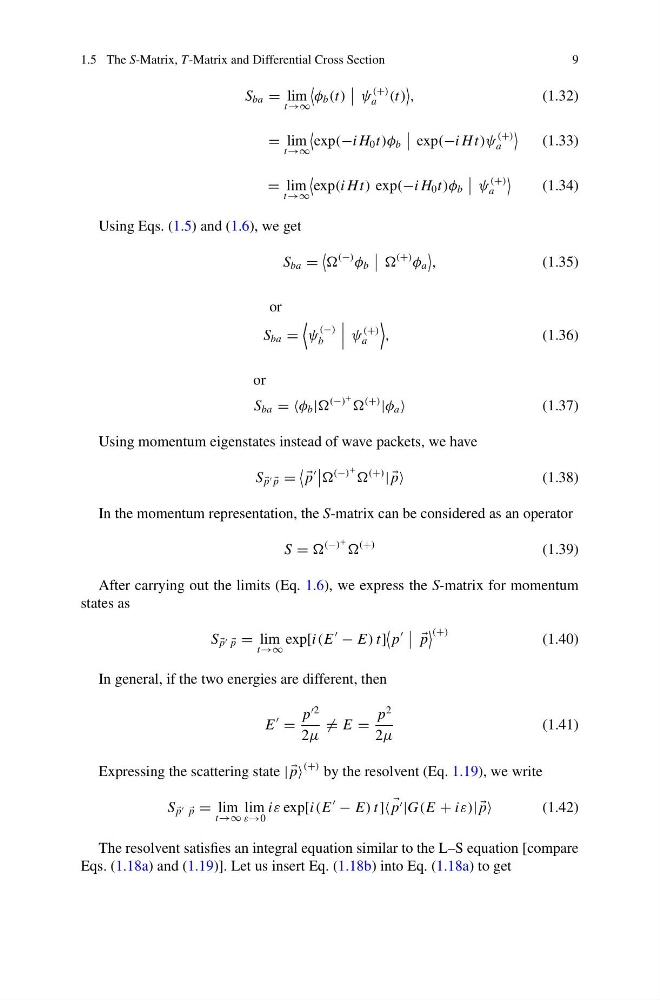
Using Eqs. (1.5) and (1.6), we get
S ba =
(−)
φ b
(+)
φ a
,
(1.35)
or
S ba =
ψ
(−)
b
ψ
(+)
a
,
(1.36)
or
S ba = φ b |
(−)
+
(+)
|φ a
(1.37)
Using momentum eigenstates instead of wave packets, we have
S
p
p =
p
(−)
+
(+)
|
p
(1.38)
In the momentum representation, the S-matrix can be considered as an operator
S =
(−)
+
(+)
(1.39)
After carrying out the limits (Eq. 1.6), we express the S-matrix for momentum
states as
S
p
p = lim
t→∞
exp[i(E
− E) t]
p
p
(+)
(1.40)
In general, if the two energies are different, then
E
=
p
2
2μ
= E =
p
2
2μ
(1.41)
Expressing the scattering state |
p
(+) by the resolvent (Eq. 1.19), we write
S
p
p = lim
t→∞
lim
ε→0
iε exp[i(E
− E) t]]
p |G(E + iε)|
p
(1.42)
The resolvent satisfies an integral equation similar to the L–S equation [compare
Eqs. (1.18a) and (1.19)]. Let us insert Eq. (1.18b) into Eq. (1.18a) to get
9
S ba = lim
t→∞
φ b (t)
ψ
(+)
a (t)
,
(1.32)
= lim
t→∞
exp(−i H 0 t)φ b
exp(−i Ht)ψ
(+)
a
(1.33)
= lim
t→∞
exp(i Ht) exp(−i H 0 t)φ b
ψ
(+)
a
(1.34)
Using Eqs. (1.5) and (1.6), we get
S ba =
(−)
φ b
(+)
φ a
,
(1.35)
or
S ba =
ψ
(−)
b
ψ
(+)
a
,
(1.36)
or
S ba = φ b |
(−)
+
(+)
|φ a
(1.37)
Using momentum eigenstates instead of wave packets, we have
S
p
p =
p
(−)
+
(+)
|
p
(1.38)
In the momentum representation, the S-matrix can be considered as an operator
S =
(−)
+
(+)
(1.39)
After carrying out the limits (Eq. 1.6), we express the S-matrix for momentum
states as
S
p
p = lim
t→∞
exp[i(E
− E) t]
p
p
(+)
(1.40)
In general, if the two energies are different, then
E
=
p
2
2μ
= E =
p
2
2μ
(1.41)
Expressing the scattering state |
p
(+) by the resolvent (Eq. 1.19), we write
S
p
p = lim
t→∞
lim
ε→0
iε exp[i(E
− E) t]]
p |G(E + iε)|
p
(1.42)
The resolvent satisfies an integral equation similar to the L–S equation [compare
Eqs. (1.18a) and (1.19)]. Let us insert Eq. (1.18b) into Eq. (1.18a) to get