

10
1 Essentials of Non-relativistic Two-Body Scattering Theory
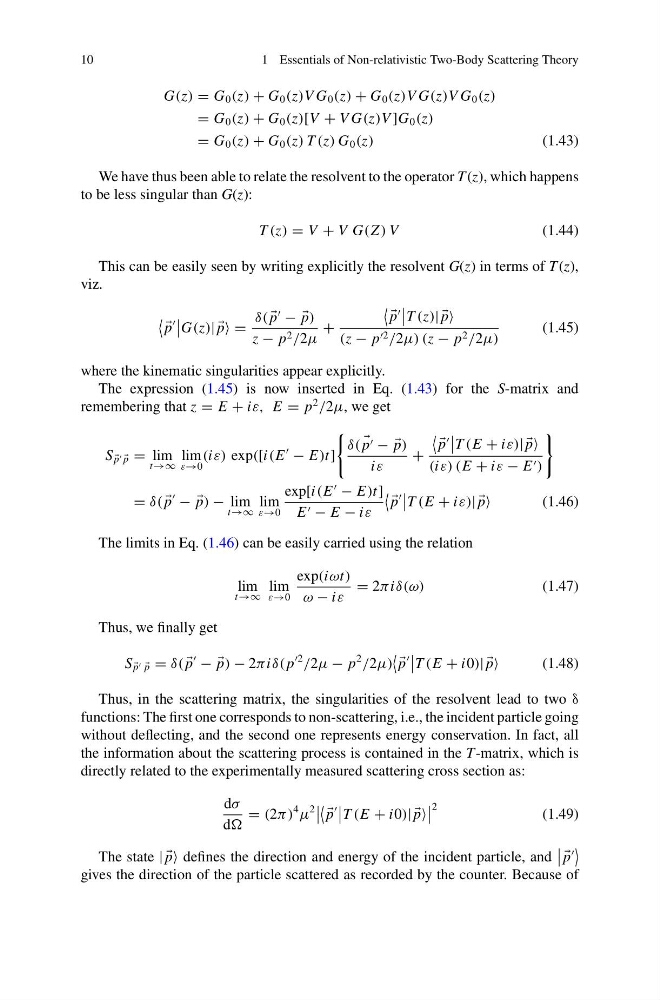
G(z) = G 0 (z) + G 0 (z)V G 0 (z) + G 0 (z)V G(z)V G 0 (z)
= G 0 (z) + G 0 (z)[V + V G(z)V ]G 0 (z)
= G 0 (z) + G 0 (z) T (z) G 0 (z)
(1.43)
We have thus been able to relate the resolvent to the operator T (z), which happens
to be less singular than G(z):
T (z) = V + V G(Z ) V
(1.44)
This can be easily seen by writing explicitly the resolvent G(z) in terms of T (z),
viz.
p
G(z)|
p =
δ(
p
− −
p)
z − p 2 /2μ
+
p
T (z)|
p
(z − p 2 /2μ) (z − p 2 /2μ)
(1.45)
where the kinematic singularities appear explicitly.
The expression (1.45) is now inserted in Eq. (1.43) for the S-matrix and
remembering that z = E + iε, E = p
2
/2μ, we get
S
p
p = lim
t→∞
lim
ε→0
(iε) exp([i(E
− E)t]
δ(
p − −
p)
iε
+
p
T (E + iε)|
p
(iε) (E + iε − E )
= δ(
p
− −
p) − lim
t→∞
lim
ε→0
exp[i(E
− E)t]
E − E − iε
p
T (E + iε)|
p
(1.46)
The limits in Eq. (1.46) can be easily carried using the relation
lim
t→∞
lim
ε→0
exp(iωt)
ω − iε
= 2πiδ(ω)
(1.47)
Thus, we finally get
S
p
p = δ(
p
− −
p) − 2πiδ( p
2
/2μ − p
2
/2μ)
p
T (E + i0)|
p
(1.48)
Thus, in the scattering matrix, the singularities of the resolvent lead to two δ
functions: The first one corresponds to non-scattering, i.e., the incident particle going
without deflecting, and the second one represents energy conservation. In fact, all
the information about the scattering process is contained in the T-matrix, which is
directly related to the experimentally measured scattering cross section as:
dσ
d
= (2π)
4
μ
2
p
T (E + i0)|
p
2
(1.49)
The state |
p defines the direction and energy of the incident particle, and
p
gives the direction of the particle scattered as recorded by the counter. Because of
1 Essentials of Non-relativistic Two-Body Scattering Theory
G(z) = G 0 (z) + G 0 (z)V G 0 (z) + G 0 (z)V G(z)V G 0 (z)
= G 0 (z) + G 0 (z)[V + V G(z)V ]G 0 (z)
= G 0 (z) + G 0 (z) T (z) G 0 (z)
(1.43)
We have thus been able to relate the resolvent to the operator T (z), which happens
to be less singular than G(z):
T (z) = V + V G(Z ) V
(1.44)
This can be easily seen by writing explicitly the resolvent G(z) in terms of T (z),
viz.
p
G(z)|
p =
δ(
p
− −
p)
z − p 2 /2μ
+
p
T (z)|
p
(z − p 2 /2μ) (z − p 2 /2μ)
(1.45)
where the kinematic singularities appear explicitly.
The expression (1.45) is now inserted in Eq. (1.43) for the S-matrix and
remembering that z = E + iε, E = p
2
/2μ, we get
S
p
p = lim
t→∞
lim
ε→0
(iε) exp([i(E
− E)t]
δ(
p − −
p)
iε
+
p
T (E + iε)|
p
(iε) (E + iε − E )
= δ(
p
− −
p) − lim
t→∞
lim
ε→0
exp[i(E
− E)t]
E − E − iε
p
T (E + iε)|
p
(1.46)
The limits in Eq. (1.46) can be easily carried using the relation
lim
t→∞
lim
ε→0
exp(iωt)
ω − iε
= 2πiδ(ω)
(1.47)
Thus, we finally get
S
p
p = δ(
p
− −
p) − 2πiδ( p
2
/2μ − p
2
/2μ)
p
T (E + i0)|
p
(1.48)
Thus, in the scattering matrix, the singularities of the resolvent lead to two δ
functions: The first one corresponds to non-scattering, i.e., the incident particle going
without deflecting, and the second one represents energy conservation. In fact, all
the information about the scattering process is contained in the T-matrix, which is
directly related to the experimentally measured scattering cross section as:
dσ
d
= (2π)
4
μ
2
p
T (E + i0)|
p
2
(1.49)
The state |
p defines the direction and energy of the incident particle, and
p
gives the direction of the particle scattered as recorded by the counter. Because of