

8
1 Essentials of Non-relativistic Two-Body Scattering Theory
ψ
(+)
p
( r ) = φ
p ( r ) −
d − → r
μ
2π
exp[i
√
2μE
r − − → r
]
r − − → r
V ( − → r
) ψ
(+)
p ( − → r
) (1.28)
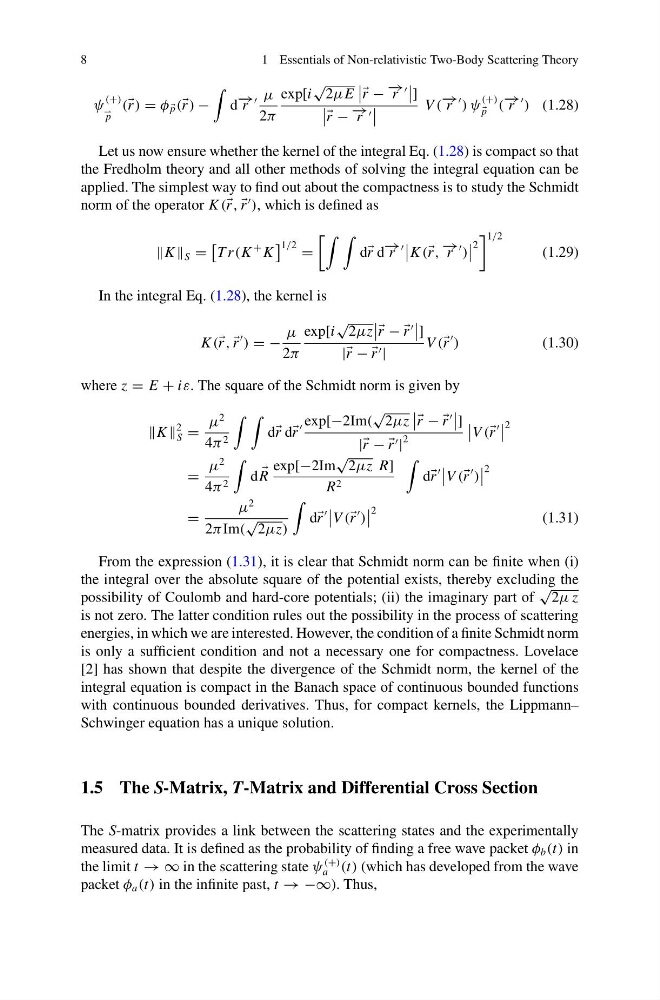
Let us now ensure whether the kernel of the integral Eq. (1.28) is compact so that
the Fredholm theory and all other methods of solving the integral equation can be
applied. The simplest way to find out about the compactness is to study the Schmidt
norm of the operator K ( r,
r
), which is defined as
K S =
T r(K
+ K
1/2 =
d r d − → r
K ( r, − → r
)
2
1/2
(1.29)
In the integral Eq. (1.28), the kernel is
K ( r ,
r
) = −
μ
2π
exp[i
√
2μz
r − −
r
]
| r − −
r |
V ( r
)
(1.30)
where z = E + iε. The square of the Schmidt norm is given by
K
2
S =
μ
2
4π 2
d r d r
exp[−2Im(
√
2μz
r − −
r
]
| r − −
r |
2
V ( r
2
=
μ
2
4π 2
d
R
exp[−2Im
√
2μz R]
R 2
d r
V ( r
)
2
=
μ
2
2π Im(
√
2μz)
d r
V ( r
)
2
(1.31)
From the expression (1.31), it is clear that Schmidt norm can be finite when (i)
the integral over the absolute square of the potential exists, thereby excluding the
possibility of Coulomb and hard-core potentials; (ii) the imaginary part of
√
2μ z
is not zero. The latter condition rules out the possibility in the process of scattering
energies, in which we are interested. However, the condition of a finite Schmidt norm
is only a sufficient condition and not a necessary one for compactness. Lovelace
[2] has shown that despite the divergence of the Schmidt norm, the kernel of the
integral equation is compact in the Banach space of continuous bounded functions
with continuous bounded derivatives. Thus, for compact kernels, the Lippmann–
Schwinger equation has a unique solution.
1.5 The S-Matrix, T-Matrix and Differential Cross Section
The S-matrix provides a link between the scattering states and the experimentally
measured data. It is defined as the probability of finding a free wave packet φ b (t) in
the limit t → ∞ in the scattering state ψ
(+)
a (t) (which has developed from the wave
packet φ a (t) in the infinite past, t → −∞). Thus,
1 Essentials of Non-relativistic Two-Body Scattering Theory
ψ
(+)
p
( r ) = φ
p ( r ) −
d − → r
μ
2π
exp[i
√
2μE
r − − → r
]
r − − → r
V ( − → r
) ψ
(+)
p ( − → r
) (1.28)
Let us now ensure whether the kernel of the integral Eq. (1.28) is compact so that
the Fredholm theory and all other methods of solving the integral equation can be
applied. The simplest way to find out about the compactness is to study the Schmidt
norm of the operator K ( r,
r
), which is defined as
K S =
T r(K
+ K
1/2 =
d r d − → r
K ( r, − → r
)
2
1/2
(1.29)
In the integral Eq. (1.28), the kernel is
K ( r ,
r
) = −
μ
2π
exp[i
√
2μz
r − −
r
]
| r − −
r |
V ( r
)
(1.30)
where z = E + iε. The square of the Schmidt norm is given by
K
2
S =
μ
2
4π 2
d r d r
exp[−2Im(
√
2μz
r − −
r
]
| r − −
r |
2
V ( r
2
=
μ
2
4π 2
d
R
exp[−2Im
√
2μz R]
R 2
d r
V ( r
)
2
=
μ
2
2π Im(
√
2μz)
d r
V ( r
)
2
(1.31)
From the expression (1.31), it is clear that Schmidt norm can be finite when (i)
the integral over the absolute square of the potential exists, thereby excluding the
possibility of Coulomb and hard-core potentials; (ii) the imaginary part of
√
2μ z
is not zero. The latter condition rules out the possibility in the process of scattering
energies, in which we are interested. However, the condition of a finite Schmidt norm
is only a sufficient condition and not a necessary one for compactness. Lovelace
[2] has shown that despite the divergence of the Schmidt norm, the kernel of the
integral equation is compact in the Banach space of continuous bounded functions
with continuous bounded derivatives. Thus, for compact kernels, the Lippmann–
Schwinger equation has a unique solution.
1.5 The S-Matrix, T-Matrix and Differential Cross Section
The S-matrix provides a link between the scattering states and the experimentally
measured data. It is defined as the probability of finding a free wave packet φ b (t) in
the limit t → ∞ in the scattering state ψ
(+)
a (t) (which has developed from the wave
packet φ a (t) in the infinite past, t → −∞). Thus,