

118
6 Three-Body Approach to Structural Properties …
Table 6.12 Comparing the values of k with Im
f
−1
k
at a few typical values of φ of the Off-shell
scattering amplitude T ( p, k; ε c ) (Eq. (6.74))
k in units of α
(radians)
Re( f
−1
k )
Im( f
−1
k )
p in units of α
0.04928
0.7972
−0.07958
−0.04827
0.4927
0.5698
0.6297
0.09404
−0.5698
0.5698
0.06487
0.4149
−0.0944
−0.0648
0.0645
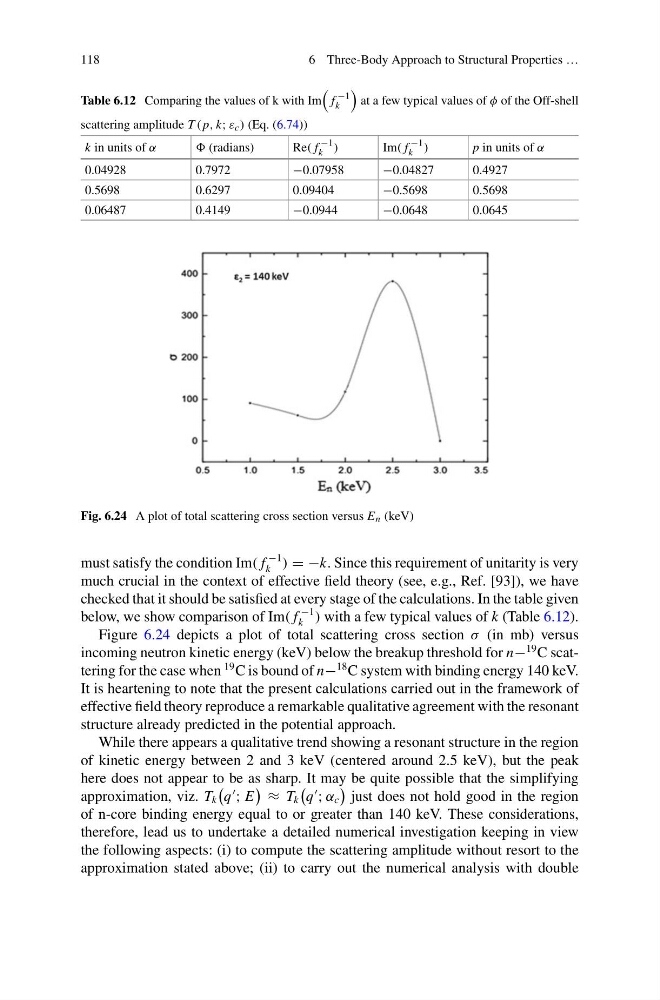
Fig. 6.24 A plot of total scattering cross section versus E n (keV)
must satisfy the condition Im( f
−1
k ) = −k. Since this requirement of unitarity is very
much crucial in the context of effective field theory (see, e.g., Ref. [93]), we have
checked that it should be satisfied at every stage of the calculations. In the table given
below, we show comparison of Im( f
−1
k ) with a few typical values of k (Table 6.12).
Figure 6.24 depicts a plot of total scattering cross section σ (in mb) versus
incoming neutron kinetic energy (keV) below the breakup threshold for n−
19 C scattering for the case when
19 C is bound of n−
18 C system with binding energy 140 keV.
It is heartening to note that the present calculations carried out in the framework of
effective field theory reproduce a remarkable qualitative agreement with the resonant
structure already predicted in the potential approach.
While there appears a qualitative trend showing a resonant structure in the region
of kinetic energy between 2 and 3 keV (centered around 2.5 keV), but the peak
here does not appear to be as sharp. It may be quite possible that the simplifying
approximation, viz. T k
q
; E
≈ T k
q
; α c
just does not hold good in the region
of n-core binding energy equal to or greater than 140 keV. These considerations,
therefore, lead us to undertake a detailed numerical investigation keeping in view
the following aspects: (i) to compute the scattering amplitude without resort to the
approximation stated above; (ii) to carry out the numerical analysis with double
6 Three-Body Approach to Structural Properties …
Table 6.12 Comparing the values of k with Im
f
−1
k
at a few typical values of φ of the Off-shell
scattering amplitude T ( p, k; ε c ) (Eq. (6.74))
k in units of α
(radians)
Re( f
−1
k )
Im( f
−1
k )
p in units of α
0.04928
0.7972
−0.07958
−0.04827
0.4927
0.5698
0.6297
0.09404
−0.5698
0.5698
0.06487
0.4149
−0.0944
−0.0648
0.0645
Fig. 6.24 A plot of total scattering cross section versus E n (keV)
must satisfy the condition Im( f
−1
k ) = −k. Since this requirement of unitarity is very
much crucial in the context of effective field theory (see, e.g., Ref. [93]), we have
checked that it should be satisfied at every stage of the calculations. In the table given
below, we show comparison of Im( f
−1
k ) with a few typical values of k (Table 6.12).
Figure 6.24 depicts a plot of total scattering cross section σ (in mb) versus
incoming neutron kinetic energy (keV) below the breakup threshold for n−
19 C scattering for the case when
19 C is bound of n−
18 C system with binding energy 140 keV.
It is heartening to note that the present calculations carried out in the framework of
effective field theory reproduce a remarkable qualitative agreement with the resonant
structure already predicted in the potential approach.
While there appears a qualitative trend showing a resonant structure in the region
of kinetic energy between 2 and 3 keV (centered around 2.5 keV), but the peak
here does not appear to be as sharp. It may be quite possible that the simplifying
approximation, viz. T k
q
; E
≈ T k
q
; α c
just does not hold good in the region
of n-core binding energy equal to or greater than 140 keV. These considerations,
therefore, lead us to undertake a detailed numerical investigation keeping in view
the following aspects: (i) to compute the scattering amplitude without resort to the
approximation stated above; (ii) to carry out the numerical analysis with double