

6.10 Efimov Effect in Halo Nuclei Using Effective Field Theory
117
+
1
π
dq
{
q
2
q 2 −k 2 −iε
Z 1 ( p, q
; E)τ
−1
(q
; E)
−Z 1 ( p, q
; ε c )τ
−1
(q
; ε c )}T k (q
, E)
+
2
π 2
q
2 dq
Z 2 ( p, q
; E)χ
−1
(q
; E)
dq
q
2
q 2 − k 2 − iε
Z 3 (q
, q
; E)τ
−1
(q
; E)
−
dq
q
2 Z 2 ( p, q
; ε c )χ
−1
(q
; ε c )
dq
Z 3 (q
, q
; ε c )τ
−1
(q
; ε c )
T k (q
, E)
(6.78)
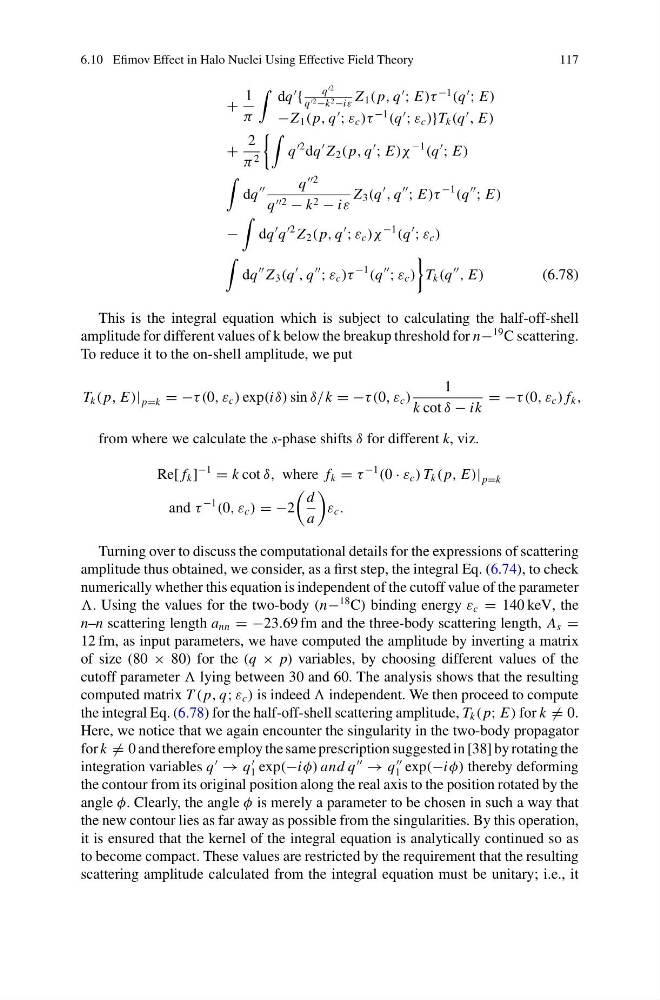
This is the integral equation which is subject to calculating the half-off-shell
amplitude for different values of k below the breakup threshold for n−
19 C scattering.
To reduce it to the on-shell amplitude, we put
T k ( p, E)| p=k = −τ (0, ε c ) exp(iδ) sin δ/k = −τ (0, ε c )
1
k cot δ − ik
= −τ (0, ε c ) f k ,
from where we calculate the s-phase shifts δ for different k, viz.
Re[ f k ]
−1
= k cot δ, where f k = τ
−1
(0 · ε c ) T k ( p, E)| p=k
and τ
−1
(0, ε c ) = −2
d
a
ε c .
Turning over to discuss the computational details for the expressions of scattering
amplitude thus obtained, we consider, as a first step, the integral Eq. (6.74), to check
numerically whether this equation is independent of the cutoff value of the parameter
. Using the values for the two-body (n−
18 C) binding energy ε c = 140 keV, the
n–n scattering length a nn = −23.69 fm and the three-body scattering length, A s =
12 fm, as input parameters, we have computed the amplitude by inverting a matrix
of size (80 × 80) for the (q × p) variables, by choosing different values of the
cutoff parameter lying between 30 and 60. The analysis shows that the resulting
computed matrix T ( p, q; ε c ) is indeed independent. We then proceed to compute
the integral Eq. (6.78) for the half-off-shell scattering amplitude, T k ( p; E) for k = 0.
Here, we notice that we again encounter the singularity in the two-body propagator
for k = 0 and therefore employ the same prescription suggested in [38] by rotating the
integration variables q
→ q
1 exp(−iφ) and q
→ q
1 exp(−iφ) thereby deforming
the contour from its original position along the real axis to the position rotated by the
angle φ. Clearly, the angle φ is merely a parameter to be chosen in such a way that
the new contour lies as far away as possible from the singularities. By this operation,
it is ensured that the kernel of the integral equation is analytically continued so as
to become compact. These values are restricted by the requirement that the resulting
scattering amplitude calculated from the integral equation must be unitary; i.e., it
117
+
1
π
dq
{
q
2
q 2 −k 2 −iε
Z 1 ( p, q
; E)τ
−1
(q
; E)
−Z 1 ( p, q
; ε c )τ
−1
(q
; ε c )}T k (q
, E)
+
2
π 2
q
2 dq
Z 2 ( p, q
; E)χ
−1
(q
; E)
dq
q
2
q 2 − k 2 − iε
Z 3 (q
, q
; E)τ
−1
(q
; E)
−
dq
q
2 Z 2 ( p, q
; ε c )χ
−1
(q
; ε c )
dq
Z 3 (q
, q
; ε c )τ
−1
(q
; ε c )
T k (q
, E)
(6.78)
This is the integral equation which is subject to calculating the half-off-shell
amplitude for different values of k below the breakup threshold for n−
19 C scattering.
To reduce it to the on-shell amplitude, we put
T k ( p, E)| p=k = −τ (0, ε c ) exp(iδ) sin δ/k = −τ (0, ε c )
1
k cot δ − ik
= −τ (0, ε c ) f k ,
from where we calculate the s-phase shifts δ for different k, viz.
Re[ f k ]
−1
= k cot δ, where f k = τ
−1
(0 · ε c ) T k ( p, E)| p=k
and τ
−1
(0, ε c ) = −2
d
a
ε c .
Turning over to discuss the computational details for the expressions of scattering
amplitude thus obtained, we consider, as a first step, the integral Eq. (6.74), to check
numerically whether this equation is independent of the cutoff value of the parameter
. Using the values for the two-body (n−
18 C) binding energy ε c = 140 keV, the
n–n scattering length a nn = −23.69 fm and the three-body scattering length, A s =
12 fm, as input parameters, we have computed the amplitude by inverting a matrix
of size (80 × 80) for the (q × p) variables, by choosing different values of the
cutoff parameter lying between 30 and 60. The analysis shows that the resulting
computed matrix T ( p, q; ε c ) is indeed independent. We then proceed to compute
the integral Eq. (6.78) for the half-off-shell scattering amplitude, T k ( p; E) for k = 0.
Here, we notice that we again encounter the singularity in the two-body propagator
for k = 0 and therefore employ the same prescription suggested in [38] by rotating the
integration variables q
→ q
1 exp(−iφ) and q
→ q
1 exp(−iφ) thereby deforming
the contour from its original position along the real axis to the position rotated by the
angle φ. Clearly, the angle φ is merely a parameter to be chosen in such a way that
the new contour lies as far away as possible from the singularities. By this operation,
it is ensured that the kernel of the integral equation is analytically continued so as
to become compact. These values are restricted by the requirement that the resulting
scattering amplitude calculated from the integral equation must be unitary; i.e., it