

114
6 Three-Body Approach to Structural Properties …
+
2
π 2
q
2 dq
Z 2
p, q
; ε c
χ
−1
q
; ε c
dq
Z 3
q
, q
; ε c
τ
−1
q
; ε c
T
q
, 0; ε c
(6.68)
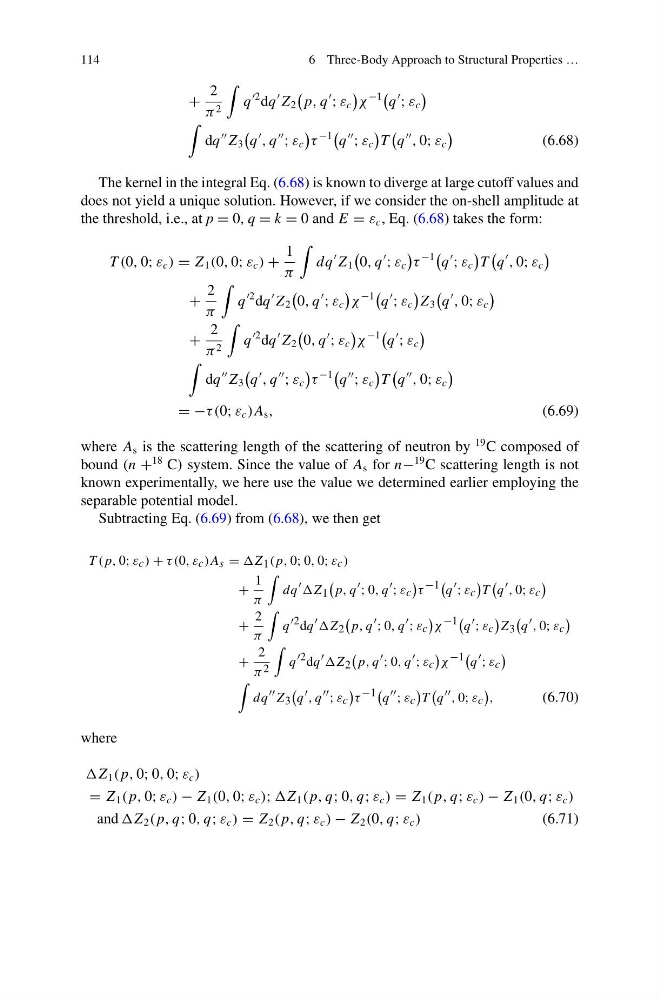
The kernel in the integral Eq. (6.68) is known to diverge at large cutoff values and
does not yield a unique solution. However, if we consider the on-shell amplitude at
the threshold, i.e., at p = 0, q = k = 0 and E = ε c , Eq. (6.68) takes the form:
T (0, 0; ε c ) = Z 1 (0, 0; ε c ) +
1
π
dq
Z 1
0, q
; ε c
τ
−1
q
; ε c
T
q
, 0; ε c
+
2
π
q
2 dq
Z 2
0, q
; ε c
χ
−1
q
; ε c
Z 3
q
, 0; ε c
+
2
π 2
q
2 dq
Z 2
0, q
; ε c
χ
−1
q
; ε c
dq
Z 3
q
, q
; ε c
τ
−1
q
; ε c
T
q
, 0; ε c
= −τ (0; ε c )A s ,
(6.69)
where A s is the scattering length of the scattering of neutron by
19 C composed of
bound (n +
18 C) system. Since the value of A s for n−
19 C scattering length is not
known experimentally, we here use the value we determined earlier employing the
separable potential model.
Subtracting Eq. (6.69) from (6.68), we then get
T ( p, 0; ε c ) + τ (0, ε c )A s = Z 1 ( p, 0; 0, 0; ε c )
+
1
π
dq Z 1
p, q ; 0, q ; ε c
τ −1
q ; ε c
T
q , 0; ε c
+
2
π
q 2 dq Z 2
p, q ; 0, q ; ε c
χ −1
q ; ε c
Z 3
q , 0; ε c
+
2
π 2
q 2 dq Z 2
p, q ; 0, q ; ε c
χ −1
q ; ε c
dq Z 3
q , q ; ε c
τ −1
q ; ε c
T
q , 0; ε c
,
(6.70)
where
Z 1 ( p, 0; 0, 0; ε c )
= Z 1 ( p, 0; ε c ) − Z 1 (0, 0; ε c ); Z 1 ( p, q; 0, q; ε c ) = Z 1 ( p, q; ε c ) − Z 1 (0, q; ε c )
and Z 2 ( p, q; 0, q; ε c ) = Z 2 ( p, q; ε c ) − Z 2 (0, q; ε c )
(6.71)
6 Three-Body Approach to Structural Properties …
+
2
π 2
q
2 dq
Z 2
p, q
; ε c
χ
−1
q
; ε c
dq
Z 3
q
, q
; ε c
τ
−1
q
; ε c
T
q
, 0; ε c
(6.68)
The kernel in the integral Eq. (6.68) is known to diverge at large cutoff values and
does not yield a unique solution. However, if we consider the on-shell amplitude at
the threshold, i.e., at p = 0, q = k = 0 and E = ε c , Eq. (6.68) takes the form:
T (0, 0; ε c ) = Z 1 (0, 0; ε c ) +
1
π
dq
Z 1
0, q
; ε c
τ
−1
q
; ε c
T
q
, 0; ε c
+
2
π
q
2 dq
Z 2
0, q
; ε c
χ
−1
q
; ε c
Z 3
q
, 0; ε c
+
2
π 2
q
2 dq
Z 2
0, q
; ε c
χ
−1
q
; ε c
dq
Z 3
q
, q
; ε c
τ
−1
q
; ε c
T
q
, 0; ε c
= −τ (0; ε c )A s ,
(6.69)
where A s is the scattering length of the scattering of neutron by
19 C composed of
bound (n +
18 C) system. Since the value of A s for n−
19 C scattering length is not
known experimentally, we here use the value we determined earlier employing the
separable potential model.
Subtracting Eq. (6.69) from (6.68), we then get
T ( p, 0; ε c ) + τ (0, ε c )A s = Z 1 ( p, 0; 0, 0; ε c )
+
1
π
dq Z 1
p, q ; 0, q ; ε c
τ −1
q ; ε c
T
q , 0; ε c
+
2
π
q 2 dq Z 2
p, q ; 0, q ; ε c
χ −1
q ; ε c
Z 3
q , 0; ε c
+
2
π 2
q 2 dq Z 2
p, q ; 0, q ; ε c
χ −1
q ; ε c
dq Z 3
q , q ; ε c
τ −1
q ; ε c
T
q , 0; ε c
,
(6.70)
where
Z 1 ( p, 0; 0, 0; ε c )
= Z 1 ( p, 0; ε c ) − Z 1 (0, 0; ε c ); Z 1 ( p, q; 0, q; ε c ) = Z 1 ( p, q; ε c ) − Z 1 (0, q; ε c )
and Z 2 ( p, q; 0, q; ε c ) = Z 2 ( p, q; ε c ) − Z 2 (0, q; ε c )
(6.71)