

6.10 Efimov Effect in Halo Nuclei Using Effective Field Theory
115
The resulting integral Eq. (6.70), as demonstrated in the work of Afnan and Phillips
[40] has the kernel that goes to zero faster as q
→ ∞ than the kernel of integral
Eq. (6.68) does and is therefore expected to admit a unique solution to Eq. (6.70).
Further, since off-the-energy shell scattering amplitude T ( p, q; E) is known
to be symmetric in the variables p and q, we write Eq. (6.67) for T (q, p; E) by
interchanging p ⇔ q when k = 0 and E = ε c to get
T (q, p; ε c ) = Z 1 (q, p; ε c ) +
1
π
dq
Z 1
q, q
; ε c
τ
−1
q
; ε c
T
q
, p; ε c
+
2
π
q
2 dq
Z 2
q, q
; ε c
χ
−1
q
; ε c
Z 3
q
, p; ε c
+
2
π 2
q
2 dq
Z 2
q, q
; ε c
χ
−1
q
; ε c
dq
Z 3
q
, q
; ε c
τ
−1
q
; ε c
T
q
, p; ε c
(6.72)
and the half-off-shell amplitude when q = k = 0 and E = ε c is
T (0, p; ε c ) = Z 1 (0, p; ε c )
+
1
π
dq
Z 1
0, q
; ε c
τ
−1
q
; ε c
T
q
, p; ε c
+
2
π
q
2 dq
Z 2
0, q
; ε c
χ
−1
q
; ε c
Z 3
q
, p; ε c
+
2
π 2
q
2 dq
Z 2
0, q
; ε c
χ
−1
q
; ε c
dq
Z 3
q
, q
; ε o
τ
−1
q
; ε c
T
q
, p; ε c
(6.73)
Subtracting Eq. (6.73) from Eq. (6.72), we have
T (q, p; ε c ) = T (0, p; ε c ) + Z 1 (q, p; 0, p; ε c ) +
1
π
dq Z 1
q, q ; 0, q ; ε c
τ −1
q ; ε c
T
q , p; ε c
+
2
π
q 2 dq Z 2
q, q ; 0, q ; ε c
χ −1
q ; ε c
Z 3
q , p; ε c
+
2
π 2
q 2 dq Z 2
q, q ; 0, q ; ε c
χ −1
q ; ε c
dq Z 3
q , q ; ε c
τ −1
q ; ε c
T
q , p; ε c
(6.74)
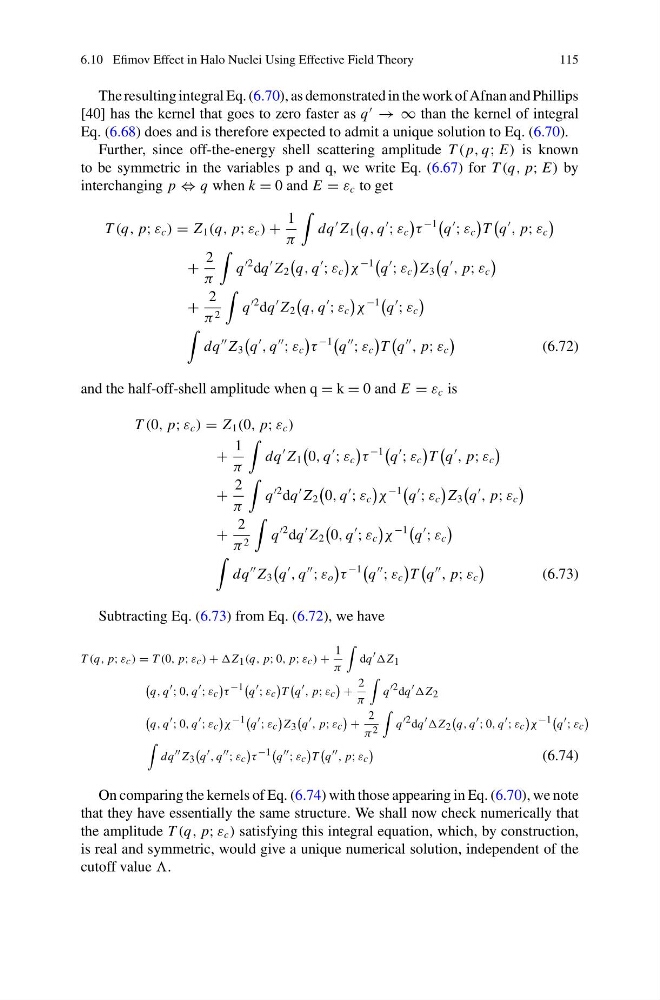
On comparing the kernels of Eq. (6.74) with those appearing in Eq. (6.70), we note
that they have essentially the same structure. We shall now check numerically that
the amplitude T (q, p; ε c ) satisfying this integral equation, which, by construction,
is real and symmetric, would give a unique numerical solution, independent of the
cutoff value .
115
The resulting integral Eq. (6.70), as demonstrated in the work of Afnan and Phillips
[40] has the kernel that goes to zero faster as q
→ ∞ than the kernel of integral
Eq. (6.68) does and is therefore expected to admit a unique solution to Eq. (6.70).
Further, since off-the-energy shell scattering amplitude T ( p, q; E) is known
to be symmetric in the variables p and q, we write Eq. (6.67) for T (q, p; E) by
interchanging p ⇔ q when k = 0 and E = ε c to get
T (q, p; ε c ) = Z 1 (q, p; ε c ) +
1
π
dq
Z 1
q, q
; ε c
τ
−1
q
; ε c
T
q
, p; ε c
+
2
π
q
2 dq
Z 2
q, q
; ε c
χ
−1
q
; ε c
Z 3
q
, p; ε c
+
2
π 2
q
2 dq
Z 2
q, q
; ε c
χ
−1
q
; ε c
dq
Z 3
q
, q
; ε c
τ
−1
q
; ε c
T
q
, p; ε c
(6.72)
and the half-off-shell amplitude when q = k = 0 and E = ε c is
T (0, p; ε c ) = Z 1 (0, p; ε c )
+
1
π
dq
Z 1
0, q
; ε c
τ
−1
q
; ε c
T
q
, p; ε c
+
2
π
q
2 dq
Z 2
0, q
; ε c
χ
−1
q
; ε c
Z 3
q
, p; ε c
+
2
π 2
q
2 dq
Z 2
0, q
; ε c
χ
−1
q
; ε c
dq
Z 3
q
, q
; ε o
τ
−1
q
; ε c
T
q
, p; ε c
(6.73)
Subtracting Eq. (6.73) from Eq. (6.72), we have
T (q, p; ε c ) = T (0, p; ε c ) + Z 1 (q, p; 0, p; ε c ) +
1
π
dq Z 1
q, q ; 0, q ; ε c
τ −1
q ; ε c
T
q , p; ε c
+
2
π
q 2 dq Z 2
q, q ; 0, q ; ε c
χ −1
q ; ε c
Z 3
q , p; ε c
+
2
π 2
q 2 dq Z 2
q, q ; 0, q ; ε c
χ −1
q ; ε c
dq Z 3
q , q ; ε c
τ −1
q ; ε c
T
q , p; ε c
(6.74)
On comparing the kernels of Eq. (6.74) with those appearing in Eq. (6.70), we note
that they have essentially the same structure. We shall now check numerically that
the amplitude T (q, p; ε c ) satisfying this integral equation, which, by construction,
is real and symmetric, would give a unique numerical solution, independent of the
cutoff value .