

6.10 Efimov Effect in Halo Nuclei Using Effective Field Theory
113
It has been explicitly demonstrated by Hammer and Mehen [112] by operating
d/d on both sides of Eq. (6.64) that the subtracted equation has a unique solution
which is renormalization group invariant. This analysis can be extended to the integral
equation for half-off-shell amplitude at any energy. Basically, this is the line of
approach employed in [40] which we are extending here in the case of n −
19 C
scattering.
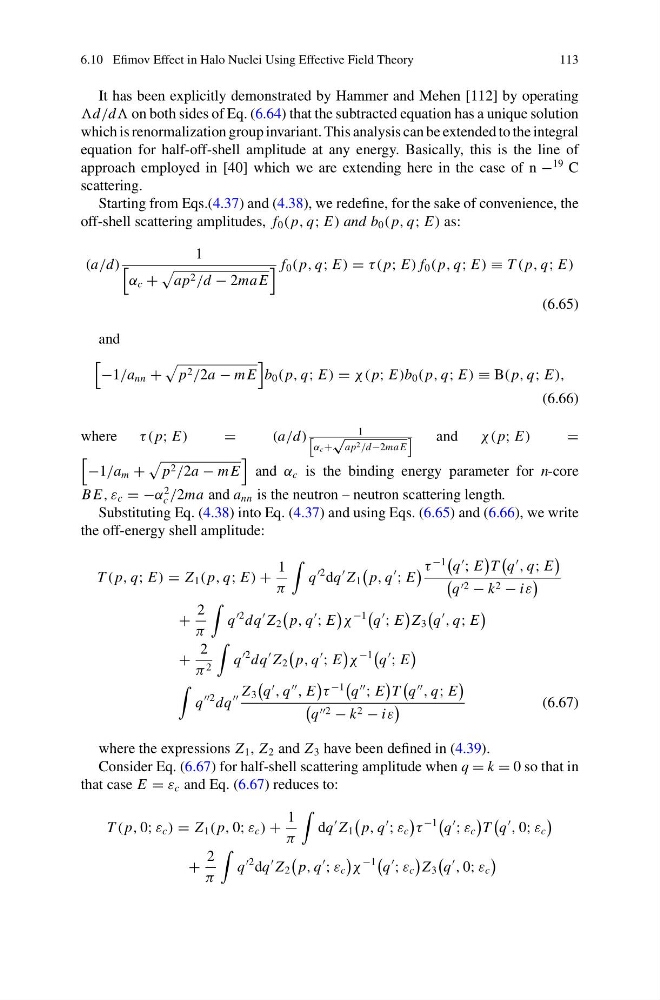
Starting from Eqs.(4.37) and (4.38), we redefine, for the sake of convenience, the
off-shell scattering amplitudes, f 0 ( p, q; E) and b 0 ( p, q; E) as:
(a/d)
1
α c +
ap 2 /d − 2ma E
f 0 ( p, q; E) = τ ( p; E) f 0 ( p, q; E) ≡ T ( p, q; E)
(6.65)
and
−1/a nn +
p 2 /2a − m E
b 0 ( p, q; E) = χ( p; E)b 0 ( p, q; E) ≡ B( p, q; E),
(6.66)
where τ ( p; E)
=
(a/d)
1
α c +
√
ap 2 /d−2ma E
and χ( p; E)
=
−1/a m +
p 2 /2a − m E
and α c is the binding energy parameter for n-core
B E, ε c = −α
2
c /2ma and a nn is the neutron – neutron scattering length.
Substituting Eq. (4.38) into Eq. (4.37) and using Eqs. (6.65) and (6.66), we write
the off-energy shell amplitude:
T ( p, q; E) = Z 1 ( p, q; E) +
1
π
q
2 dq
Z 1
p, q
; E
τ
−1
q
; E
T
q
, q; E
q 2 − k 2 − iε
+
2
π
q
2 dq
Z 2
p, q
; E
χ
−1
q
; E
Z 3
q
, q; E
+
2
π 2
q
2 dq
Z 2
p, q
; E
χ
−1
q
; E
q
2 dq
Z 3
q
, q
, E
τ
−1
q
; E
T
q
, q; E
q 2 − k 2 − iε
(6.67)
where the expressions Z 1 , Z 2 and Z 3 have been defined in (4.39).
Consider Eq. (6.67) for half-shell scattering amplitude when q = k = 0 so that in
that case E = ε c and Eq. (6.67) reduces to:
T ( p, 0; ε c ) = Z 1 ( p, 0; ε c ) +
1
π
dq
Z 1
p, q
; ε c
τ
−1
q
; ε c
T
q
, 0; ε c
+
2
π
q
2 dq
Z 2
p, q
; ε c
χ
−1
q
; ε c
Z 3
q
, 0; ε c
113
It has been explicitly demonstrated by Hammer and Mehen [112] by operating
d/d on both sides of Eq. (6.64) that the subtracted equation has a unique solution
which is renormalization group invariant. This analysis can be extended to the integral
equation for half-off-shell amplitude at any energy. Basically, this is the line of
approach employed in [40] which we are extending here in the case of n −
19 C
scattering.
Starting from Eqs.(4.37) and (4.38), we redefine, for the sake of convenience, the
off-shell scattering amplitudes, f 0 ( p, q; E) and b 0 ( p, q; E) as:
(a/d)
1
α c +
ap 2 /d − 2ma E
f 0 ( p, q; E) = τ ( p; E) f 0 ( p, q; E) ≡ T ( p, q; E)
(6.65)
and
−1/a nn +
p 2 /2a − m E
b 0 ( p, q; E) = χ( p; E)b 0 ( p, q; E) ≡ B( p, q; E),
(6.66)
where τ ( p; E)
=
(a/d)
1
α c +
√
ap 2 /d−2ma E
and χ( p; E)
=
−1/a m +
p 2 /2a − m E
and α c is the binding energy parameter for n-core
B E, ε c = −α
2
c /2ma and a nn is the neutron – neutron scattering length.
Substituting Eq. (4.38) into Eq. (4.37) and using Eqs. (6.65) and (6.66), we write
the off-energy shell amplitude:
T ( p, q; E) = Z 1 ( p, q; E) +
1
π
q
2 dq
Z 1
p, q
; E
τ
−1
q
; E
T
q
, q; E
q 2 − k 2 − iε
+
2
π
q
2 dq
Z 2
p, q
; E
χ
−1
q
; E
Z 3
q
, q; E
+
2
π 2
q
2 dq
Z 2
p, q
; E
χ
−1
q
; E
q
2 dq
Z 3
q
, q
, E
τ
−1
q
; E
T
q
, q; E
q 2 − k 2 − iε
(6.67)
where the expressions Z 1 , Z 2 and Z 3 have been defined in (4.39).
Consider Eq. (6.67) for half-shell scattering amplitude when q = k = 0 so that in
that case E = ε c and Eq. (6.67) reduces to:
T ( p, 0; ε c ) = Z 1 ( p, 0; ε c ) +
1
π
dq
Z 1
p, q
; ε c
τ
−1
q
; ε c
T
q
, 0; ε c
+
2
π
q
2 dq
Z 2
p, q
; ε c
χ
−1
q
; ε c
Z 3
q
, 0; ε c