

112
6 Three-Body Approach to Structural Properties …
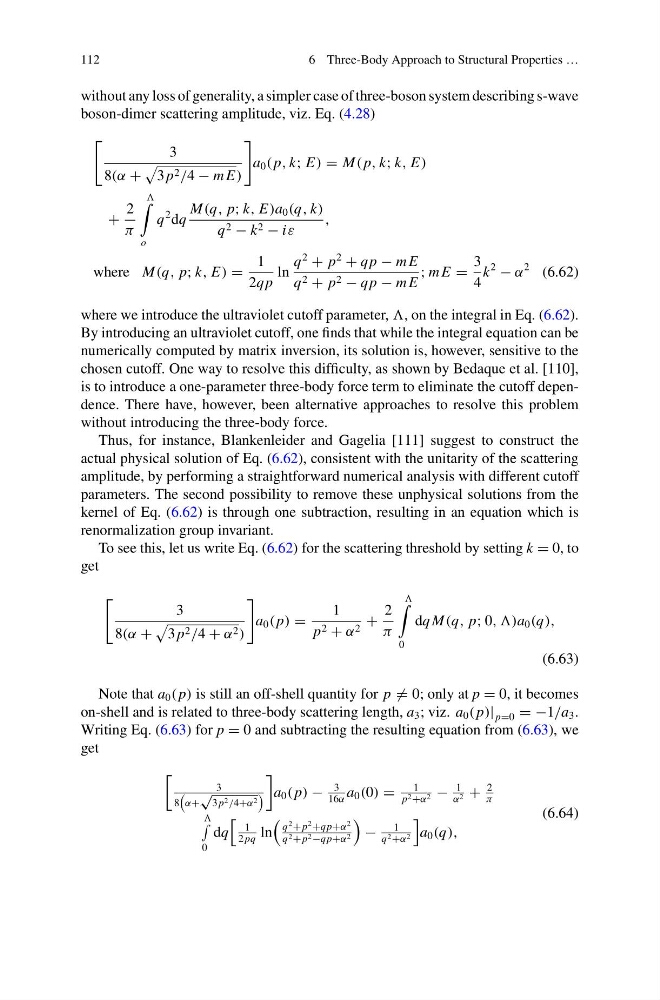
without any loss of generality, a simpler case of three-boson system describing s-wave
boson-dimer scattering amplitude, viz. Eq. (4.28)
3
8(α +
3 p 2 /4 − m E)
a 0 ( p, k; E) = M( p, k; k, E)
+
2
π
o
q
2 dq
M(q, p; k, E)a 0 (q, k)
q 2 − k 2 − iε
,
where M(q, p; k, E) =
1
2qp
ln
q
2
+ p
2
+ qp − m E
q 2 + p 2 − qp − m E
; m E =
3
4
k
2
− α
2 (6.62)
where we introduce the ultraviolet cutoff parameter, , on the integral in Eq. (6.62).
By introducing an ultraviolet cutoff, one finds that while the integral equation can be
numerically computed by matrix inversion, its solution is, however, sensitive to the
chosen cutoff. One way to resolve this difficulty, as shown by Bedaque et al. [110],
is to introduce a one-parameter three-body force term to eliminate the cutoff dependence. There have, however, been alternative approaches to resolve this problem
without introducing the three-body force.
Thus, for instance, Blankenleider and Gagelia [111] suggest to construct the
actual physical solution of Eq. (6.62), consistent with the unitarity of the scattering
amplitude, by performing a straightforward numerical analysis with different cutoff
parameters. The second possibility to remove these unphysical solutions from the
kernel of Eq. (6.62) is through one subtraction, resulting in an equation which is
renormalization group invariant.
To see this, let us write Eq. (6.62) for the scattering threshold by setting k = 0, to
get
3
8(α +
3 p 2 /4 + α 2 )
a 0 ( p) =
1
p 2 + α 2 +
2
π
0
dq M(q, p; 0, ,)a 0 (q),
(6.63)
Note that a 0 ( p) is still an off-shell quantity for p = 0; only at p = 0, it becomes
on-shell and is related to three-body scattering length, a 3 ; viz. a 0 ( p)| p=0 = −1/a 3 .
Writing Eq. (6.63) for p = 0 and subtracting the resulting equation from (6.63), we
get
3
8
α+
√
3 p 2 /4+α 2
a 0 ( p) −
3
16α
a 0 (0) =
1
p 2 +α 2 −
1
α 2 +
2
π
0
dq
1
2 pq
ln
q
2 + p
2 +qp+α
2
q 2 + p 2 −qp+α 2
−
1
q 2 +α 2
a 0 (q),
(6.64)
6 Three-Body Approach to Structural Properties …
without any loss of generality, a simpler case of three-boson system describing s-wave
boson-dimer scattering amplitude, viz. Eq. (4.28)
3
8(α +
3 p 2 /4 − m E)
a 0 ( p, k; E) = M( p, k; k, E)
+
2
π
o
q
2 dq
M(q, p; k, E)a 0 (q, k)
q 2 − k 2 − iε
,
where M(q, p; k, E) =
1
2qp
ln
q
2
+ p
2
+ qp − m E
q 2 + p 2 − qp − m E
; m E =
3
4
k
2
− α
2 (6.62)
where we introduce the ultraviolet cutoff parameter, , on the integral in Eq. (6.62).
By introducing an ultraviolet cutoff, one finds that while the integral equation can be
numerically computed by matrix inversion, its solution is, however, sensitive to the
chosen cutoff. One way to resolve this difficulty, as shown by Bedaque et al. [110],
is to introduce a one-parameter three-body force term to eliminate the cutoff dependence. There have, however, been alternative approaches to resolve this problem
without introducing the three-body force.
Thus, for instance, Blankenleider and Gagelia [111] suggest to construct the
actual physical solution of Eq. (6.62), consistent with the unitarity of the scattering
amplitude, by performing a straightforward numerical analysis with different cutoff
parameters. The second possibility to remove these unphysical solutions from the
kernel of Eq. (6.62) is through one subtraction, resulting in an equation which is
renormalization group invariant.
To see this, let us write Eq. (6.62) for the scattering threshold by setting k = 0, to
get
3
8(α +
3 p 2 /4 + α 2 )
a 0 ( p) =
1
p 2 + α 2 +
2
π
0
dq M(q, p; 0, ,)a 0 (q),
(6.63)
Note that a 0 ( p) is still an off-shell quantity for p = 0; only at p = 0, it becomes
on-shell and is related to three-body scattering length, a 3 ; viz. a 0 ( p)| p=0 = −1/a 3 .
Writing Eq. (6.63) for p = 0 and subtracting the resulting equation from (6.63), we
get
3
8
α+
√
3 p 2 /4+α 2
a 0 ( p) −
3
16α
a 0 (0) =
1
p 2 +α 2 −
1
α 2 +
2
π
0
dq
1
2 pq
ln
q
2 + p
2 +qp+α
2
q 2 + p 2 −qp+α 2
−
1
q 2 +α 2
a 0 (q),
(6.64)