

102
6 Three-Body Approach to Structural Properties …
4π
a
d
h
p
2
, k
2
; α
2
2
a k ( p) = (2π)
3 K 1 (
p,
k) + 4π
d q K 1 (
p,
q)a k ( q)
q 2 − k 2 − iε
+ 2(2π)
3
dq K 2 (
p,
q)K 3 ( q,
k)τ n (q)
+ 2(4π)
d q K 2 (
p,
q)τ n (q)
d q
K 3
q,
q
a k
q
q 2 − k 2 − iε
(6.61)
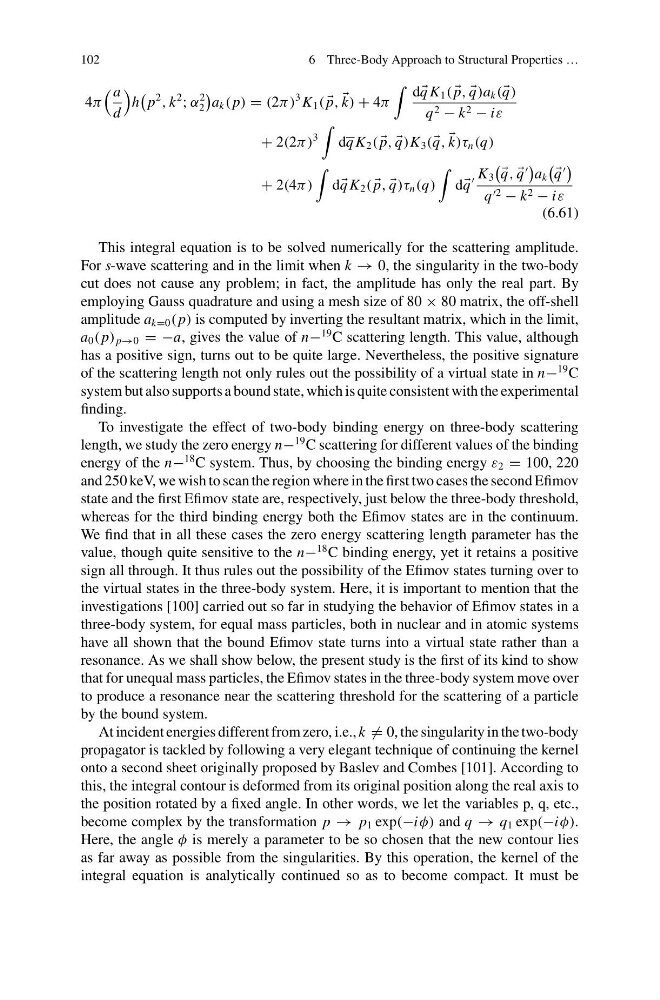
This integral equation is to be solved numerically for the scattering amplitude.
For s-wave scattering and in the limit when k → 0, the singularity in the two-body
cut does not cause any problem; in fact, the amplitude has only the real part. By
employing Gauss quadrature and using a mesh size of 80 × 80 matrix, the off-shell
amplitude a k=0 ( p) is computed by inverting the resultant matrix, which in the limit,
a 0 ( p) p→0 = −a, gives the value of n−
19 C scattering length. This value, although
has a positive sign, turns out to be quite large. Nevertheless, the positive signature
of the scattering length not only rules out the possibility of a virtual state in n−
19 C
system but also supports a bound state, which is quite consistent with the experimental
finding.
To investigate the effect of two-body binding energy on three-body scattering
length, we study the zero energy n−
19 C scattering for different values of the binding
energy of the n−
18 C system. Thus, by choosing the binding energy ε 2 = 100, 220
and 250 keV, we wish to scan the region where in the first two cases the second Efimov
state and the first Efimov state are, respectively, just below the three-body threshold,
whereas for the third binding energy both the Efimov states are in the continuum.
We find that in all these cases the zero energy scattering length parameter has the
value, though quite sensitive to the n−
18 C binding energy, yet it retains a positive
sign all through. It thus rules out the possibility of the Efimov states turning over to
the virtual states in the three-body system. Here, it is important to mention that the
investigations [100] carried out so far in studying the behavior of Efimov states in a
three-body system, for equal mass particles, both in nuclear and in atomic systems
have all shown that the bound Efimov state turns into a virtual state rather than a
resonance. As we shall show below, the present study is the first of its kind to show
that for unequal mass particles, the Efimov states in the three-body system move over
to produce a resonance near the scattering threshold for the scattering of a particle
by the bound system.
At incident energies different from zero, i.e., k = 0, the singularity in the two-body
propagator is tackled by following a very elegant technique of continuing the kernel
onto a second sheet originally proposed by Baslev and Combes [101]. According to
this, the integral contour is deformed from its original position along the real axis to
the position rotated by a fixed angle. In other words, we let the variables p, q, etc.,
become complex by the transformation p → p 1 exp(−iφ) and q → q 1 exp(−iφ).
Here, the angle φ is merely a parameter to be so chosen that the new contour lies
as far away as possible from the singularities. By this operation, the kernel of the
integral equation is analytically continued so as to become compact. It must be
6 Three-Body Approach to Structural Properties …
4π
a
d
h
p
2
, k
2
; α
2
2
a k ( p) = (2π)
3 K 1 (
p,
k) + 4π
d q K 1 (
p,
q)a k ( q)
q 2 − k 2 − iε
+ 2(2π)
3
dq K 2 (
p,
q)K 3 ( q,
k)τ n (q)
+ 2(4π)
d q K 2 (
p,
q)τ n (q)
d q
K 3
q,
q
a k
q
q 2 − k 2 − iε
(6.61)
This integral equation is to be solved numerically for the scattering amplitude.
For s-wave scattering and in the limit when k → 0, the singularity in the two-body
cut does not cause any problem; in fact, the amplitude has only the real part. By
employing Gauss quadrature and using a mesh size of 80 × 80 matrix, the off-shell
amplitude a k=0 ( p) is computed by inverting the resultant matrix, which in the limit,
a 0 ( p) p→0 = −a, gives the value of n−
19 C scattering length. This value, although
has a positive sign, turns out to be quite large. Nevertheless, the positive signature
of the scattering length not only rules out the possibility of a virtual state in n−
19 C
system but also supports a bound state, which is quite consistent with the experimental
finding.
To investigate the effect of two-body binding energy on three-body scattering
length, we study the zero energy n−
19 C scattering for different values of the binding
energy of the n−
18 C system. Thus, by choosing the binding energy ε 2 = 100, 220
and 250 keV, we wish to scan the region where in the first two cases the second Efimov
state and the first Efimov state are, respectively, just below the three-body threshold,
whereas for the third binding energy both the Efimov states are in the continuum.
We find that in all these cases the zero energy scattering length parameter has the
value, though quite sensitive to the n−
18 C binding energy, yet it retains a positive
sign all through. It thus rules out the possibility of the Efimov states turning over to
the virtual states in the three-body system. Here, it is important to mention that the
investigations [100] carried out so far in studying the behavior of Efimov states in a
three-body system, for equal mass particles, both in nuclear and in atomic systems
have all shown that the bound Efimov state turns into a virtual state rather than a
resonance. As we shall show below, the present study is the first of its kind to show
that for unequal mass particles, the Efimov states in the three-body system move over
to produce a resonance near the scattering threshold for the scattering of a particle
by the bound system.
At incident energies different from zero, i.e., k = 0, the singularity in the two-body
propagator is tackled by following a very elegant technique of continuing the kernel
onto a second sheet originally proposed by Baslev and Combes [101]. According to
this, the integral contour is deformed from its original position along the real axis to
the position rotated by a fixed angle. In other words, we let the variables p, q, etc.,
become complex by the transformation p → p 1 exp(−iφ) and q → q 1 exp(−iφ).
Here, the angle φ is merely a parameter to be so chosen that the new contour lies
as far away as possible from the singularities. By this operation, the kernel of the
integral equation is analytically continued so as to become compact. It must be