

6.7 Movement of Efimov States in 20 C Causing Resonance …
101
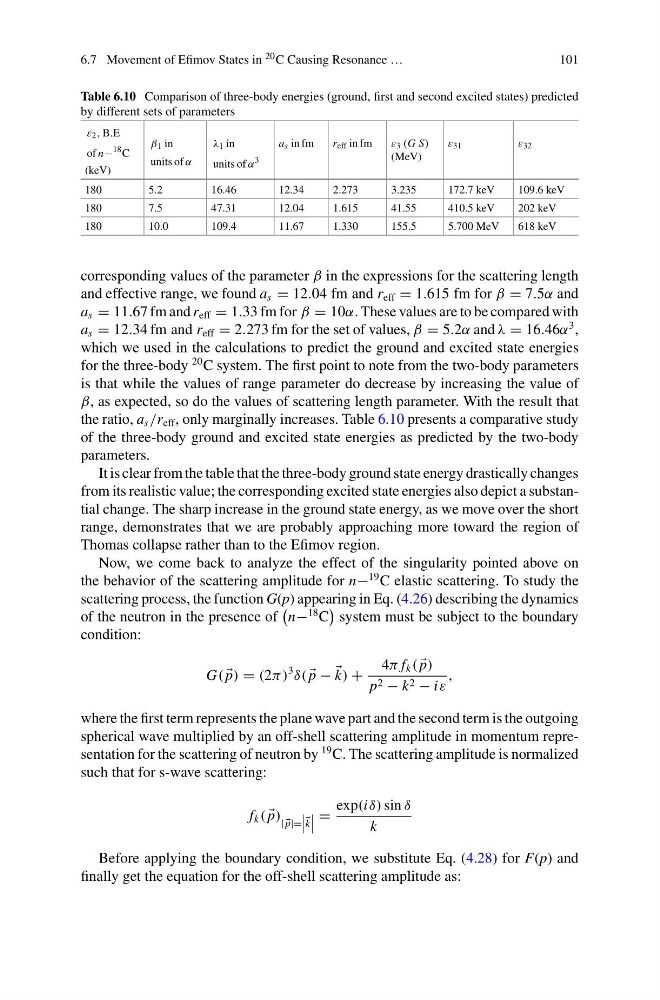
Table 6.10 Comparison of three-body energies (ground, first and second excited states) predicted
by different sets of parameters
ε 2 , B.E
of n−
18 C
(keV)
β 1 in
units of α
λ 1 in
units of α
3
a s in fm
r eff in fm
ε 3 (G S)
(MeV)
ε 31
ε 32
180
5.2
16.46
12.34
2.273
3.235
172.7 keV
109.6 keV
180
7.5
47.31
12.04
1.615
41.55
410.5 keV
202 keV
180
10.0
109.4
11.67
1.330
155.5
5.700 MeV
618 keV
corresponding values of the parameter β in the expressions for the scattering length
and effective range, we found a s = 12.04 fm and r eff = 1.615 fm for β = 7.5α and
a s = 11.67 fm and r eff = 1.33 fm for β = 10α. These values are to be compared with
a s = 12.34 fm and r eff = 2.273 fm for the set of values, β = 5.2α and λ = 16.46α
3 ,
which we used in the calculations to predict the ground and excited state energies
for the three-body
20 C system. The first point to note from the two-body parameters
is that while the values of range parameter do decrease by increasing the value of
β, as expected, so do the values of scattering length parameter. With the result that
the ratio, a s /r eff , only marginally increases. Table 6.10 presents a comparative study
of the three-body ground and excited state energies as predicted by the two-body
parameters.
It is clear from the table that the three-body ground state energy drastically changes
from its realistic value; the corresponding excited state energies also depict a substantial change. The sharp increase in the ground state energy, as we move over the short
range, demonstrates that we are probably approaching more toward the region of
Thomas collapse rather than to the Efimov region.
Now, we come back to analyze the effect of the singularity pointed above on
the behavior of the scattering amplitude for n−
19 C elastic scattering. To study the
scattering process, the function G(p) appearing in Eq. (4.26) describing the dynamics
of the neutron in the presence of
n−
18 C
system must be subject to the boundary
condition:
G(
p) = (2π)
3
δ(
p −
k) +
4π f k (
p)
p 2 − k 2 − iε
,
where the first term represents the plane wave part and the second term is the outgoing
spherical wave multiplied by an off-shell scattering amplitude in momentum representation for the scattering of neutron by
19 C. The scattering amplitude is normalized
such that for s-wave scattering:
f k (
p) |
p|=
k
=
exp(iδ) sin δ
k
Before applying the boundary condition, we substitute Eq. (4.28) for F(p) and
finally get the equation for the off-shell scattering amplitude as:
101
Table 6.10 Comparison of three-body energies (ground, first and second excited states) predicted
by different sets of parameters
ε 2 , B.E
of n−
18 C
(keV)
β 1 in
units of α
λ 1 in
units of α
3
a s in fm
r eff in fm
ε 3 (G S)
(MeV)
ε 31
ε 32
180
5.2
16.46
12.34
2.273
3.235
172.7 keV
109.6 keV
180
7.5
47.31
12.04
1.615
41.55
410.5 keV
202 keV
180
10.0
109.4
11.67
1.330
155.5
5.700 MeV
618 keV
corresponding values of the parameter β in the expressions for the scattering length
and effective range, we found a s = 12.04 fm and r eff = 1.615 fm for β = 7.5α and
a s = 11.67 fm and r eff = 1.33 fm for β = 10α. These values are to be compared with
a s = 12.34 fm and r eff = 2.273 fm for the set of values, β = 5.2α and λ = 16.46α
3 ,
which we used in the calculations to predict the ground and excited state energies
for the three-body
20 C system. The first point to note from the two-body parameters
is that while the values of range parameter do decrease by increasing the value of
β, as expected, so do the values of scattering length parameter. With the result that
the ratio, a s /r eff , only marginally increases. Table 6.10 presents a comparative study
of the three-body ground and excited state energies as predicted by the two-body
parameters.
It is clear from the table that the three-body ground state energy drastically changes
from its realistic value; the corresponding excited state energies also depict a substantial change. The sharp increase in the ground state energy, as we move over the short
range, demonstrates that we are probably approaching more toward the region of
Thomas collapse rather than to the Efimov region.
Now, we come back to analyze the effect of the singularity pointed above on
the behavior of the scattering amplitude for n−
19 C elastic scattering. To study the
scattering process, the function G(p) appearing in Eq. (4.26) describing the dynamics
of the neutron in the presence of
n−
18 C
system must be subject to the boundary
condition:
G(
p) = (2π)
3
δ(
p −
k) +
4π f k (
p)
p 2 − k 2 − iε
,
where the first term represents the plane wave part and the second term is the outgoing
spherical wave multiplied by an off-shell scattering amplitude in momentum representation for the scattering of neutron by
19 C. The scattering amplitude is normalized
such that for s-wave scattering:
f k (
p) |
p|=
k
=
exp(iδ) sin δ
k
Before applying the boundary condition, we substitute Eq. (4.28) for F(p) and
finally get the equation for the off-shell scattering amplitude as: