

100
6 Three-Body Approach to Structural Properties …
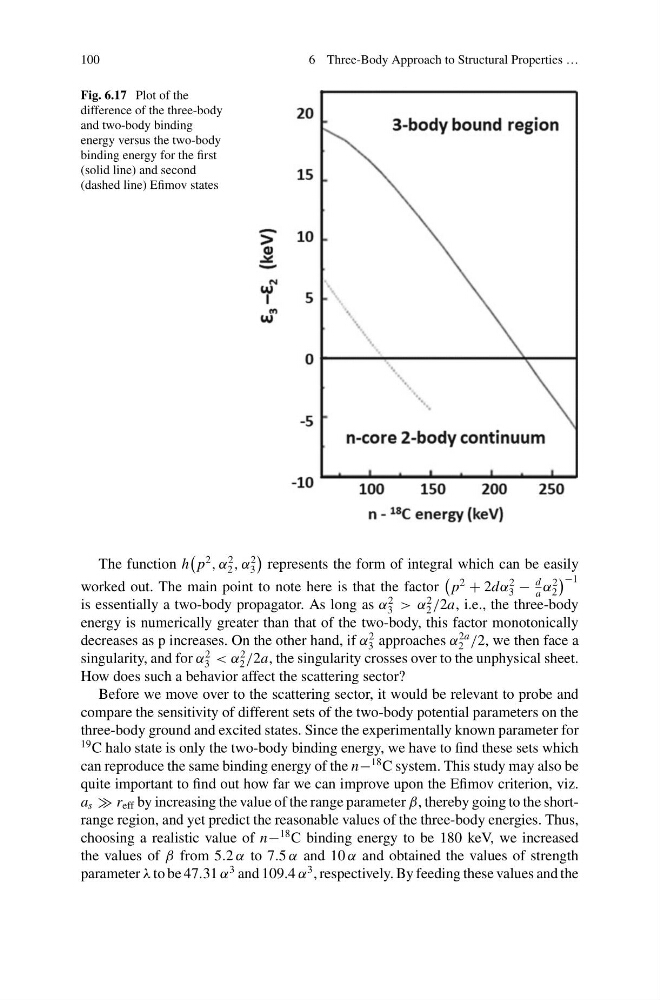
Fig. 6.17 Plot of the
difference of the three-body
and two-body binding
energy versus the two-body
binding energy for the first
(solid line) and second
(dashed line) Efimov states
The function h
p
2
, α
2
2 , α
2
3
represents the form of integral which can be easily
worked out. The main point to note here is that the factor
p
2
+ 2dα
2
3 −
d
a
α
2
2
−1
is essentially a two-body propagator. As long as α
2
3 > α
2
2 /2a, i.e., the three-body
energy is numerically greater than that of the two-body, this factor monotonically
decreases as p increases. On the other hand, if α
2
3 approaches α
2a
2 /2, we then face a
singularity, and for α
2
3 < α
2
2 /2a, the singularity crosses over to the unphysical sheet.
How does such a behavior affect the scattering sector?
Before we move over to the scattering sector, it would be relevant to probe and
compare the sensitivity of different sets of the two-body potential parameters on the
three-body ground and excited states. Since the experimentally known parameter for
19 C halo state is only the two-body binding energy, we have to find these sets which
can reproduce the same binding energy of the n−
18 C system. This study may also be
quite important to find out how far we can improve upon the Efimov criterion, viz.
a s r eff by increasing the value of the range parameter β, thereby going to the shortrange region, and yet predict the reasonable values of the three-body energies. Thus,
choosing a realistic value of n−
18 C binding energy to be 180 keV, we increased
the values of β from 5.2 α to 7.5 α and 10 α and obtained the values of strength
parameter λ to be 47.31 α
3 and 109.4 α
3 , respectively. By feeding these values and the
6 Three-Body Approach to Structural Properties …
Fig. 6.17 Plot of the
difference of the three-body
and two-body binding
energy versus the two-body
binding energy for the first
(solid line) and second
(dashed line) Efimov states
The function h
p
2
, α
2
2 , α
2
3
represents the form of integral which can be easily
worked out. The main point to note here is that the factor
p
2
+ 2dα
2
3 −
d
a
α
2
2
−1
is essentially a two-body propagator. As long as α
2
3 > α
2
2 /2a, i.e., the three-body
energy is numerically greater than that of the two-body, this factor monotonically
decreases as p increases. On the other hand, if α
2
3 approaches α
2a
2 /2, we then face a
singularity, and for α
2
3 < α
2
2 /2a, the singularity crosses over to the unphysical sheet.
How does such a behavior affect the scattering sector?
Before we move over to the scattering sector, it would be relevant to probe and
compare the sensitivity of different sets of the two-body potential parameters on the
three-body ground and excited states. Since the experimentally known parameter for
19 C halo state is only the two-body binding energy, we have to find these sets which
can reproduce the same binding energy of the n−
18 C system. This study may also be
quite important to find out how far we can improve upon the Efimov criterion, viz.
a s r eff by increasing the value of the range parameter β, thereby going to the shortrange region, and yet predict the reasonable values of the three-body energies. Thus,
choosing a realistic value of n−
18 C binding energy to be 180 keV, we increased
the values of β from 5.2 α to 7.5 α and 10 α and obtained the values of strength
parameter λ to be 47.31 α
3 and 109.4 α
3 , respectively. By feeding these values and the