

94
6 Three-Body Approach to Structural Properties …
Table 6.6 Three-body energies for ground and excited states of 19 B for different two-body input
parameters, β 1 = 4.75α
n− 17 B energy (keV)
λ c /α 3
a s (fm)
ε 0 (keV)
ε 1 (keV)
ε 2 (keV)
514.8
8.49
−6.515
500
135.3
9.50
−12.71
728
48
10.0
−21.16
851
7.7
10.5
−53.2
978
0.16
0.67
10.75
−179.6
1042
5.40
0.36
Table 6.7 Three-body energy of the ground and excited states of 22 C for different two-body input
parameters.β 1 = 4.9α
n− 20 C energy (keV)
λ c /α z
a s (fm)
ε 0 (keV)
ε 1 (keV)
ε 2 (keV)
319
9.82
−8.23
1120
127
10.5
−13.02
1287
48.8
11.0
−21.0
1410
9.3
11.5
−48.2
1540
0.122
1.46
11.75
−121.5
1608
4.74
0.198
rather large size of the matrix with double precision so as to minimize the possible
truncation errors.
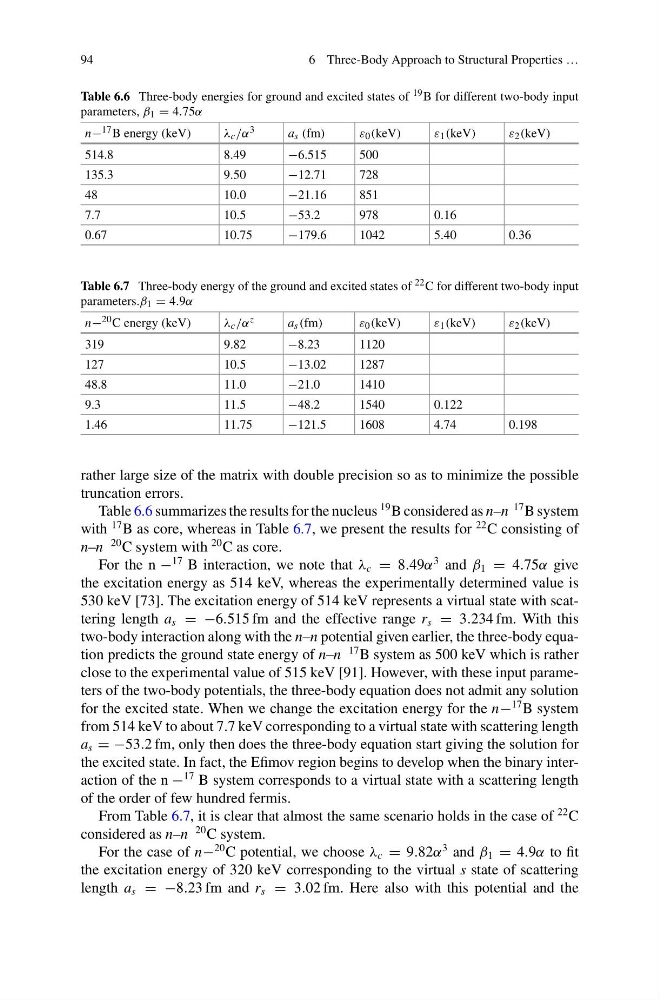
Table 6.6 summarizes the results for the nucleus
19 B considered as n–n
17 B system
with
17 B as core, whereas in Table 6.7, we present the results for
22 C consisting of
n–n
20 C system with
20 C as core.
For the n −
17 B interaction, we note that λ c = 8.49α
3 and β 1 = 4.75α give
the excitation energy as 514 keV, whereas the experimentally determined value is
530 keV [73]. The excitation energy of 514 keV represents a virtual state with scattering length a s = −6.515 fm and the effective range r s = 3.234 fm. With this
two-body interaction along with the n–n potential given earlier, the three-body equation predicts the ground state energy of n–n
17 B system as 500 keV which is rather
close to the experimental value of 515 keV [91]. However, with these input parameters of the two-body potentials, the three-body equation does not admit any solution
for the excited state. When we change the excitation energy for the n−
17 B system
from 514 keV to about 7.7 keV corresponding to a virtual state with scattering length
a s = −53.2 fm, only then does the three-body equation start giving the solution for
the excited state. In fact, the Efimov region begins to develop when the binary interaction of the n −
17 B system corresponds to a virtual state with a scattering length
of the order of few hundred fermis.
From Table 6.7, it is clear that almost the same scenario holds in the case of
22 C
considered as n–n
20 C system.
For the case of n−
20 C potential, we choose λ c = 9.82α
3 and β 1 = 4.9α to fit
the excitation energy of 320 keV corresponding to the virtual s state of scattering
length a s = −8.23 fm and r s = 3.02 fm. Here also with this potential and the
6 Three-Body Approach to Structural Properties …
Table 6.6 Three-body energies for ground and excited states of 19 B for different two-body input
parameters, β 1 = 4.75α
n− 17 B energy (keV)
λ c /α 3
a s (fm)
ε 0 (keV)
ε 1 (keV)
ε 2 (keV)
514.8
8.49
−6.515
500
135.3
9.50
−12.71
728
48
10.0
−21.16
851
7.7
10.5
−53.2
978
0.16
0.67
10.75
−179.6
1042
5.40
0.36
Table 6.7 Three-body energy of the ground and excited states of 22 C for different two-body input
parameters.β 1 = 4.9α
n− 20 C energy (keV)
λ c /α z
a s (fm)
ε 0 (keV)
ε 1 (keV)
ε 2 (keV)
319
9.82
−8.23
1120
127
10.5
−13.02
1287
48.8
11.0
−21.0
1410
9.3
11.5
−48.2
1540
0.122
1.46
11.75
−121.5
1608
4.74
0.198
rather large size of the matrix with double precision so as to minimize the possible
truncation errors.
Table 6.6 summarizes the results for the nucleus
19 B considered as n–n
17 B system
with
17 B as core, whereas in Table 6.7, we present the results for
22 C consisting of
n–n
20 C system with
20 C as core.
For the n −
17 B interaction, we note that λ c = 8.49α
3 and β 1 = 4.75α give
the excitation energy as 514 keV, whereas the experimentally determined value is
530 keV [73]. The excitation energy of 514 keV represents a virtual state with scattering length a s = −6.515 fm and the effective range r s = 3.234 fm. With this
two-body interaction along with the n–n potential given earlier, the three-body equation predicts the ground state energy of n–n
17 B system as 500 keV which is rather
close to the experimental value of 515 keV [91]. However, with these input parameters of the two-body potentials, the three-body equation does not admit any solution
for the excited state. When we change the excitation energy for the n−
17 B system
from 514 keV to about 7.7 keV corresponding to a virtual state with scattering length
a s = −53.2 fm, only then does the three-body equation start giving the solution for
the excited state. In fact, the Efimov region begins to develop when the binary interaction of the n −
17 B system corresponds to a virtual state with a scattering length
of the order of few hundred fermis.
From Table 6.7, it is clear that almost the same scenario holds in the case of
22 C
considered as n–n
20 C system.
For the case of n−
20 C potential, we choose λ c = 9.82α
3 and β 1 = 4.9α to fit
the excitation energy of 320 keV corresponding to the virtual s state of scattering
length a s = −8.23 fm and r s = 3.02 fm. Here also with this potential and the