

6.4 Search for Efimov States in Halo Nuclei like 14 Be, 19 B, 22 C and 20 C
9 3
We vary the strength parameter λ 1 to produce virtual n−
12 Be states at energies
varying from 50 to 0.01 keV. The corresponding values of the scattering length range
from −21 to −1491 fm. We observe that at 50 keV virtual state, the three-body
binding energy for
14 Be, as obtained from Eq. (6.54), is 1350 keV which is exactly
the experimental value of the two-neutron separation energy. However, this two-body
potential does not reproduce any excited state for
14 Be. As the virtual state energy
of n −
12 Be system is decreased, we not only get the ground state energy, but also
the excited state energy for the
14 Be system.
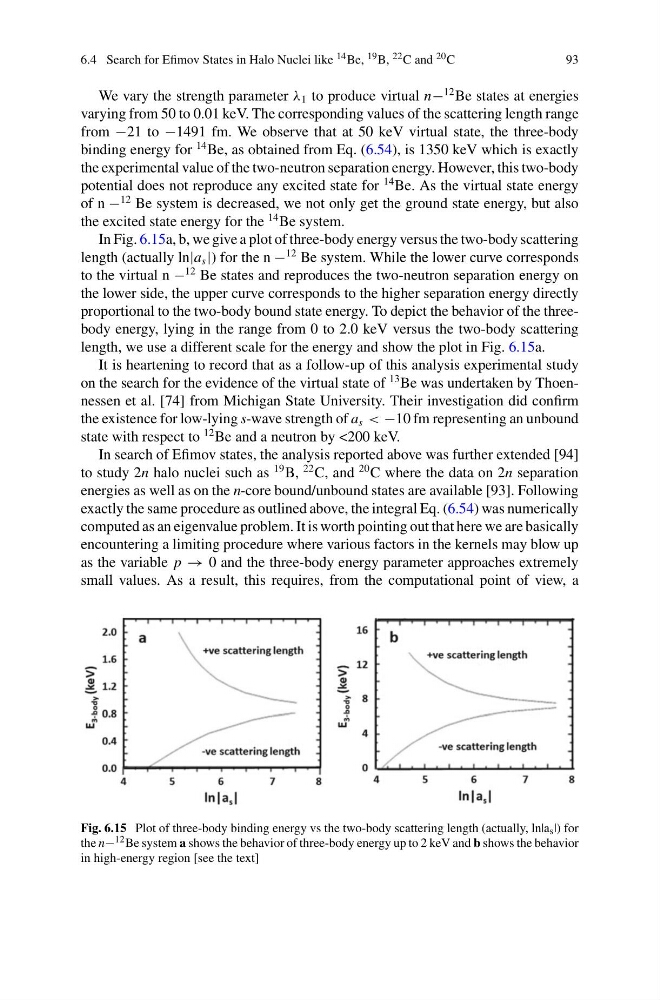
In Fig. 6.15a, b, we give a plot of three-body energy versus the two-body scattering
length (actually ln|a s |) for the n −
12 Be system. While the lower curve corresponds
to the virtual n −
12 Be states and reproduces the two-neutron separation energy on
the lower side, the upper curve corresponds to the higher separation energy directly
proportional to the two-body bound state energy. To depict the behavior of the threebody energy, lying in the range from 0 to 2.0 keV versus the two-body scattering
length, we use a different scale for the energy and show the plot in Fig. 6.15a.
It is heartening to record that as a follow-up of this analysis experimental study
on the search for the evidence of the virtual state of
13 Be was undertaken by Thoennessen et al. [74] from Michigan State University. Their investigation did confirm
the existence for low-lying s-wave strength of a s < −10 fm representing an unbound
state with respect to
12 Be and a neutron by <200 keV.
In search of Efimov states, the analysis reported above was further extended [94]
to study 2n halo nuclei such as
19 B,
22 C, and
20 C where the data on 2n separation
energies as well as on the n-core bound/unbound states are available [93]. Following
exactly the same procedure as outlined above, the integral Eq. (6.54) was numerically
computed as an eigenvalue problem. It is worth pointing out that here we are basically
encountering a limiting procedure where various factors in the kernels may blow up
as the variable p → 0 and the three-body energy parameter approaches extremely
small values. As a result, this requires, from the computational point of view, a
Fig. 6.15 Plot of three-body binding energy vs the two-body scattering length (actually, ln|a s |) for
the n− 12 Be system a shows the behavior of three-body energy up to 2 keV and b shows the behavior
in high-energy region [see the text]
9 3
We vary the strength parameter λ 1 to produce virtual n−
12 Be states at energies
varying from 50 to 0.01 keV. The corresponding values of the scattering length range
from −21 to −1491 fm. We observe that at 50 keV virtual state, the three-body
binding energy for
14 Be, as obtained from Eq. (6.54), is 1350 keV which is exactly
the experimental value of the two-neutron separation energy. However, this two-body
potential does not reproduce any excited state for
14 Be. As the virtual state energy
of n −
12 Be system is decreased, we not only get the ground state energy, but also
the excited state energy for the
14 Be system.
In Fig. 6.15a, b, we give a plot of three-body energy versus the two-body scattering
length (actually ln|a s |) for the n −
12 Be system. While the lower curve corresponds
to the virtual n −
12 Be states and reproduces the two-neutron separation energy on
the lower side, the upper curve corresponds to the higher separation energy directly
proportional to the two-body bound state energy. To depict the behavior of the threebody energy, lying in the range from 0 to 2.0 keV versus the two-body scattering
length, we use a different scale for the energy and show the plot in Fig. 6.15a.
It is heartening to record that as a follow-up of this analysis experimental study
on the search for the evidence of the virtual state of
13 Be was undertaken by Thoennessen et al. [74] from Michigan State University. Their investigation did confirm
the existence for low-lying s-wave strength of a s < −10 fm representing an unbound
state with respect to
12 Be and a neutron by <200 keV.
In search of Efimov states, the analysis reported above was further extended [94]
to study 2n halo nuclei such as
19 B,
22 C, and
20 C where the data on 2n separation
energies as well as on the n-core bound/unbound states are available [93]. Following
exactly the same procedure as outlined above, the integral Eq. (6.54) was numerically
computed as an eigenvalue problem. It is worth pointing out that here we are basically
encountering a limiting procedure where various factors in the kernels may blow up
as the variable p → 0 and the three-body energy parameter approaches extremely
small values. As a result, this requires, from the computational point of view, a
Fig. 6.15 Plot of three-body binding energy vs the two-body scattering length (actually, ln|a s |) for
the n− 12 Be system a shows the behavior of three-body energy up to 2 keV and b shows the behavior
in high-energy region [see the text]