

6.3 Resonant States of 11 Li, Probability Distributions and β-decay of Halo Analog States
89
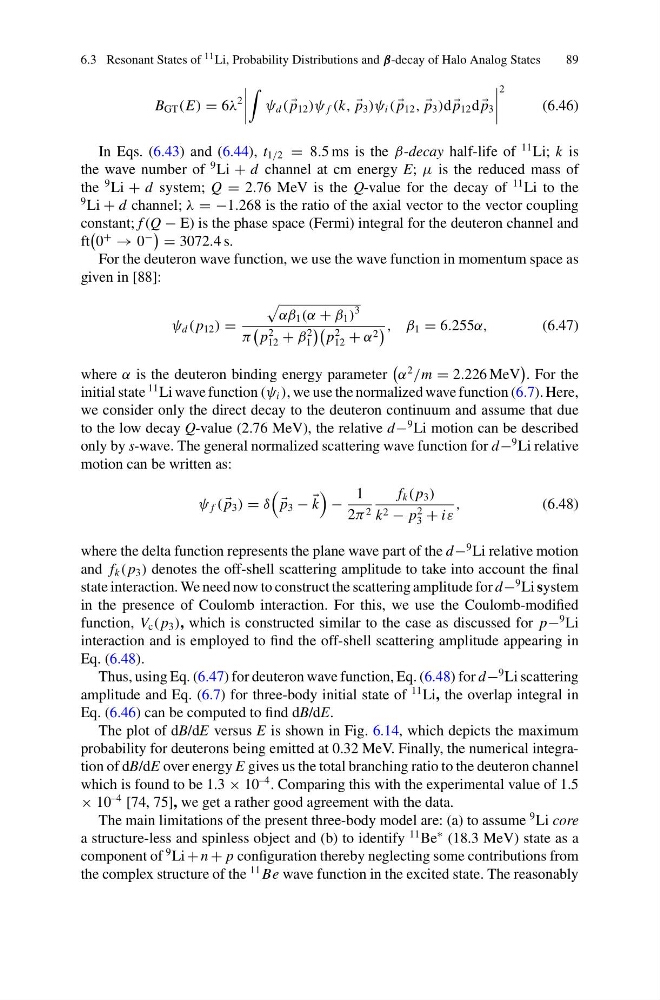
B GT (E) = 6λ
2
ψ d (
p 12 )ψ f (k,
p 3 )ψ i (
p 12 ,
p 3 )d
p 12 d
p 3
2
(6.46)
In Eqs. (6.43) and (6.44), t 1/2 = 8.5 ms is the β-decay half-life of
11 Li; k is
the wave number of
9 Li + d channel at cm energy E; μ is the reduced mass of
the
9 Li + d system; Q = 2.76 MeV is the Q-value for the decay of
11 Li to the
9 Li + d channel; λ = −1.268 is the ratio of the axial vector to the vector coupling
constant; f (Q − E) is the phase space (Fermi) integral for the deuteron channel and
ft
0
+
→ 0
−
= 3072.4 s.
For the deuteron wave function, we use the wave function in momentum space as
given in [88]:
ψ d ( p 12 ) =
αβ 1 (α + β 1 )
3
π
p
2
12 + β
2
1
p
2
12 + α 2
, β 1 = 6.255α,
(6.47)
where α is the deuteron binding energy parameter
α
2
/m = 2.226 MeV
. For the
initial state
11 Li wave function (ψ i ), we use the normalized wave function (6.7). Here,
we consider only the direct decay to the deuteron continuum and assume that due
to the low decay Q-value (2.76 MeV), the relative d−
9 Li motion can be described
only by s-wave. The general normalized scattering wave function for d−
9 Li relative
motion can be written as:
ψ f (
p 3 ) = δ
p 3 −
k
−
1
2π 2
f k ( p 3 )
k 2 − p
2
3 + iε
,
(6.48)
where the delta function represents the plane wave part of the d−
9 Li relative motion
and f k ( p 3 ) denotes the off-shell scattering amplitude to take into account the final
state interaction. We need now to construct the scattering amplitude for d−
9 Li system
in the presence of Coulomb interaction. For this, we use the Coulomb-modified
function, V c ( p 3 ), which is constructed similar to the case as discussed for p−
9 Li
interaction and is employed to find the off-shell scattering amplitude appearing in
Eq. (6.48).
Thus, using Eq. (6.47) for deuteron wave function, Eq. (6.48) for d−
9 Li scattering
amplitude and Eq. (6.7) for three-body initial state of
11 Li, the overlap integral in
Eq. (6.46) can be computed to find dB/dE.
The plot of dB/dE versus E is shown in Fig. 6.14, which depicts the maximum
probability for deuterons being emitted at 0.32 MeV. Finally, the numerical integration of dB/dE over energy E gives us the total branching ratio to the deuteron channel
which is found to be 1.3 × 10
–4 . Comparing this with the experimental value of 1.5
× 10
–4 [74, 75], we get a rather good agreement with the data.
The main limitations of the present three-body model are: (a) to assume
9 Li core
a structure-less and spinless object and (b) to identify
11 Be
∗ (18.3 MeV) state as a
component of
9 Li + n + p configuration thereby neglecting some contributions from
the complex structure of the
11 Be wave function in the excited state. The reasonably
89
B GT (E) = 6λ
2
ψ d (
p 12 )ψ f (k,
p 3 )ψ i (
p 12 ,
p 3 )d
p 12 d
p 3
2
(6.46)
In Eqs. (6.43) and (6.44), t 1/2 = 8.5 ms is the β-decay half-life of
11 Li; k is
the wave number of
9 Li + d channel at cm energy E; μ is the reduced mass of
the
9 Li + d system; Q = 2.76 MeV is the Q-value for the decay of
11 Li to the
9 Li + d channel; λ = −1.268 is the ratio of the axial vector to the vector coupling
constant; f (Q − E) is the phase space (Fermi) integral for the deuteron channel and
ft
0
+
→ 0
−
= 3072.4 s.
For the deuteron wave function, we use the wave function in momentum space as
given in [88]:
ψ d ( p 12 ) =
αβ 1 (α + β 1 )
3
π
p
2
12 + β
2
1
p
2
12 + α 2
, β 1 = 6.255α,
(6.47)
where α is the deuteron binding energy parameter
α
2
/m = 2.226 MeV
. For the
initial state
11 Li wave function (ψ i ), we use the normalized wave function (6.7). Here,
we consider only the direct decay to the deuteron continuum and assume that due
to the low decay Q-value (2.76 MeV), the relative d−
9 Li motion can be described
only by s-wave. The general normalized scattering wave function for d−
9 Li relative
motion can be written as:
ψ f (
p 3 ) = δ
p 3 −
k
−
1
2π 2
f k ( p 3 )
k 2 − p
2
3 + iε
,
(6.48)
where the delta function represents the plane wave part of the d−
9 Li relative motion
and f k ( p 3 ) denotes the off-shell scattering amplitude to take into account the final
state interaction. We need now to construct the scattering amplitude for d−
9 Li system
in the presence of Coulomb interaction. For this, we use the Coulomb-modified
function, V c ( p 3 ), which is constructed similar to the case as discussed for p−
9 Li
interaction and is employed to find the off-shell scattering amplitude appearing in
Eq. (6.48).
Thus, using Eq. (6.47) for deuteron wave function, Eq. (6.48) for d−
9 Li scattering
amplitude and Eq. (6.7) for three-body initial state of
11 Li, the overlap integral in
Eq. (6.46) can be computed to find dB/dE.
The plot of dB/dE versus E is shown in Fig. 6.14, which depicts the maximum
probability for deuterons being emitted at 0.32 MeV. Finally, the numerical integration of dB/dE over energy E gives us the total branching ratio to the deuteron channel
which is found to be 1.3 × 10
–4 . Comparing this with the experimental value of 1.5
× 10
–4 [74, 75], we get a rather good agreement with the data.
The main limitations of the present three-body model are: (a) to assume
9 Li core
a structure-less and spinless object and (b) to identify
11 Be
∗ (18.3 MeV) state as a
component of
9 Li + n + p configuration thereby neglecting some contributions from
the complex structure of the
11 Be wave function in the excited state. The reasonably