

88
6 Three-Body Approach to Structural Properties …
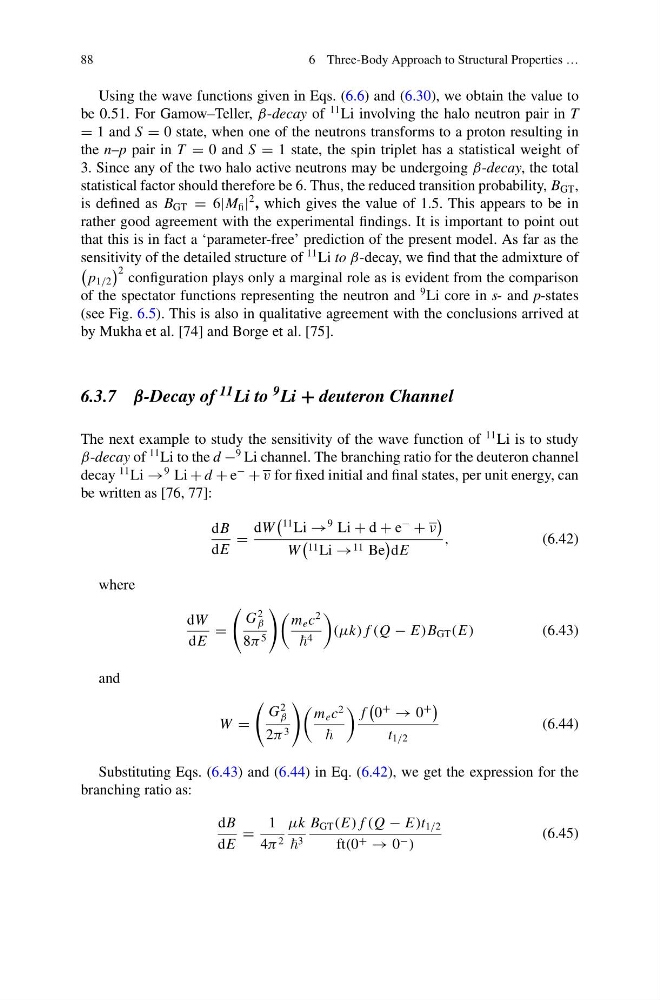
Using the wave functions given in Eqs. (6.6) and (6.30), we obtain the value to
be 0.51. For Gamow–Teller, β-decay of
11 Li involving the halo neutron pair in T
= 1 and S = 0 state, when one of the neutrons transforms to a proton resulting in
the n–p pair in T = 0 and S = 1 state, the spin triplet has a statistical weight of
3. Since any of the two halo active neutrons may be undergoing β-decay, the total
statistical factor should therefore be 6. Thus, the reduced transition probability, B GT ,
is defined as B GT = 6|M fi |
2 , which gives the value of 1.5. This appears to be in
rather good agreement with the experimental findings. It is important to point out
that this is in fact a ‘parameter-free’ prediction of the present model. As far as the
sensitivity of the detailed structure of
11 Li to β-decay, we find that the admixture of
p 1/2
2 configuration plays only a marginal role as is evident from the comparison
of the spectator functions representing the neutron and
9 Li core in s- and p-states
(see Fig. 6.5). This is also in qualitative agreement with the conclusions arrived at
by Mukha et al. [74] and Borge et al. [75].
6.3.7 β-Decay of 11 Li to 9 Li + deuteron Channel
The next example to study the sensitivity of the wave function of
11 Li is to study
β-decay of
11 Li to the d −
9 Li channel. The branching ratio for the deuteron channel
decay
11 Li →
9 Li + d + e
−
+ v for fixed initial and final states, per unit energy, can
be written as [76, 77]:
dB
dE
=
dW
11 Li →
9 Li + d + e
−
+ ν
W
11 Li → 11 Be
dE
,
(6.42)
where
dW
dE
=
G
2
β
8π 5
m e c
2
4
(μk) f (Q − E)B GT (E)
(6.43)
and
W =
G
2
β
2π 3
m e c
2
f
0
+
→ 0
+
t 1/2
(6.44)
Substituting Eqs. (6.43) and (6.44) in Eq. (6.42), we get the expression for the
branching ratio as:
dB
dE
=
1
4π 2
μk
3
B GT (E) f (Q − E)t 1/2
ft(0 + → 0 − )
(6.45)
6 Three-Body Approach to Structural Properties …
Using the wave functions given in Eqs. (6.6) and (6.30), we obtain the value to
be 0.51. For Gamow–Teller, β-decay of
11 Li involving the halo neutron pair in T
= 1 and S = 0 state, when one of the neutrons transforms to a proton resulting in
the n–p pair in T = 0 and S = 1 state, the spin triplet has a statistical weight of
3. Since any of the two halo active neutrons may be undergoing β-decay, the total
statistical factor should therefore be 6. Thus, the reduced transition probability, B GT ,
is defined as B GT = 6|M fi |
2 , which gives the value of 1.5. This appears to be in
rather good agreement with the experimental findings. It is important to point out
that this is in fact a ‘parameter-free’ prediction of the present model. As far as the
sensitivity of the detailed structure of
11 Li to β-decay, we find that the admixture of
p 1/2
2 configuration plays only a marginal role as is evident from the comparison
of the spectator functions representing the neutron and
9 Li core in s- and p-states
(see Fig. 6.5). This is also in qualitative agreement with the conclusions arrived at
by Mukha et al. [74] and Borge et al. [75].
6.3.7 β-Decay of 11 Li to 9 Li + deuteron Channel
The next example to study the sensitivity of the wave function of
11 Li is to study
β-decay of
11 Li to the d −
9 Li channel. The branching ratio for the deuteron channel
decay
11 Li →
9 Li + d + e
−
+ v for fixed initial and final states, per unit energy, can
be written as [76, 77]:
dB
dE
=
dW
11 Li →
9 Li + d + e
−
+ ν
W
11 Li → 11 Be
dE
,
(6.42)
where
dW
dE
=
G
2
β
8π 5
m e c
2
4
(μk) f (Q − E)B GT (E)
(6.43)
and
W =
G
2
β
2π 3
m e c
2
f
0
+
→ 0
+
t 1/2
(6.44)
Substituting Eqs. (6.43) and (6.44) in Eq. (6.42), we get the expression for the
branching ratio as:
dB
dE
=
1
4π 2
μk
3
B GT (E) f (Q − E)t 1/2
ft(0 + → 0 − )
(6.45)