

90
6 Three-Body Approach to Structural Properties …
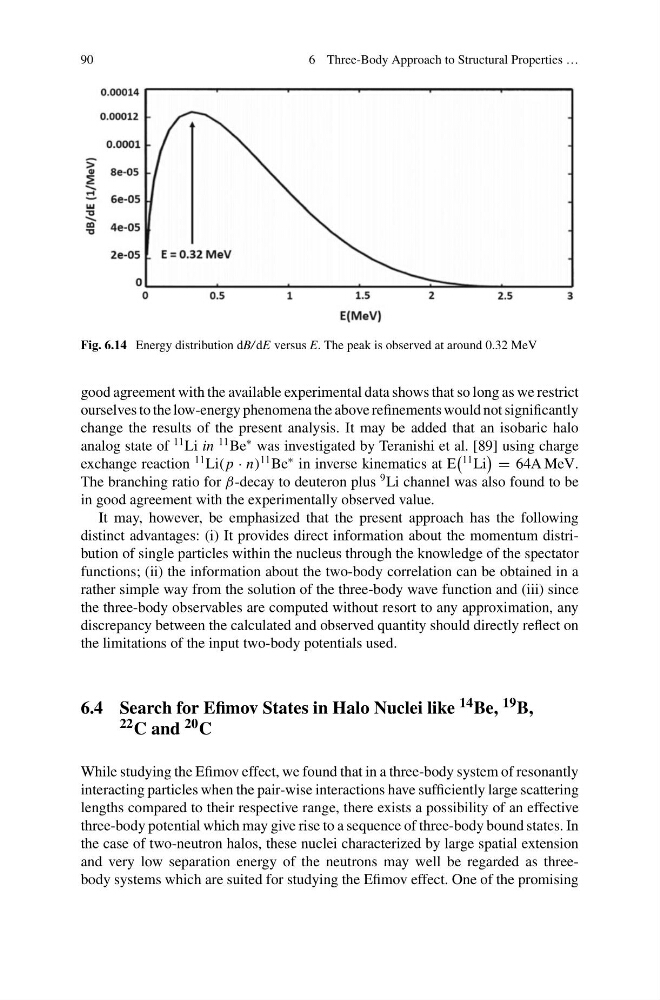
Fig. 6.14 Energy distribution dB/ dE versus E. The peak is observed at around 0.32 MeV
good agreement with the available experimental data shows that so long as we restrict
ourselves to the low-energy phenomena the above refinements would not significantly
change the results of the present analysis. It may be added that an isobaric halo
analog state of
11 Li in
11 Be
∗ was investigated by Teranishi et al. [89] using charge
exchange reaction
11 Li( p · n)
11 Be
∗ in inverse kinematics at E
11 Li
= 64A MeV.
The branching ratio for β-decay to deuteron plus
9 Li channel was also found to be
in good agreement with the experimentally observed value.
It may, however, be emphasized that the present approach has the following
distinct advantages: (i) It provides direct information about the momentum distribution of single particles within the nucleus through the knowledge of the spectator
functions; (ii) the information about the two-body correlation can be obtained in a
rather simple way from the solution of the three-body wave function and (iii) since
the three-body observables are computed without resort to any approximation, any
discrepancy between the calculated and observed quantity should directly reflect on
the limitations of the input two-body potentials used.
6.4 Search for Efimov States in Halo Nuclei like 14 Be, 19 B,
22 C and 20 C
While studying the Efimov effect, we found that in a three-body system of resonantly
interacting particles when the pair-wise interactions have sufficiently large scattering
lengths compared to their respective range, there exists a possibility of an effective
three-body potential which may give rise to a sequence of three-body bound states. In
the case of two-neutron halos, these nuclei characterized by large spatial extension
and very low separation energy of the neutrons may well be regarded as threebody systems which are suited for studying the Efimov effect. One of the promising
6 Three-Body Approach to Structural Properties …
Fig. 6.14 Energy distribution dB/ dE versus E. The peak is observed at around 0.32 MeV
good agreement with the available experimental data shows that so long as we restrict
ourselves to the low-energy phenomena the above refinements would not significantly
change the results of the present analysis. It may be added that an isobaric halo
analog state of
11 Li in
11 Be
∗ was investigated by Teranishi et al. [89] using charge
exchange reaction
11 Li( p · n)
11 Be
∗ in inverse kinematics at E
11 Li
= 64A MeV.
The branching ratio for β-decay to deuteron plus
9 Li channel was also found to be
in good agreement with the experimentally observed value.
It may, however, be emphasized that the present approach has the following
distinct advantages: (i) It provides direct information about the momentum distribution of single particles within the nucleus through the knowledge of the spectator
functions; (ii) the information about the two-body correlation can be obtained in a
rather simple way from the solution of the three-body wave function and (iii) since
the three-body observables are computed without resort to any approximation, any
discrepancy between the calculated and observed quantity should directly reflect on
the limitations of the input two-body potentials used.
6.4 Search for Efimov States in Halo Nuclei like 14 Be, 19 B,
22 C and 20 C
While studying the Efimov effect, we found that in a three-body system of resonantly
interacting particles when the pair-wise interactions have sufficiently large scattering
lengths compared to their respective range, there exists a possibility of an effective
three-body potential which may give rise to a sequence of three-body bound states. In
the case of two-neutron halos, these nuclei characterized by large spatial extension
and very low separation energy of the neutrons may well be regarded as threebody systems which are suited for studying the Efimov effect. One of the promising