

Substituting l n ed E n
M ¼
Ngb
2
exp
gbH
2kT
À exp
ÀgbH
2kT
exp
gbH
2kT
þ exp
ÀgbH
2kT
2
4
3
5
in general given the short distance between the magnetic levels gbH/KT ( 1, thus
exp
ÆgbH
2kT
% 1 Æ
gbH
2kT
M ¼
Ng
2
b
2 H
4kT
since v para ¼ ~
M ~
H
v ¼
Ng
2
b
2
4kT
v ¼
Ng
2
b
2
3kT
SðS þ 1Þ
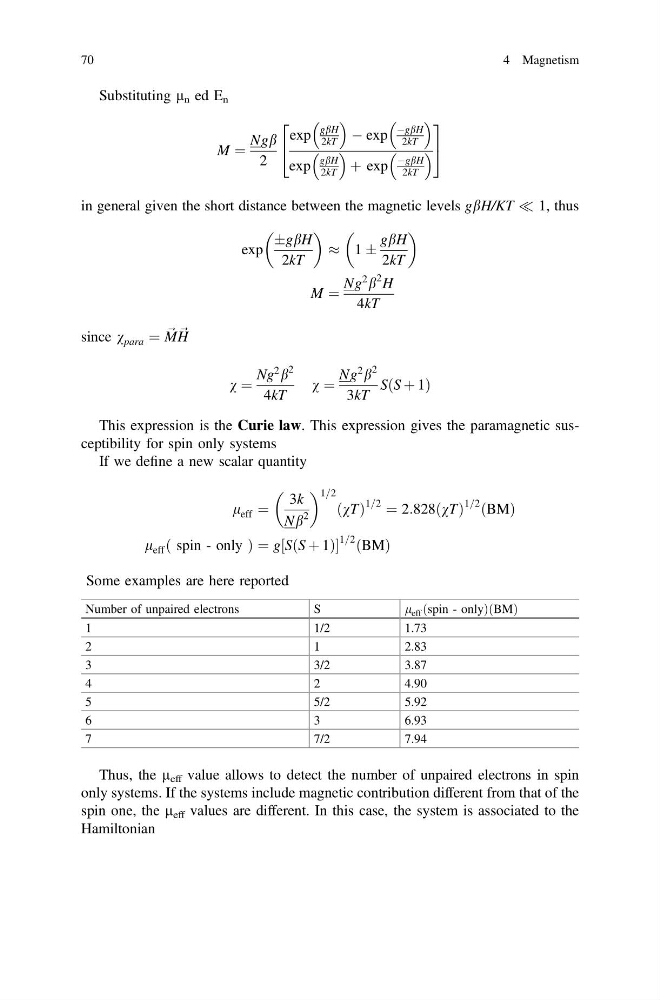
This expression is the Curie law. This expression gives the paramagnetic susceptibility for spin only systems
If we define a new scalar quantity
l eff ¼
3k
Nb
2
1=2
ðvTÞ
1=2 ¼ 2:828ðvTÞ
1=2 ðBMÞ
l eff ð spin - only Þ ¼ g½SðS þ 1Þ
1=2 ðBMÞ
Some examples are here reported
Number of unpaired electrons
S
l eff ðspin - onlyÞðBMÞ
1
1/2
1.73
2
1
2.83
3
3/2
3.87
4
2
4.90
5
5/2
5.92
6
3
6.93
7
7/2
7.94
Thus, the l eff value allows to detect the number of unpaired electrons in spin
only systems. If the systems include magnetic contribution different from that of the
spin one, the l eff values are different. In this case, the system is associated to the
Hamiltonian
70
4 Magnetism
M ¼
Ngb
2
exp
gbH
2kT
À exp
ÀgbH
2kT
exp
gbH
2kT
þ exp
ÀgbH
2kT
2
4
3
5
in general given the short distance between the magnetic levels gbH/KT ( 1, thus
exp
ÆgbH
2kT
% 1 Æ
gbH
2kT
M ¼
Ng
2
b
2 H
4kT
since v para ¼ ~
M ~
H
v ¼
Ng
2
b
2
4kT
v ¼
Ng
2
b
2
3kT
SðS þ 1Þ
This expression is the Curie law. This expression gives the paramagnetic susceptibility for spin only systems
If we define a new scalar quantity
l eff ¼
3k
Nb
2
1=2
ðvTÞ
1=2 ¼ 2:828ðvTÞ
1=2 ðBMÞ
l eff ð spin - only Þ ¼ g½SðS þ 1Þ
1=2 ðBMÞ
Some examples are here reported
Number of unpaired electrons
S
l eff ðspin - onlyÞðBMÞ
1
1/2
1.73
2
1
2.83
3
3/2
3.87
4
2
4.90
5
5/2
5.92
6
3
6.93
7
7/2
7.94
Thus, the l eff value allows to detect the number of unpaired electrons in spin
only systems. If the systems include magnetic contribution different from that of the
spin one, the l eff values are different. In this case, the system is associated to the
Hamiltonian
70
4 Magnetism