

^
H ¼ k ^
L Á ^ S þ b ^
L þ g e ^ S
À
Á Á H
E n ¼ E
ð0Þ
n
kLÁS
þ
HE
ð1Þ
n
firstÀorder Zeeman ðdiagonal termsÞ
þ
H
2 E
ð2Þ
n
sccondÀorder Zeeman ðoffÀdiagonal termsÞ
By replacing in the Curie expression exp(–E n /kT) with
exp
ÀE
ð0Þ
n À HE
ð1Þ
n À H
2 E
ð2Þ
n þ Á Á Á
kT
!
ffi 1 À
HE
ð1Þ
n
kT
!
exp
ÀE
ð0Þ
n
kT
!
l n ¼
À@E n
@H
¼ ÀE
ð1Þ
n À 2HE
ð2Þ
n
M ¼ N
P
n
ÀE
ð1Þ
n À 2HE
ð2Þ
n
1 À
HE
ð1Þ
n
kT
exp
ÀE
ð0Þ
n
kT
P
n
exp
ÀE
ð0Þ
n
kT
1 À
HE
ð1Þ
n
kT
Being M = 0 for H = 0
À
X
n
E
ð1Þ
n exp
ÀE
ð0Þ
n
kT
!
¼ 0
Neglecting the terms higher than E
ð2Þ
n and E
ð2Þ
n  E
ð1Þ
n
v ¼ N
P
n
E
ð1Þ
n
ð Þ
2
kT À 2E
ð2Þ
n
!
exp ÀE
ð0Þ
n
kT
P
n
exp
ÀE
ð0Þ
n
kT
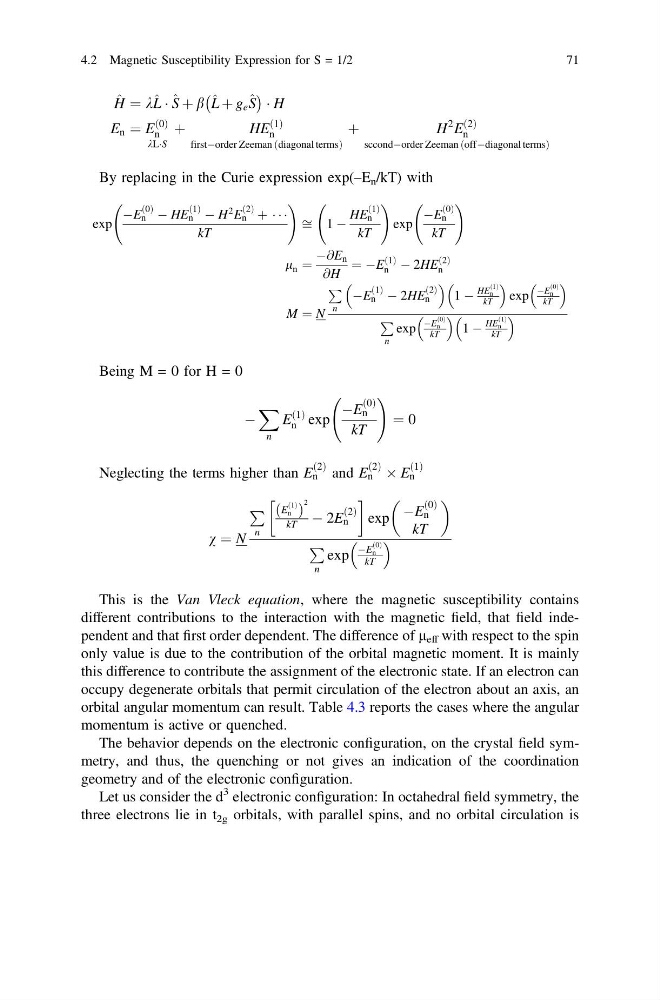
This is the Van Vleck equation, where the magnetic susceptibility contains
different contributions to the interaction with the magnetic field, that field independent and that first order dependent. The difference of l eff with respect to the spin
only value is due to the contribution of the orbital magnetic moment. It is mainly
this difference to contribute the assignment of the electronic state. If an electron can
occupy degenerate orbitals that permit circulation of the electron about an axis, an
orbital angular momentum can result. Table 4.3 reports the cases where the angular
momentum is active or quenched.
The behavior depends on the electronic configuration, on the crystal field symmetry, and thus, the quenching or not gives an indication of the coordination
geometry and of the electronic configuration.
Let us consider the d
3 electronic configuration: In octahedral field symmetry, the
three electrons lie in t 2g orbitals, with parallel spins, and no orbital circulation is
4.2 Magnetic Susceptibility Expression for S = 1/2
71
H ¼ k ^
L Á ^ S þ b ^
L þ g e ^ S
À
Á Á H
E n ¼ E
ð0Þ
n
kLÁS
þ
HE
ð1Þ
n
firstÀorder Zeeman ðdiagonal termsÞ
þ
H
2 E
ð2Þ
n
sccondÀorder Zeeman ðoffÀdiagonal termsÞ
By replacing in the Curie expression exp(–E n /kT) with
exp
ÀE
ð0Þ
n À HE
ð1Þ
n À H
2 E
ð2Þ
n þ Á Á Á
kT
!
ffi 1 À
HE
ð1Þ
n
kT
!
exp
ÀE
ð0Þ
n
kT
!
l n ¼
À@E n
@H
¼ ÀE
ð1Þ
n À 2HE
ð2Þ
n
M ¼ N
P
n
ÀE
ð1Þ
n À 2HE
ð2Þ
n
1 À
HE
ð1Þ
n
kT
exp
ÀE
ð0Þ
n
kT
P
n
exp
ÀE
ð0Þ
n
kT
1 À
HE
ð1Þ
n
kT
Being M = 0 for H = 0
À
X
n
E
ð1Þ
n exp
ÀE
ð0Þ
n
kT
!
¼ 0
Neglecting the terms higher than E
ð2Þ
n and E
ð2Þ
n  E
ð1Þ
n
v ¼ N
P
n
E
ð1Þ
n
ð Þ
2
kT À 2E
ð2Þ
n
!
exp ÀE
ð0Þ
n
kT
P
n
exp
ÀE
ð0Þ
n
kT
This is the Van Vleck equation, where the magnetic susceptibility contains
different contributions to the interaction with the magnetic field, that field independent and that first order dependent. The difference of l eff with respect to the spin
only value is due to the contribution of the orbital magnetic moment. It is mainly
this difference to contribute the assignment of the electronic state. If an electron can
occupy degenerate orbitals that permit circulation of the electron about an axis, an
orbital angular momentum can result. Table 4.3 reports the cases where the angular
momentum is active or quenched.
The behavior depends on the electronic configuration, on the crystal field symmetry, and thus, the quenching or not gives an indication of the coordination
geometry and of the electronic configuration.
Let us consider the d
3 electronic configuration: In octahedral field symmetry, the
three electrons lie in t 2g orbitals, with parallel spins, and no orbital circulation is
4.2 Magnetic Susceptibility Expression for S = 1/2
71