

4.2 Magnetic Susceptibility Expression for S = 1/2
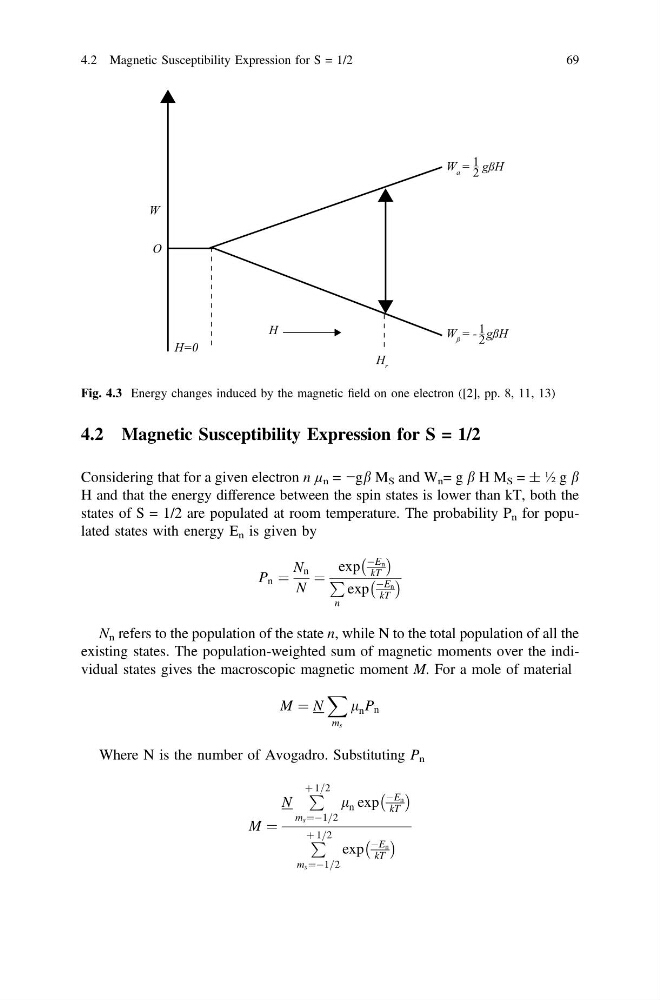
Considering that for a given electron n µ n = −gb M S and W n = g b H M S = ± ½ g b
H and that the energy difference between the spin states is lower than kT, both the
states of S = 1/2 are populated at room temperature. The probability P n for populated states with energy E n is given by
P n ¼
N n
N
¼
exp
ÀE n
kT
À Á
P
n
exp
ÀE n
kT
À Á
N n refers to the population of the state n, while N to the total population of all the
existing states. The population-weighted sum of magnetic moments over the individual states gives the macroscopic magnetic moment M. For a mole of material
M ¼ N
X
m s
l n P n
Where N is the number of Avogadro. Substituting P n
M ¼
N
P
þ 1=2
m s ¼À1=2
l n exp
ÀE n
kT
À Á
P
þ 1=2
m s ¼À1=2
exp
ÀE n
kT
À Á
W a = gßH
1
2
W ß = - gßH
1
2
H r
H
W
O
H=0
Fig. 4.3 Energy changes induced by the magnetic field on one electron ([2], pp. 8, 11, 13)
4.2 Magnetic Susceptibility Expression for S = 1/2
69
Considering that for a given electron n µ n = −gb M S and W n = g b H M S = ± ½ g b
H and that the energy difference between the spin states is lower than kT, both the
states of S = 1/2 are populated at room temperature. The probability P n for populated states with energy E n is given by
P n ¼
N n
N
¼
exp
ÀE n
kT
À Á
P
n
exp
ÀE n
kT
À Á
N n refers to the population of the state n, while N to the total population of all the
existing states. The population-weighted sum of magnetic moments over the individual states gives the macroscopic magnetic moment M. For a mole of material
M ¼ N
X
m s
l n P n
Where N is the number of Avogadro. Substituting P n
M ¼
N
P
þ 1=2
m s ¼À1=2
l n exp
ÀE n
kT
À Á
P
þ 1=2
m s ¼À1=2
exp
ÀE n
kT
À Á
W a = gßH
1
2
W ß = - gßH
1
2
H r
H
W
O
H=0
Fig. 4.3 Energy changes induced by the magnetic field on one electron ([2], pp. 8, 11, 13)
4.2 Magnetic Susceptibility Expression for S = 1/2
69