

As S z is commutative with the Hamiltonian operator H, Hw i M s Æ 1=2
ð
Þ¼
W Æ1=2 w i M s Æ 1=2
ð
Þ
By associating to the magnetic moment µ z , the corresponding operator
l z ¼ ÀgbM s
l z ¼ ÀgbS z
and to the energy W ¼ Àl z H
The corresponding Hamiltonian is H ¼ gbHS z
W 1=2 ¼ 1=2gbH
W À1=2 ¼ À1=2gbH
DW ¼ gbH
See Fig. 4.3.
The energy transition is DW and is tuned by H, provided DM s = ± 1 as selection
rule g is a value peculiar of the electron behavior.
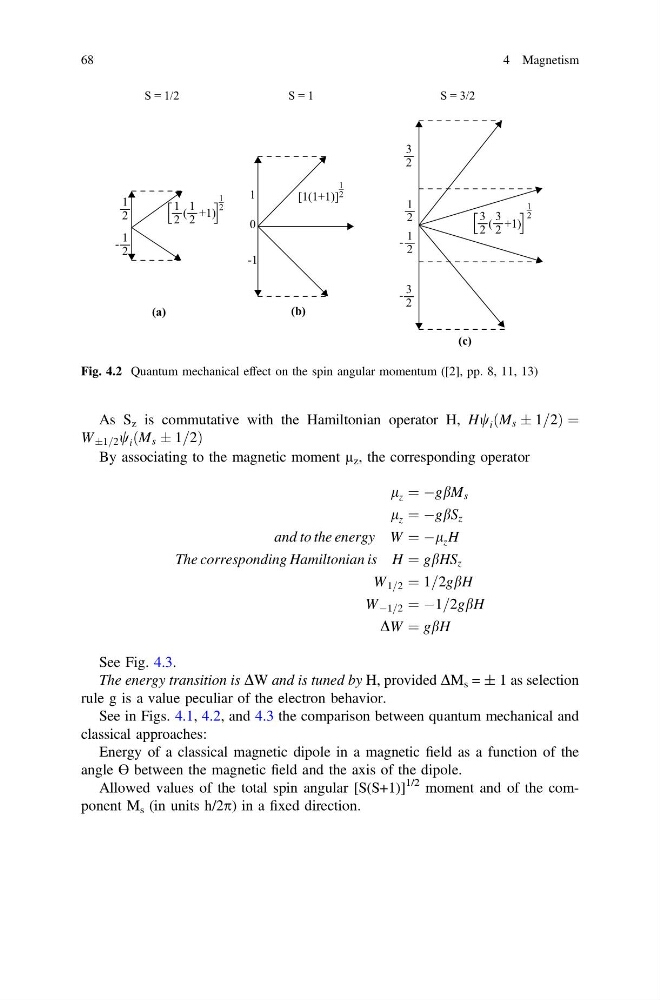
See in Figs. 4.1, 4.2, and 4.3 the comparison between quantum mechanical and
classical approaches:
Energy of a classical magnetic dipole in a magnetic field as a function of the
angle Ɵ between the magnetic field and the axis of the dipole.
Allowed values of the total spin angular [S(S+1)]
1/2 moment and of the component M s (in units h/2p) in a fixed direction.
S = 1/2
(a)
(b)
(c)
S = 3/2
S = 1
1
0
-1
-
1
2
3
2
1
2
1
2
3
2
1
2
1
2
1
2
1
2
1
2
1
2
( +1)
3
2
3
2
( +1)
[1(1+1)]
-
-
Fig. 4.2 Quantum mechanical effect on the spin angular momentum ([2], pp. 8, 11, 13)
68
4 Magnetism
ð
Þ¼
W Æ1=2 w i M s Æ 1=2
ð
Þ
By associating to the magnetic moment µ z , the corresponding operator
l z ¼ ÀgbM s
l z ¼ ÀgbS z
and to the energy W ¼ Àl z H
The corresponding Hamiltonian is H ¼ gbHS z
W 1=2 ¼ 1=2gbH
W À1=2 ¼ À1=2gbH
DW ¼ gbH
See Fig. 4.3.
The energy transition is DW and is tuned by H, provided DM s = ± 1 as selection
rule g is a value peculiar of the electron behavior.
See in Figs. 4.1, 4.2, and 4.3 the comparison between quantum mechanical and
classical approaches:
Energy of a classical magnetic dipole in a magnetic field as a function of the
angle Ɵ between the magnetic field and the axis of the dipole.
Allowed values of the total spin angular [S(S+1)]
1/2 moment and of the component M s (in units h/2p) in a fixed direction.
S = 1/2
(a)
(b)
(c)
S = 3/2
S = 1
1
0
-1
-
1
2
3
2
1
2
1
2
3
2
1
2
1
2
1
2
1
2
1
2
1
2
( +1)
3
2
3
2
( +1)
[1(1+1)]
-
-
Fig. 4.2 Quantum mechanical effect on the spin angular momentum ([2], pp. 8, 11, 13)
68
4 Magnetism