

v v is the magnetic susceptibility for unit of volume, dimensionless
v v /d = v g gram susceptibility (cm
3 /gr) v g ⋅ MW (cm
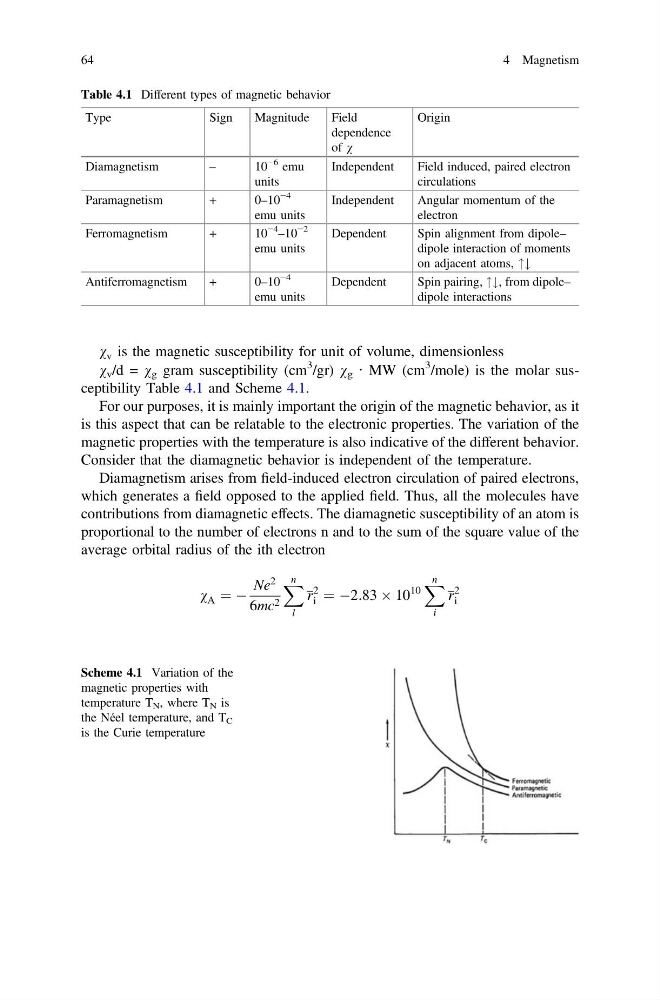
3 /mole) is the molar susceptibility Table 4.1 and Scheme 4.1.
For our purposes, it is mainly important the origin of the magnetic behavior, as it
is this aspect that can be relatable to the electronic properties. The variation of the
magnetic properties with the temperature is also indicative of the different behavior.
Consider that the diamagnetic behavior is independent of the temperature.
Diamagnetism arises from field-induced electron circulation of paired electrons,
which generates a field opposed to the applied field. Thus, all the molecules have
contributions from diamagnetic effects. The diamagnetic susceptibility of an atom is
proportional to the number of electrons n and to the sum of the square value of the
average orbital radius of the ith electron
v A ¼ À
Ne
2
6mc 2
X n
l
r
2
i ¼ À2:83 Â 10
10
X n
i
r
2
i
Table 4.1 Different types of magnetic behavior
Type
Sign
Magnitude
Field
dependence
of v
Origin
Diamagnetism
–
10
−6 emu
units
Independent
Field induced, paired electron
circulations
Paramagnetism
+
0–10
−4
emu units
Independent
Angular momentum of the
electron
Ferromagnetism
+
10
−4
–10
−2
emu units
Dependent
Spin alignment from dipole–
dipole interaction of moments
on adjacent atoms, "#
Antiferromagnetism
+
0–10
−4
emu units
Dependent
Spin pairing, "#, from dipole–
dipole interactions
Scheme 4.1 Variation of the
magnetic properties with
temperature T N , where T N is
the Néel temperature, and T C
is the Curie temperature
64
4 Magnetism
v v /d = v g gram susceptibility (cm
3 /gr) v g ⋅ MW (cm
3 /mole) is the molar susceptibility Table 4.1 and Scheme 4.1.
For our purposes, it is mainly important the origin of the magnetic behavior, as it
is this aspect that can be relatable to the electronic properties. The variation of the
magnetic properties with the temperature is also indicative of the different behavior.
Consider that the diamagnetic behavior is independent of the temperature.
Diamagnetism arises from field-induced electron circulation of paired electrons,
which generates a field opposed to the applied field. Thus, all the molecules have
contributions from diamagnetic effects. The diamagnetic susceptibility of an atom is
proportional to the number of electrons n and to the sum of the square value of the
average orbital radius of the ith electron
v A ¼ À
Ne
2
6mc 2
X n
l
r
2
i ¼ À2:83 Â 10
10
X n
i
r
2
i
Table 4.1 Different types of magnetic behavior
Type
Sign
Magnitude
Field
dependence
of v
Origin
Diamagnetism
–
10
−6 emu
units
Independent
Field induced, paired electron
circulations
Paramagnetism
+
0–10
−4
emu units
Independent
Angular momentum of the
electron
Ferromagnetism
+
10
−4
–10
−2
emu units
Dependent
Spin alignment from dipole–
dipole interaction of moments
on adjacent atoms, "#
Antiferromagnetism
+
0–10
−4
emu units
Dependent
Spin pairing, "#, from dipole–
dipole interactions
Scheme 4.1 Variation of the
magnetic properties with
temperature T N , where T N is
the Néel temperature, and T C
is the Curie temperature
64
4 Magnetism